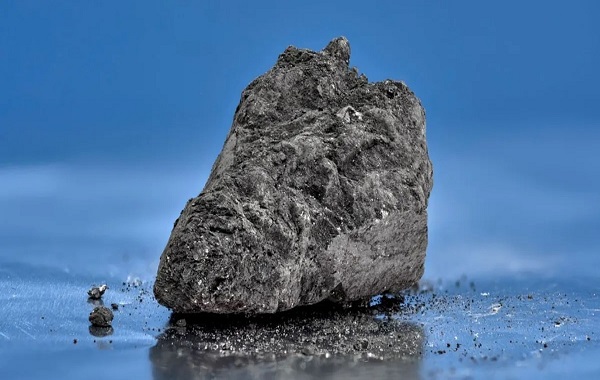
4.6 billion-year-old Winchcombe meteorite contains the building blocks of life
New research on the meteorite that crashed onto a driveway in Winchcombe, Gloucestershire in February 2021, reveals the presence of organic compounds that hold the secrets to the origin of life.
The latest analysis shows a range of organic matter, as per a press statement. It reveals that the asteroid was once part of a larger space rock where liquid water was once present.
The first meteorite discovered with extra-terrestrial water
The new research, led by Dr. Queenie Chan, from the Department of Earth Sciences at Royal Holloway, University of London, shows how the Winchcombe meteorite may have once had access to all the materials required for the building blocks of life. The organic matter it holds only requires water for a chemical reaction to occur that would convert molecules into amino acids and proteins.
The Winchcombe meteorite is a rare carbon-rich chondritic meteorite, meaning it is made up of up to 3.5 weight percent of carbon — only 4 percent of all recovered meteorites are this type.
There are reportedly more than 1,000 eyewitness accounts of it falling to Earth, and footage of the fireball is widely circulated online. Thankfully for the scientists who were tasked with analyzing the roughly 1lb (0.5kg) space rock, it was retrieved within 12 hours, meaning it was largely untainted by Earthly minerals and waters.
An initial analysis of the meteorite fragment last September revealed that it contained the first-ever extra-terrestrial water detected in a meteorite that had fallen to Earth.
Now, the new analysis suggests the Winchcombe meteorite may be a new class of weak meteorite that has never been studied before. According to Dr. Chan, “meteorite fall happens all year round, however, what makes this meteorite fall so unique is that this is the first meteorite to have been observed by numerous eyewitnesses, recorded, and recovered in the U.K. in the last 30 years.”
“Winchcombe belongs to a rare type of carbonaceous meteorite which typically contains a rich inventory of organic compounds and water,” Chan continued. “The first Winchcombe meteorite stone was recovered within 12 hours of the fireball observation event and properly curated to restrict any terrestrial contamination. This allowed us to study the organic signature truly essential to the meteorite itself.”
Source: Interesting Engineering
Russia to launch mission to rescue stranded ISS crew after meteoroid strike
Russia to launch mission to rescue stranded ISS crew after meteoroid strike
4.6 billion-year-old Winchcombe meteorite contains the building blocks of life