3300-year-old monument in Paris holds secret inscriptions from Egyptian ruler
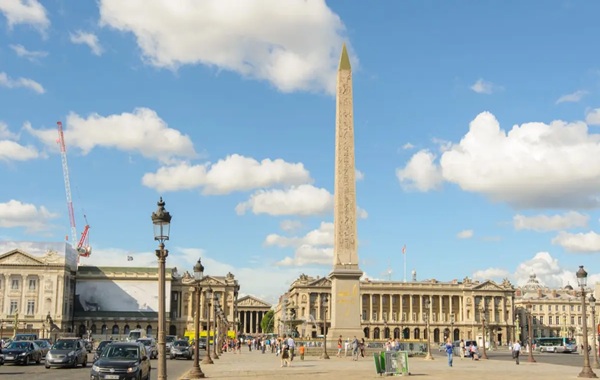
Nearly 200 years ago, a 3,300-year-old obelisk from Egypt was gifted to France. It now stands in the heart of Paris at Place de la Concorde. Erected there in 1836, the monument, originally from Luxor, is one of the oldest objects in the city.
Many believed that scholars had already uncovered everything there was to know about the ancient monument. But that assumption has just been turned on its head.
Jean-Guillaume Olette-Pelletier, an expert in both Egyptology and cryptology at the Catholic University of Paris, has found seven hidden messages carved into the obelisk. The messages date back to the reign of Pharaoh Ramses II.
These messages had gone unnoticed until the Egyptologist observed them during renovation work in 2021. He made the discovery while the obelisk was covered in scaffolding, which allowed him to get a closer look at its highest and least accessible sections, particularly near the golden pyramid-like tip.
According to French media reports, Olette-Pelletier first spotted the inscriptions when he decided to read the hieroglyphs horizontally rather than vertically. This unusual reading direction helped him notice signs that had previously escaped attention.
Cryptic inscriptions meant only for the elite
Some of the messages are not immediately visible, even when looking directly at the hieroglyphs. These are known as “crypto-hieroglyphs,” a form of writing used by Egypt’s elite that hides additional meanings within standard symbols.
According to La Brújula Verde, only six people in the world today are qualified to read these secret inscriptions.
One message was discovered beneath a drawing of the god Amun. “People had not noticed that under [one of the drawings] of the god Amun, there is an offering table. This allows us to discover a sentence where no element is missing: an offering that the king gives to the god Amun,” Olette-Pelletier told BFMTV.
The way these inscriptions are arranged on the obelisk creates what the researcher calls “three-dimensional cryptography.” To understand the hidden messages, a person must walk around the obelisk. Each side offers part of a bigger message, revealing more meanings when combined and viewed from different angles.
Another fascinating detail: one of the encrypted phrases would have been visible only to people arriving by boat. This line faces the direction from which elite travelers would have approached the Luxor Temple via the Nile River. According to EuroWeekly, this suggests the messages were carefully designed for a very specific and powerful audience.
One inscription praises Pharaoh Ramses II as a divine figure. Another tells viewers to make offerings to calm the gods’ anger. Each one highlights key ideas central to Ramses II’s reign—his power, military victories, long rule, and connection to the divine.
“These messages are a form of propaganda in favor of the builder of the site: Pharaoh Ramses II,” Olette-Pelletier told Le Point. He believes Ramses was trying to prove his divine status not to the public, but to other nobles who had the education to understand such advanced wordplay.
A monument still full of surprises
The Luxor Obelisk is more than a decorative piece of ancient history. It’s a carefully crafted political tool from one of Egypt’s most powerful rulers. Ramses II reigned from 1279 to 1213 BCE and is widely recognized as one of Egypt’s greatest pharaohs. The obelisk in Paris is one of a pair he built to stand at the entrance of the Luxor Temple. Its twin still remains in Egypt.
While thousands of tourists pass by the obelisk in Place de la Concorde every day, most are unaware of the ancient intelligence hidden in plain sight. Olette-Pelletier’s discovery proves that even the most studied historical artifacts can still hold secrets.
The full research will be published in an upcoming edition of ENiM (Egypt of the Nile and Mediterranean), a journal dedicated to ancient Egyptian studies.
Source: Interesting Engineering
Scientists Discover First Probable Evidence of a Roman Fighter Mauled by a Lion
3300-year-old monument in Paris holds secret inscriptions from Egyptian ruler/3300-year-old monument in Paris holds secret inscriptions from Egyptian ruler