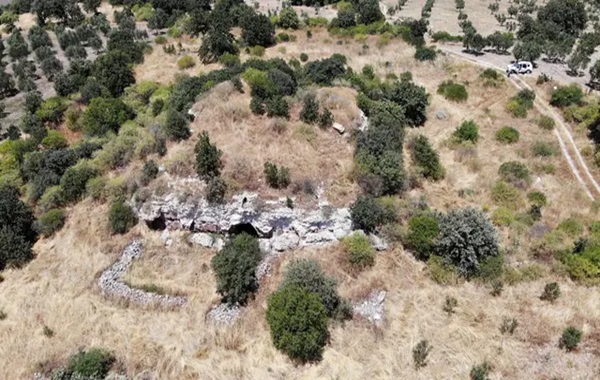
2400-year-old theatre with 12000-spectator capacity discovered in Turkey
In a groundbreaking discovery, Turkish scientists have discovered the ruins of a theatre in city of Alexandria Troas, in Canakkale. It’s a seaport city located on the southern shore of the Dardanelles along the Aegean Sea in northwestern Turkey.
The archaeologists believe the theatre could be around 2400 years old.
A major portion of it is still left to be excavated, but its unique features have startled them already
The theatre can accommodate between 10000 and 12000 spectators, according to archaeologists.
A historic crossroads of civilizations revealed
The site where the theatre was discovered was initially called Sigeia, as per the Greek City Times. It was around 306 BC that Antigonus refounded the city when he expanded it and renamed it as Antigonia Troas, after settling people from five other towns in Sigeia. Later in 301 BC, Lysimachus renamed it to Alexandria Troas. Currently, only a few structures or parts of structures are remaining at the 900-acre site.
Experts note that this is perhaps one of the reasons why the discovery of the theatre has caused furore among the community.
Furthermore, archaeologists believe that this region is unique owing to its location. They believe this location has been a crossroad for many civilizations for centuries and influenced the culture.
One of these included the Greeks, who had a significant impact on the history of the region since they had established settlements.
Excavations at Alexandria Troas
The excavations at Alexandria Troas began this year in July and are expected to continue till the end of the year. As per Ancient Origins, archaeologist Erhan Oztepe from Ankara University is leading the 40-member excavation team. Turkey’s Ministry of Culture and Tourism is sponsoring the project.
Initially, the team was mainly focused on excavating the ancient city center and its forum. However, the discovery of the Greek theatre drew their attention.
According to Professor Oztepe, the theatre was located quite strategically in order to gain an advantage of the slope of the hillside. Owing to this placement, rows of seats could be installed one above the other. He added that based on the wall techniques and other clues, modifications were made during the Roman period, particularly under Hadrian’s rule.
Experts highlighted another significant structure uncovered during the excavation—the Odeon, a venue historically used for concerts and other musical events. Professor Oztepe noted that similar theatres were commonly built by the Greeks in cities like Troy and Parion.
Troy, one of the world’s most renowned archaeological sites, is believed to be the legendary battleground of the Trojan War, where Greeks and Trojans famously clashed. Troy also earned repute owing to its association with Homer’s epic poems, the Iliad and the Odyssey.
Source: Interesting Engineering
Experts studying ‘alien mummies’ from Peru make startling find while dissecting their bodies
2400-year-old theatre with 12000-spectator capacity discovered in Turkey