230 Million-Year-Old Fossils Reveal How Ancient Amphibians Defied Nature’s Extremes—Could We Learn Their Secrets?
Newly discovered amphibian fossils from Wyoming offer profound insights into ancient survival strategies. These findings not only highlight the evolutionary adaptability of prehistoric creatures but also provide valuable lessons for modern amphibians facing the challenges of climate change.
Extreme Weather in Ancient Wyoming: How Amphibians Survived
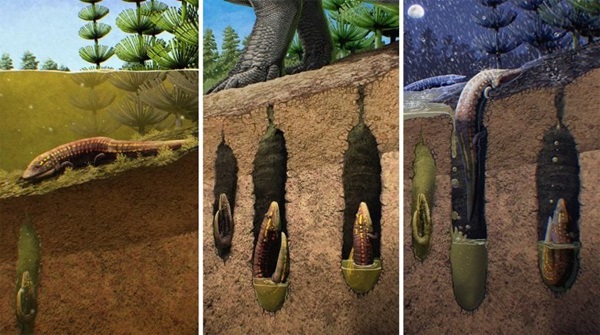
Over 230 million years ago, ancient Wyoming was subjected to extreme weather patterns, including torrential rains followed by prolonged dry spells. These shifts posed a significant threat to amphibians, which rely on moisture to sustain their delicate skin. However, a group of salamander-like creatures demonstrated remarkable resilience to such conditions, adapting by burrowing underground during dry periods. This adaptation enabled them to survive until the next monsoon, offering modern researchers critical lessons on how animals might cope with today’s shifting climate patterns.
The Discovery of Ancient Burrows: Fossils Inside Torpedo-Shaped Structures
In a groundbreaking study published in Proceedings of the Royal Society B, researchers unveiled a new species of fossil amphibians preserved inside cylindrical, torpedo-shaped burrows. These burrows, up to 12 inches long, indicate that the amphibians likely waited out the harsh dry season by burrowing deep into the earth, where they remained in a dormant-like state until moisture returned.
Dr. Cal So, the study’s lead author, explains, “The rocks in the area suggest that Wyoming experienced drastic seasonal effects, similar to the mega-monsoons that affected the entire supercontinent of Pangea. The fossils we found inside these burrows provide a window into how these creatures adapted to survive in such an extreme environment.”
Early Discoveries and the Fascinating Fossil Burrows
The journey to understanding these ancient fossils began in 2014 when David Lovelace, a researcher from the University of Wisconsin, stumbled upon small cylindrical rock structures while conducting fieldwork in Wyoming’s Serendipity Beds. Lovelace, an expert in ichnology (the study of trace fossils like footprints and burrows), immediately recognized the formations as burrows once created by ancient creatures. Upon closer inspection, he found a remarkably tiny skull embedded inside one of the burrows, initially mistaking it for a baby crocodile. However, after further analysis, it became clear that the skull belonged to an ancient amphibian, a species never before identified.
High-Resolution Imaging Reveals the Fossils’ Hidden Secrets
Upon returning to the lab, Lovelace and his colleagues used advanced imaging technology, including high-resolution CT scans, to reveal the secrets of the fossils. “When we saw the tiny skeleton inside the burrow, we knew we had uncovered something extraordinary,” says Lovelace. The team eventually unearthed around 80 fossilized burrows, many containing skulls and bones from these ancient amphibians. These bones provided further insight into the creature’s physical traits, such as its small, underdeveloped limbs. Researchers hypothesized that the amphibians likely used their specialized, scoop-shaped skulls to burrow through soft riverbeds, enabling them to retreat underground during the dry season.
How Ancient Amphibians Adapted: Insights into Modern Survival Strategies
The fossil evidence suggests that these prehistoric amphibians employed a strategy not unlike the hibernation tactics of some modern salamanders and fish. During the rainy season, the amphibians thrived in the rivers, but once these waterways dried up, they dug head-first into the moist mud, where they likely entered a state of metabolic slowdown. This behavior allowed them to endure the dry season without dehydrating. Unfortunately, the fossilized animals’ final fate was linked to the shifting riverbeds, which left them stranded in dried-out burrows, unable to emerge.
Collaborative Research with Eastern Shoshone Community
The area where these fossils were found is located on the ancestral lands of the Eastern Shoshone people. In recognition of this, the research team formed a meaningful collaboration with the Shoshone community. They invited local students, teachers, and elders to join them in the field, where they discovered additional burrows and learned about the significance of the land from the Shoshone perspective.
The Shoshone language and culture played an integral part in the discovery process. Working with the elders, the team named the newly identified fossil amphibian Ninumbeehan dookoodukah in Shoshone, meaning “Little People’s flesh eater.” This name honors the culture of the Eastern Shoshone and pays tribute to the sharp teeth of the fossilized creature.
Implications for Modern Amphibians: Climate Change and Survival
The study of Ninumbeehan dookoodukah offers hope for modern amphibians, many of which are facing serious threats due to climate change. Pardo, a postdoctoral researcher at the Field Museum, explains, “The ability of Ninumbeehan to lower its metabolic rate to survive dry spells provides a glimmer of hope for some modern amphibian species that share similar seasonal behaviors.” While climate change continues to threaten biodiversity, understanding the adaptive strategies of ancient creatures like Ninumbeehan could inform efforts to protect vulnerable amphibian species today.
In conclusion, these ancient fossils offer more than just a snapshot of life millions of years ago; they provide critical insights into survival strategies that might help today’s species adapt to the challenges posed by a rapidly changing climate. By studying the way ancient amphibians weathered extreme conditions, scientists are uncovering the potential for resilience in the face of modern environmental shifts.
Source: 230 Million-Year-Old Fossils Reveal How Ancient Amphibians Defied Nature’s Extremes—Could We Learn Their Secrets?
“Alien Invasion or Invitation? A Daily Breakdown of Humanity’s Reaction”
“Alien Invasion or Invitation? A Daily Breakdown of Humanity’s Reaction”
230 Million-Year-Old Fossils Reveal How Ancient Amphibians Defied Nature’s Extremes—Could We Learn Their Secrets?