2000-year-old Roman ‘Bigfoot’ mystery: 5,000 giant shoes unearthed in Britain
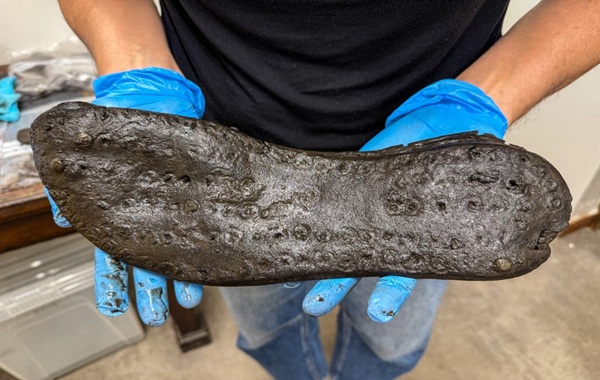
Archaeologists at Magna Fort in England have unearthed a staggering 5,000 Ancient Roman shoes, with some so extraordinarily large they’ve sparked a playful comparison to Bigfoot. The remarkable discovery has experts questioning why Roman Britons at this particular site were seemingly so well-endowed in the foot department.
The Vindolanda Charitable Trust’s archaeologists, consistently making finds near Hadrian’s Wall, recently reported on eight truly gigantic shoes. The biggest among them measures nearly 12 inches long—that’s a US size 14 or a European 48.
Dr. Elizabeth Greene, an Associate Professor at the University of Western Ontario and Vindolanda’s resident shoe specialist, believes these oversized shoes indicate “something very different” was “going on here at Magna.”
She noted that it’s “clear that these shoes are much larger on average than most of the Vindolanda collection.”
A press release from the Trust highlighted the unique nature of each shoe, fostering “an immediate connection with the person who wore it.”
While the exact wearers remain unknown, the sheer number and size of these shoes suggest a significant population of large-footed Romans once resided here.
The Roman Brits had extraordinarily large feet
Five years ago, the Vindolanda Charitable Trust embarked on a major excavation at Magna, a former Roman fort established around 80 AD, predating Hadrian’s Wall. This strategic site once guarded a Roman road junction and is now known as Carvoran Roman Fort.
The initial breakthrough came when archaeologists reached semi-anaerobic, low-oxygen deposits within the fort’s northern ditches, unearthing the first of 32 shoes. Since then, the site has yielded a remarkable treasure trove: from tiny baby booties and elaborate summer sandals to robust marching boots. These artifacts continue to “captivate the imagination” of both archaeologists and visitors, allowing them to literally “put themselves in the shoes” of ancient Romans from two millennia ago.
Thousands of pairs have been found, but it’s the incredibly impressive sizes that have truly astonished researchers. News of their existence spread rapidly as more oversized footwear continued to emerge. With a quarter of all shoes discovered at Magna categorized as extra-large, the question remains: why so many, and why so big?
Archaeologists are still searching for definitive answers, though the fort’s location on a major road might hold a clue to this unique concentration of footwear.
Climate change is putting the shoes at risk
“Organic finds like this are some of the most precious to come from our sites, which capture the imagination of visitors and volunteers alike, but they are also the most at risk from our changing climate,” Rachel Frame, Senior Archaeologist at the Magna Project, commented in a press release.
“We are grateful to have the support from The National Lottery Heritage Fund, made possible by National Lottery players, who have enabled the Magna project to be realised – there is much more to discover about the people who lived at Magna and to understand about the impact climate change is having on this hugely important historical resource.”
The Trust’s CEO and Director of Excavations, Dr Andrew Birley, concluded that “this really shows us what is at risk if climate change continues to rob us of such vital information. It reminds us that not every population was the same, that wide variations between the regiments and people who served along Hadrian’s Wall, could be cultural and physical.”
“Without artifacts like these wonderful shoes from Magna and Vindolanda, it would be almost impossible to know information like this. We can only celebrate and marvel at the diversity and differences of these people if we can still see them in the archaeological data we gather today”.
Source: Interesting Engineering
361000-year-old discovery in China: Oldest wooden tools shake up archaeology
2000-year-old Roman ‘Bigfoot’ mystery: 5,000 giant shoes unearthed in Britain