1700-Year-Old Mayan Relic Uncovers Clues of Political Intrigue and Conquest
A buried altar recently discovered just outside the heart of the ancient Maya city of Tikal may shed new light on a pivotal chapter in Mesoamerican history. The altar, found by an international team of archaeologists, including researchers from Brown University, is believed to date back to the late 4th century A.D.—a period marked by political turmoil and cultural collision.
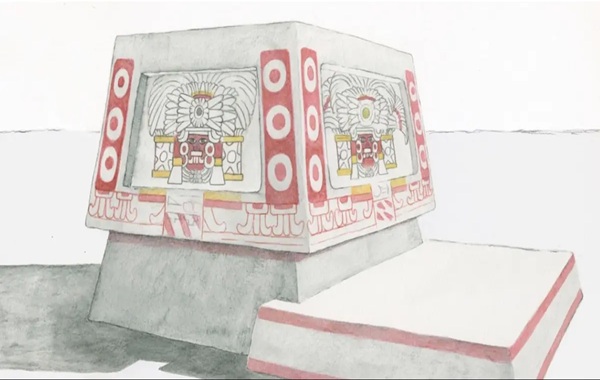
The artistic style used for the altar captures the figure and face of a man clad in a feathered headdress, surrounded by rich symbolic ornaments. It illustrates the ‘Storm God’ in a manner resembling Teotihuacan stylistic iconography.
Scholars suggest it was an artisan from the far-off Teotihuacan City, over 600 miles away, who crafted this altar, as its design does not reflect the artistry of the Maya civilization.
“It’s increasingly clear that this was an extraordinary period of turbulence at Tikal,” said Stephen Houston, who co-authored the paper.
“What the altar confirms is that wealthy leaders from Teotihuacan came to Tikal and created replicas of ritual facilities that would have existed in their home city. It shows Teotihuacan left a heavy imprint there.”
A coup hidden in stone and soil
Previously, the relationship between Teotihuacan and Tikal was thought to be mainly commercial. By the late 300s AD, the signs of a radical change started to appear. Inscriptions discovered many years ago narrate the story of Tikal’s king being overthrown in 378 A.D.
“It’s almost as if Tikal poked the beast and got too much attention from Teotihuacan,” Houston said. “That’s when foreigners started moving into the area.”
LiDAR scans add supporting evidence that what was previously thought to be natural land was, in fact, a buried version of the iconic citadel that Teotihuacan is famous for.
This alter was most likely built up in the period after this turmoil. Archaeologists discovered the remains of a child who was buried alive sitting. Although this isn’t common among Maya traditions, it is a practice that stems from Teotihuacan. An adult buried nearby was discovered with a green obsidian dart, clearly a trademark of Teotihuacan’s skillful craftsmanship.
“The Maya regularly buried buildings and rebuilt on top of them,” said co-author Andrew Scherer. “But here, they buried the altar and surrounding buildings and just left them, even though this would have been prime real estate centuries later. They treated it almost like a memorial or a radioactive zone. It probably speaks to the complicated feelings they had about Teotihuacan.”
Legacy of a Maya’s imperial encounter
Despite the apparent violence and cultural imposition, Tikal’s fortunes ultimately surged in the centuries following Teotihuacan’s intervention. The city grew into a dominant force in the Maya world, even as it grappled with the memory of foreign control.
For Houston and his colleague Andrew Scherer, the entire episode echoes familiar patterns in world history: powerful empires extending their reach into prosperous lands to exploit their riches.
“Everyone knows what happened to the Aztec civilization after the Spanish arrived,” Houston said. “Our findings show evidence that that’s a tale as old as time. These powers of central Mexico reached into the Maya world because they saw it as a place of extraordinary wealth, of special feathers from tropical birds, jade and chocolate. As far as Teotihuacan was concerned, it was the land of milk and honey.”
Source: Interesting Engineering
1700-Year-Old Mayan Relic Uncovers Clues of Political Intrigue and Conquest