
10 billion light-years away, a galaxy cluster glows with ancient radio energy
In a remote corner of the cosmos, researchers have discovered a giant cloud of high-energy particles, a mini-halo, surrounding a young galaxy cluster that formed just four billion years after the Big Bang.
It’s the most distant structure of its kind ever observed, and it’s rewriting our understanding of how galaxy clusters evolve. “It’s as if we’ve discovered a vast cosmic ocean, where entire galaxy clusters are constantly immersed in high-energy particles,” Hlavacek-Larrondo, one of the researchers, said.
Until now, astronomers thought such powerful particle activity only happened later in cosmic history. However, this faint radio signal, spanning across a million light-years, proves that even the earliest galaxy clusters were teeming with energetic processes.
The finding could reshape our theories about black holes, cosmic collisions, and other hidden forces that have been driving cosmic evolution for billions of years.
Finding a halo 10 billion light-years away
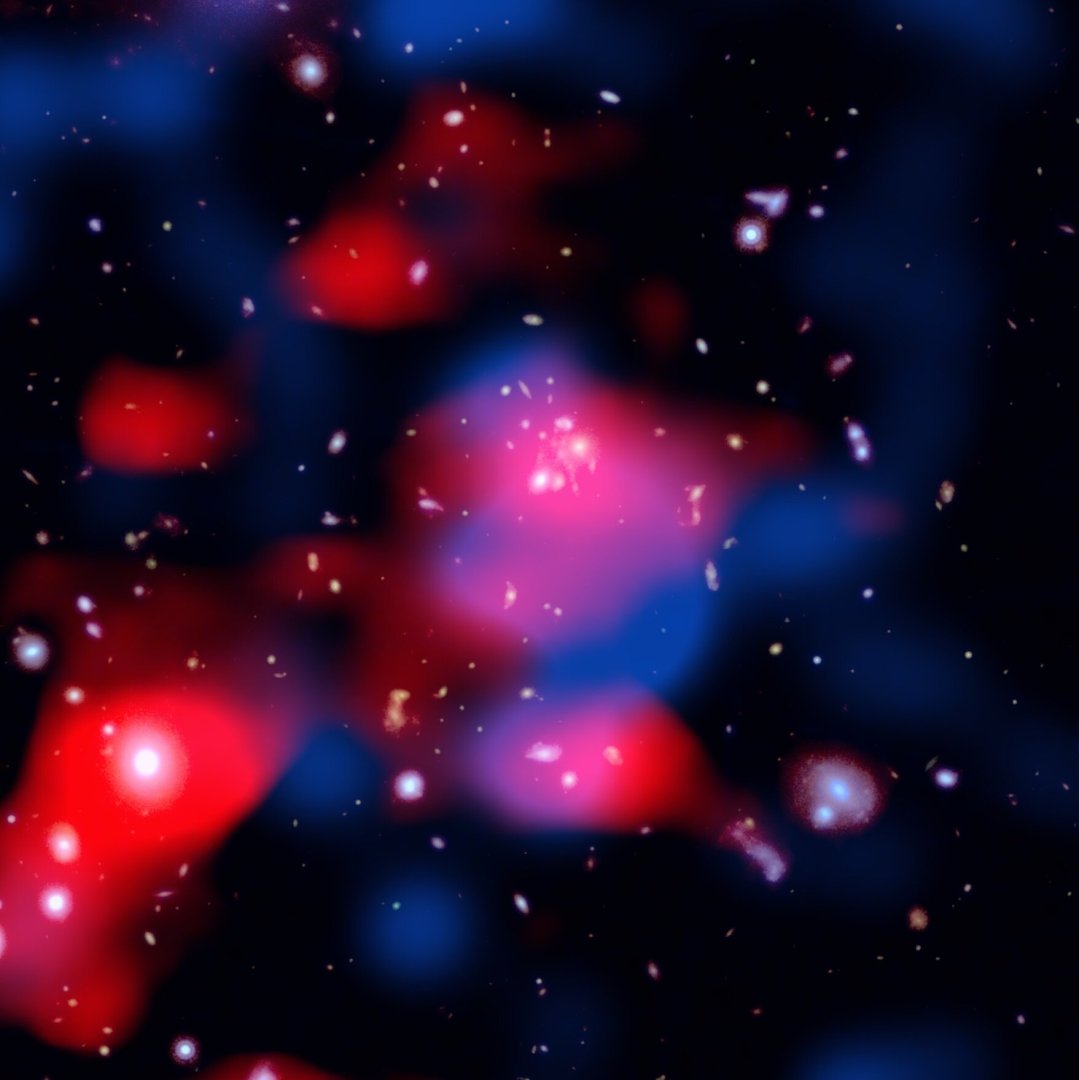
Mini-halos are vast clouds of high-energy particles that sit between galaxies in a cluster. These charged and incredibly fast particles emit faint radio waves as they move through space. However, detecting such halos is extremely difficult, especially in the distant universe.
The farther something is, the fainter its signal becomes. Until this study, astronomers weren’t able to spot these structures more than a few billion light-years away. However, thanks to a powerful new tool called the Low Frequency Array (LOFAR), this time, scientists detected a halo located 10 billion light years away.
LOFAR is a massive radio telescope that comprises 100,000 antennas spread across eight European countries. The researchers used it to study SpARCS1049, a galaxy cluster so far away that the light we see from it today began its journey when the universe was less than a third of its current age.
As they sifted through data from LOFAR, they noticed something unusual—a faint but widespread radio signal surrounding the cluster. Importantly, this glow wasn’t coming from the galaxies themselves. Instead, it seemed to come from the vast space in between them and matched the signature of a mini-halo ten times the size of the Milky Way.
However, where do these halo particles come from?
The researchers believe there are two likely answers. One possibility is that supermassive black holes at the centers of galaxies in the cluster are blasting out jets of high-energy particles. However, it’s still unclear how those particles travel so far and stay energized across such huge distances.
Another explanation is that particles inside the hot gas of the cluster are constantly colliding with each other at near-light speeds, creating even more energetic particles in the process. Either way, it’s clear that these high-energy particles have been present and influencing galaxy clusters for billions of years longer than we thought.
“It’s astonishing to find such a strong radio signal at this distance. It means these energetic particles and the processes creating them have been shaping galaxy clusters for nearly the entire history of the universe,” Roland Timmerman, one of the researchers, said.
We have just scratched the surface
This discovery gives scientists a rare peek into the early universe and suggests that powerful forces, like black holes and particle collisions, have been affecting galaxy clusters from the very beginning.
However, many questions remain. How exactly do black holes spread energy so widely? How do these particles stay energized for billions of years? And what role do magnetic fields play in all of this? These are the puzzles that future telescopes like the Square Kilometer Array (SKA) will help solve.
SKA, once operational with over 131,000 antennas, will be even more sensitive than LOFAR and could uncover many more mini-halos hidden in the distant universe. For now, the current research provides a strong hint that the early universe was far more energetic and dynamic than we ever imagined.
“We are just scratching the surface of how energetic the early universe really was. This discovery gives us a new window into how galaxy clusters grow and evolve, driven by both black holes and high-energy particle physics,” Hlavacek-Larrondo said.
Source: Interesting Engineering
Astronomers Explore Different Physics on Simulated Clones of the Milky Way
10 billion light-years away, a galaxy cluster glows with ancient radio energy