Will Optimized Cycle Analysis Revolutionize Extraterrestrial Energy?
Tackling Lunar Power Challenges with Advanced Stirling Engine Models
Multiple space agencies, including NASA’s Artemis Program, China’s International Lunar Research Station (ILRS), and ESA’s Moon Village, are racing to establish a sustained human presence around the Moon’s South Pole-Aitken Basin. Yet powering these outposts through the two‑week lunar night remains a formidable obstacle. Could high‑efficiency Stirling engines coupled with compact nuclear reactors hold the solution?
Space Nuclear Reactor Power Systems: A Stirling Engine Revolution
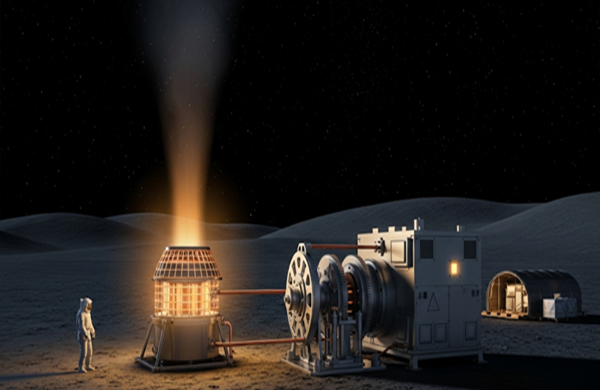
Stirling engines—closed‑cycle regenerative systems that convert thermal gradients into mechanical work—offer unmatched efficiency and reliability for extraterrestrial habitats. When paired with space nuclear reactors, they form Space Nuclear Reactor Power Systems (SNRPS) that promise continuous electricity through extreme temperature swings. However, engineers have long struggled to predict real‑world performance due to complex heat losses, fluid dynamics, and mechanical constraints.
Bridging Theory and Practice: A Refined Analytical Model
Led by Prof. Shang‑Dong Yang of Chengdu University of Technology’s College of Nuclear Technology and Automation Engineering, a team from CNTAE and the Science and Technology on Reactor System Design Technology Laboratory at the Nuclear Power Institute of China developed an optimized Stirling cycle analysis method. Published in Nuclear Science and Techniques, their model integrates key energy dissipation factors—shuttle heat loss, seal leakage, flow resistance, and finite piston speed—to bridge ideal thermodynamic cycles and actual engine behavior.
“Our refined model offers a clearer picture of how design parameters such as regenerator porosity and working fluid choice affect efficiency and power output,” Prof. Fong noted in a recent
EurekaAlert release.

Real‑World Validation: GPU‑3 and RE‑1000 Benchmarks
To ensure predictive accuracy, the researchers validated their model against experimental data from NASA’s GPU‑3 and the free‑piston RE‑1000 engines, both conceived in the 1970s for lunar mission support. By capturing the nuances of gas dynamics and mechanical losses, the optimized model achieved performance predictions within striking distance of measured values. What design tweaks will maximize power density for future prototypes?
Key Design Parameters: Regenerator Porosity and Working Fluids
Among the study’s pivotal findings is the impact of regenerator porosity on heat exchange efficiency. A finely tuned matrix can significantly reduce shuttle heat loss, boosting net power output. Likewise, selecting the optimal working fluid—whether helium for high conductivity or hydrogen for better expansion work—profoundly influences performance under lunar vacuum conditions. How might these insights guide the next generation of compact, ruggedized Stirling engines?
Next Steps: Dynamic Operational Scenarios and Transient Analysis
While steady‑state predictions mark a milestone, the team plans to extend their model to transient operations such as engine startup, shutdown, and load fluctuations. Addressing thermal balance across these phases is critical for integrated reactor‑engine systems, especially in sensitive space environments. Future research will explore how a heat‑pipe reactor’s output profile interacts with engine dynamics to ensure stability, efficiency, and safety.
Toward Sustainable Lunar Outposts and Earth Applications
Beyond powering Moon bases, advanced Stirling engines could revolutionize terrestrial compact energy systems, offering clean, reliable power for remote installations and disaster relief. As the optimized model informs prototype development under simulated lunar and Martian conditions, what novel applications might emerge for on‑Earth energy resilience?
By combining rigorous thermodynamic analysis with real‑world validation, this optimized Stirling engine model paves the way for robust, efficient power systems beyond Earth—and back home. As agencies and private partners gear up for sustained lunar habitation, these analytical advancements will be instrumental in lighting the path to humanity’s next giant leap.
Source: Will Optimized Cycle Analysis Revolutionize Extraterrestrial Energy?
Is This New Sednoid Discovery Rewriting Kuiper Belt History?
Is This New Sednoid Discovery Rewriting Kuiper Belt History?