What Secret Data Did a Sonic Boom Reveal About Earth’s Atmosphere?
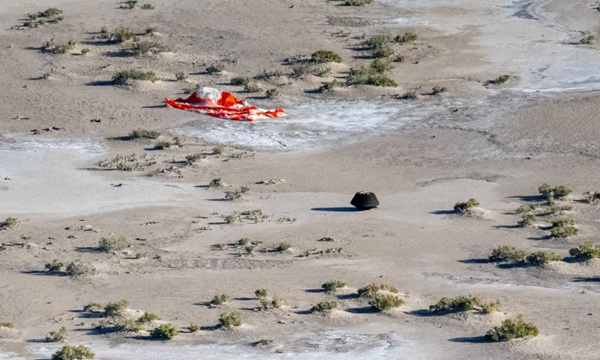
On December 3, 2018, NASA’s OSIRIS-REx mission successfully reached Near-Earth Asteroid 101955 Bennu, marking a significant milestone in space exploration. Over the course of two years, the spacecraft meticulously collected rock and regolith samples, offering invaluable insights into the early Solar System. After completing its primary mission, the spacecraft began its journey back to Earth, carrying these precious samples within a protective sample return capsule (SRC). On September 24, 2023, the SRC made its fiery reentry into Earth’s atmosphere, where it was successfully retrieved by NASA scientists.
Harnessing Hypersonic Sonic Booms for Geophysical Research
As the SRC hurtled toward Earth at hypersonic speeds, it generated an intense sonic boom, a phenomenon that provided a unique opportunity for scientific observation. The shockwave created by this event was powerful enough to be recorded using a cutting-edge technique known as Distributed Acoustic Sensing (DAS). This innovative method leverages fiber-optic cables to detect and capture seismic and acoustic disturbances in real-time.
Traditionally, researchers have relied on infrasound and seismic sensors to study the atmospheric reentry of space capsules. However, the known trajectory and timing of the OSIRIS-REx SRC presented an unprecedented chance to apply DAS technology to this type of event. By deploying DAS interrogators and fiber-optic cables near the expected impact zone, scientists were able to obtain the first recorded detection of an SRC’s reentry using this advanced sensing method.
Deploying DAS Technology in the Nevada Desert
A specialized research team set out to capture the geophysical signals of the SRC’s reentry using a robust DAS network. To achieve this, two DAS interrogators and more than 12 kilometers (7.45 miles) of fiber-optic cables were deployed across two strategic locations near Eureka, Nevada. This network also included six co-located seismometer-infrasound sensor pairs, ensuring a comprehensive recording of the event.
Despite the logistical challenges, the team successfully installed the system ahead of the capsule’s arrival. The deployment process involved maneuvering massive optical fiber spools, each weighing over 100 kilograms. Notably, one segment of the fiber (approximately 5 kilometers) was positioned at the Eureka airport, a site that also hosted other sensor deployments, including seismic, infrasound, and GPS instruments. The remaining 7 kilometers of fiber stretched along a remote dirt road in Newark Valley, allowing for additional data collection from an isolated environment.

Capturing the Sonic Boom: A Breakthrough in Sensing Technology
As the SRC streaked across the sky, the DAS interrogators successfully recorded a detailed profile of the sonic boom’s interaction with the Earth’s surface. The resulting data captured a sharp, impulsive arrival followed by an extended coda, mirroring patterns observed in traditional seismometer and infrasound recordings. However, DAS technology offered a unique advantage—it provided a continuous, spatially dense measurement of how the sonic boom propagated and interacted with the terrain.
Unlike conventional sensors that only capture signals at discrete points, DAS allowed researchers to observe how the shockwave transformed as it encountered hills, valleys, and other geographical features. This capability enhances the ability to analyze atmospheric entry events with greater precision, shedding new light on the physical processes at play.
Advancing Meteor and Asteroid Impact Predictions
Beyond the study of spacecraft reentry, this breakthrough in DAS technology holds immense potential for planetary defense and meteor impact monitoring. By deploying dense sensor arrays over large areas, researchers can improve their ability to track and characterize meteors and asteroids as they enter Earth’s atmosphere.
The ability to map shockwave interactions with terrain in real-time could significantly refine trajectory estimations, offering better predictive capabilities for incoming celestial bodies. The application of DAS in this field represents a step forward in mitigating potential hazards posed by meteoroids and other space debris.
The Future of OSIRIS-REx: A New Mission to Apophis
Following its successful sample return, the OSIRIS-REx spacecraft has embarked on a new journey. Now renamed OSIRIS-APEX (Apophis Explorer), the spacecraft is set to rendezvous with Near-Earth Asteroid 99942 Apophis in 2029. This next phase of exploration will provide further opportunities to study asteroid composition, surface dynamics, and potential planetary defense strategies.
As NASA and the scientific community continue to push the boundaries of exploration, the integration of DAS technology in space research demonstrates how innovative sensing methods can transform our understanding of both human-made and natural atmospheric reentry events. The successful application of DAS in monitoring the OSIRIS-REx SRC marks the beginning of a new era in high-resolution geophysical sensing, paving the way for future advancements in aerospace and planetary sciences.
Source: What Secret Data Did a Sonic Boom Reveal About Earth’s Atmosphere?
Do We Live in a Special Region of the Cosmos? Scientists Investigate
Do We Live in a Special Region of the Cosmos? Scientists Investigate
What Secret Data Did a Sonic Boom Reveal About Earth’s Atmosphere?