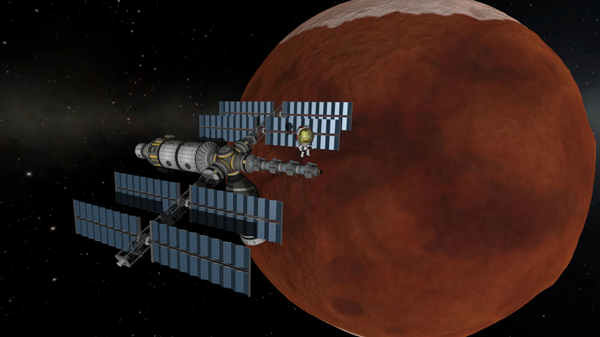
What If the Next NASA Mission Was Designed in a Video Game?
Is Kerbal Space Program the Secret Weapon for Next-Gen Mission Design?
With major space agencies preparing for crewed missions to the Moon and commercial players racing to commercialize Low Earth Orbit (LEO), space exploration is poised for a transformative boom. Regular journeys to cislunar space, permanent infrastructure on and around the Moon, and increased commercial payload deliveries are becoming tangible goals. To achieve these efficiently and sustainably, innovative engineering processes and mission architectures must become the norm.
But how can agencies integrate revolutionary technologies still largely championed by the commercial sector? A surprising tool may hold the answer: a popular video game known for its creative sandbox-style freedom—Kerbal Space Program (KSP).
Purdue Engineers Propose a New Approach: Using Kerbal Space Program for Early Mission Design
A team from Purdue University, led by Doctoral Research Assistant Rodrigo N. Schmitt, believes that sandbox games like KSP could bridge the innovation gap in mission planning. Alongside Moacir F. Becker, Daniel DeLaurentis, and Kenshiro Oguri, Schmitt detailed their vision in a recent paper published in Acta Astronautica.
Their proposal: integrate KSP’s highly flexible environment—augmented with realistic mods—with high-fidelity astrodynamics models to aid in early-stage mission development. Could a game really help shape humanity’s next steps into the cosmos?
How Kerbal Space Program Enhances Modern Mission Architecture
One of the most significant spaceflight developments in the past two decades has been the rise of reusable launch vehicles, with SpaceX’s Falcon 9 and Falcon Heavy leading the charge. The next critical leap—On-Orbit Refueling (OOR)—will be essential for sustainable cislunar missions and deeper space exploration.

Although reusable systems and orbital refueling have been envisioned since the 1960s, traditional space mission planning has been slow to adopt them. Yet they are cornerstones of NASA’s “Moon to Mars” exploration strategy, which views the Moon as a testbed for technologies needed to build sustainable outposts beyond Earth.
KSP offers a sandbox where these concepts can be modeled early and tested virtually. Schmitt’s research used the Realism Overhaul (RO) mod to simulate Artemis spacecraft systems and mission profiles, building on KSP’s growing reputation as a tool for teaching orbital mechanics and spacecraft design principles.
What if the next breakthrough in mission architecture begins with a virtual rocket launch in a video game?
Sandbox Simulations: How KSP Enhances Early-Stage Mission Development
NASA divides mission development into structured phases, with early steps focusing on broad exploration of architectural options. Schmitt’s team leveraged KSP to simulate the Pre-Phase A stage of the Artemis V mission profile—using the game to explore how depot location, fuel capacity, and mission design interact.
Key modifications and models used included:
Circular Restricted 3 Body Problem (CR3BP) to simulate gravitational forces between the Earth, Moon, and spacecraft.
Cislunar Object-Oriented Systems Modeling and Integration Code (COSMIC) to represent mission entities like launch vehicles, depots, and landers.

They chose Artemis V because of its ambitious goals, including the deployment of Lunar View, ESA’s refueling module for the Gateway outpost, a critical node in future lunar and cislunar operations.
Breaking Down the Simulated Artemis V Mission Architecture
The Purdue team’s simulation broke the Artemis V mission into five key phases:
Orbit Insertion: Launch aboard NASA’s Space Launch System (SLS) and insertion of the Orion spacecraft into Low Earth Orbit.
Transfer to Halo Orbit: Orion performs a lunar injection maneuver to rendezvous with the Gateway station and deploy the Lunar View refueling module.
Descent to the Lunar Surface: Crew members transfer to a lander (e.g., Blue Moon HLS) for descent to the lunar surface.
Ascent to Halo Orbit: After completing surface operations, the crew returns to the Gateway.
Earth Reentry: The Orion spacecraft brings the crew safely back to Earth.
Within these phases, multiple design options were considered for refueling depots (Lunar View, Modular, and Extended variants) and landers (Lockheed Martin HLS, Blue Moon HLS, Dynetics HLS). Even various Gateway orbit placements and transfer maneuvers were tested—an impressive 10,000 simulation points in total.
Kerbal Space Program’s Hidden Strength: Rapid Prototyping for Aerospace Design
Using the OpenMDAO Python library for efficient high-dimensional sampling, the team assessed:
Cost (measured in KSP’s in-game currency)
Complexity (derived from a non-dimensional graph energy metric)
Performance (quantified by time of flight)
The combination of KSP’s Realism Overhaul (RO) and kRPC mods was crucial. RO allowed intricate spacecraft designs to be built rapidly, while kRPC enabled detailed data extraction—such as propulsion statistics, mass properties, and delta-v budgets.
The ability to directly tweak and re-test mission configurations in KSP proved invaluable for iterating through design possibilities—something traditional modeling tools often struggle to deliver as quickly.
Final Insights: Can Gaming Revolutionize Space Mission Engineering?

The Purdue team’s findings highlight how KSP, when integrated with advanced astrodynamics models, can serve as a powerful tool for:
Early mission prototyping
Iterative design refinement
Strategic decision-making support for stakeholders
Their framework paves the way for sandbox games to become legitimate aids in preliminary aerospace design, potentially slashing costs and development times for future space missions.
Could the next leap in human space exploration be fueled by a generation of engineers who first mastered orbital mechanics in a virtual Kerbal universe?
Looking Ahead: Expanding the Mission Simulation Framework
Schmitt and his team plan to expand their framework by:
Incorporating more sophisticated space systems
Applying optimization techniques for design refinement
Exploring the full potential of SpaceX’s Starship for cislunar and interplanetary missions
Fortunately, KSP’s rich ecosystem of mods—including the Starship Expansion Project—offers a head start in simulating orbital refueling strategies and modular mission architectures.
In the new era of space exploration, where rapid innovation is key, perhaps the best training ground for tomorrow’s aerospace engineers lies not in a traditional classroom—but somewhere between Earth and the Mun
Source: What If the Next NASA Mission Was Designed in a Video Game?