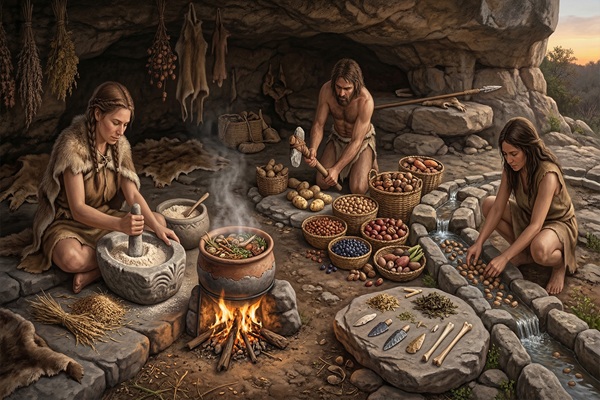
What If the First Humans Were More Like Experimental Chefs Than Mammoth Hunters?
For decades, the popular image of Paleolithic humans has been simple and dramatic: powerful hunters chasing large animals across ancient landscapes and surviving mainly on meat. This narrative has strongly influenced the modern Paleo diet, a nutritional trend that promotes a meat-heavy menu inspired by what many believe our ancestors ate.
However, new archaeological research now challenges that familiar story. Scientists argue that early humans were not primarily meat-focused hunters. Instead, they relied on a remarkably diverse diet that included a wide range of plant foods alongside animal resources.
So what did prehistoric people actually eat? And could our understanding of human evolution—and even modern diet trends—be built on an incomplete picture?
Archaeological Evidence Challenging the Meat-Heavy Paleo Diet
A recent study published in the Journal of Archaeological Research by scientists from the Australian National University and the University of Toronto Mississauga takes a closer look at this long-standing assumption.
The researchers argue that Paleolithic diets were far more varied than previously believed. Early humans did hunt animals, but they also gathered, processed, and consumed numerous plant foods. These included wild seeds, starchy tubers, nuts, and other plant resources that could provide essential calories and nutrients.
For many years, the archaeological record appeared to support the meat-heavy theory. After all, animal bones survive for tens of thousands of years and are easy to detect during excavations. Plant remains, on the other hand, often decay rapidly and disappear from the record.
However, new scientific techniques are changing this perspective. Researchers are now identifying microscopic traces of plant use—such as starch grains, phytoliths, and plant fibers—preserved on ancient tools.
As these subtle traces accumulate, they tell a different story. Early humans were not merely hunters. They were skilled food processors who invested time and effort into making plant foods edible.
Could the traditional “meat-centric” view of prehistoric diets simply reflect what survives best in the archaeological record?
Ancient Plant Processing: Grinding, Cooking, and Detoxifying Plant Foods
One of the most important findings of the study concerns the sophisticated methods early humans used to process plants.
According to co-author Dr. Anna Florin, archaeologists often treat plant use as something that became important only after the invention of agriculture. Yet growing evidence suggests that humans were manipulating plant foods thousands of years earlier.
Archaeological discoveries from many regions reveal grinding stones, pounding tools, and cooking technologies used to prepare wild plant foods. These tools contain microscopic residues that show people were grinding seeds, crushing nuts, and preparing starchy roots long before farming began.
Why was this processing so important?
Many wild plants contain toxins or tough fibers that make them difficult to eat. However, grinding, roasting, soaking, and heating can transform these plants into safe and nutritious food sources. These techniques also help unlock calories that would otherwise remain inaccessible.
For example, starchy tubers often become easier to digest after cooking. Bitter nuts may require leaching or roasting to remove harmful compounds. Seeds can release more energy when ground into meal.
In other words, early humans were not simply gathering plants. They were engineering their food.
This raises an intriguing question: Did food processing play a larger role in human evolution than we previously imagined?
Humans as a Broad-Spectrum Species: The Evolutionary Advantage of Dietary Flexibility
The researchers describe humans as a “broad-spectrum species.” This concept suggests that our evolutionary success comes from our ability to exploit many types of resources rather than specializing in a single food source.
Unlike predators that depend almost entirely on meat, early humans adapted to changing environments by diversifying their diets. When large game animals were scarce, people could rely on plants. When seasons changed, they could shift toward different food sources.
This flexibility offered enormous advantages.
For instance, groups migrating into unfamiliar regions would encounter new landscapes and ecosystems. Survival in such places required experimentation and innovation. People needed to identify edible plants, learn how to prepare them safely, and develop tools to process them efficiently.
Co-author Dr. Monica Ramsey emphasizes that processed plant foods likely played a crucial role in human expansion across the globe. The ability to unlock calories from a wide variety of plants allowed humans to thrive in deserts, forests, and temperate regions alike.
Without that dietary adaptability, would our species have spread so successfully across the planet?
The Hidden Role of Plants in Human Evolution
Plants may have shaped human evolution more deeply than the archaeological record once suggested.
While bones and stone tools dominate museum collections, microscopic plant residues tell a quieter but equally important story. Grinding stones stained with starch grains, ancient dental calculus containing plant particles, and residues on cutting tools all point toward a long history of plant consumption.
These discoveries suggest that plants were not merely fallback foods during times of scarcity. Instead, they may have been a consistent and valuable component of early human diets.
Furthermore, plant foods often provide essential vitamins, minerals, and carbohydrates that complement the protein and fat obtained from animal sources. A mixed diet could therefore support better nutrition and greater resilience.
If this is true, then perhaps the popular image of prehistoric humans feasting mainly on mammoth steaks needs reconsideration.
Were our ancestors actually more like adaptable culinary experimenters than specialized hunters?
Rethinking the Modern Paleo Diet in Light of Archaeology
The modern Paleo diet is built on the idea that humans evolved primarily as meat eaters and that returning to this ancestral pattern promotes better health. However, the new archaeological evidence complicates that narrative.
If Paleolithic people regularly consumed and processed plants, then their diets may have been far more balanced than many modern interpretations suggest.
This does not mean early humans avoided meat. Hunting clearly played an important role in many prehistoric societies. Yet it appears that plants, too, contributed substantial calories and nutrients.
The real lesson may not be about choosing meat or plants. Instead, it may lie in understanding the dietary flexibility that allowed humans to survive in unpredictable environments.
Our ancestors were not following strict nutritional rules. They were adapting creatively to whatever resources their surroundings provided.
Could that flexibility—rather than any single food group—be the true evolutionary foundation of human diets?
What This Research Means for Understanding Prehistoric Life
The emerging evidence encourages archaeologists to rethink long-held assumptions about ancient diets.
First, it highlights how preservation bias can shape scientific interpretation. Because animal bones survive better than plant remains, early researchers may have unintentionally overemphasized the importance of meat.
Second, it underscores the value of new analytical methods. Techniques that detect microscopic residues now reveal aspects of ancient life that were previously invisible.
Finally, the research reminds us that human history is often more complex than popular narratives suggest. The daily meals of prehistoric people likely varied widely depending on geography, season, and cultural knowledge.
This complexity raises new questions that scientists are only beginning to explore.
How widespread was plant processing among different prehistoric populations?
Did some regions rely more heavily on plant foods than others?
And could the technological skills involved in preparing plants have influenced the development of early human cognition and culture?
A New Picture of Early Humans: Adaptive, Curious, and Resourceful
In the end, the study paints a vivid and dynamic portrait of early human life.
Rather than focusing narrowly on hunting large animals, our ancestors appear to have experimented with a vast menu of edible resources. They gathered seeds, dug up roots, cracked nuts, and invented methods to transform raw ingredients into nourishing meals.
This behavior reveals something profound about human nature.
Early humans were not simply survivors reacting to their environment. They were innovators, constantly testing new foods and refining techniques to make them edible and nutritious.
As Dr. Ramsey describes it, our species evolved as “plant-loving, tool-using food enthusiasts who could turn almost anything into dinner.”
And perhaps that adaptability—combined with curiosity and creativity—became one of the greatest survival tools in human history.
So the next time we imagine prehistoric life, we might ask a different question.
Were the first humans merely hunters of giant animals, or were they the world’s earliest experimental chefs?
Source: What If the First Humans Were More Like Experimental Chefs Than Mammoth Hunters?
What If the First Humans Were More Like Experimental Chefs Than Mammoth Hunters?
Sources
Florin, Anna & Ramsey, Monica. Journal of Archaeological Research — Study on Paleolithic plant processing and diet diversity.
Australian National University research publications on prehistoric food processing.
University of Toronto Mississauga archaeological research contributions on early human diets.
Recent archaeological analyses of starch grains, phytoliths, and plant residues on prehistoric tools.
What If the First Humans Were More Like Experimental Chefs Than Mammoth Hunters?