What If Neanderthals Weren’t Wanderers but Navigators? A 40,000-Year Map of Their Stone Tools Could Reveal They Had a Plan
Neanderthal Stone Tools Unearthed in Zaragoza Cave
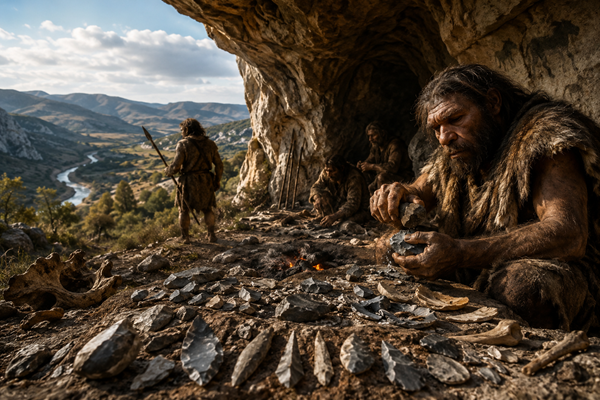
What can everyday objects tell us about a species that vanished thousands of years ago? Archaeologists working in the Aguilón P5 cave near Zaragoza, Spain, are uncovering answers. During July of two thousand twenty-six, a team from the University of Zaragoza excavated the cave’s entrance and discovered a dense concentration of high-quality flint tools. These artifacts belong to the Mousterian tradition, a stone tool industry exclusively linked to Neanderthals across Europe.
The cave sits in the Aragón region, a landscape that once hosted some of the last Neanderthal communities. The newly found tools did not originate locally. Instead, the flint came from outcrops near Botorrita, a location beyond the immediate site. This detail matters. It shows that Neanderthals planned their movements, selected raw materials, and transported stone over distances. The tools are not just objects; they are evidence of decision-making and landscape use.
Marta Alcolea, scientific co-director of the project, stated in a university release that Aguilón P5 offers an exceptional opportunity to understand these final Neanderthal groups. Her words emphasize that the goal is not merely to collect artifacts but to reconstruct behaviors. Each excavation season adds another piece to the puzzle of when these people lived, how they organized their spaces, and what environments they occupied.
But why focus on the cave mouth? The entrance provided light, protection from elements, and easy access to the surrounding terrain. Neanderthals used this area for chipping flint, preparing food, and possibly cooking. Similar activity areas appear at other Neanderthal sites across Europe, yet Aguilón P5 preserves a remarkably intact record.
Mousterian Flint Tools Reveal a Neanderthal Workspace
The tools recovered include points, scrapers, notches, and denticulates. Alongside them, excavators found fractured animal bones and numerous hearths. These finds indicate repeated occupations over millennia. A study published in Quaternary International by Carlos Mazo and Marta Alcolea in two thousand twenty reported lithics, processed fauna, and charred plant remains from layers dating between beyond fifty thousand and approximately forty-one thousand nine hundred years before present.
By two thousand twenty-four, the team had recovered roughly ten thousand stone and animal-bone remains, according to the Aragón Environmental Science Research Institute. Such a large assemblage allows researchers to analyze spatial patterns. Where did knapping occur? Where did people discard waste? The answers help define a Neanderthal workspace.
Moreover, the cave’s stratigraphy reveals multiple visits across time. Neanderthals returned to Aguilón P5 again and again, suggesting it held lasting significance. Perhaps it served as a seasonal camp or a shelter during hunting expeditions. The presence of hearths implies social gatherings around fire. Could these flames have warmed families during cold Ice Age nights? The evidence invites such questions.
Flint Sources Map Neanderthal Movement and Planning
The flint from Botorrita carries a hidden map. By tracing the stone’s origin, archaeologists reconstruct Neanderthal routes across the landscape. Similar studies elsewhere have demonstrated long-distance movements of these populations. For instance, a bone spear point found in Spain shows how flexibly Neanderthals used available materials.
Why did they travel to Botorrita for flint? Perhaps the local stone lacked quality, or the outcrop held symbolic value. The choice reflects knowledge of territory and resource distribution. Neanderthals did not simply wander; they planned expeditions to obtain superior raw material.
This planning extends to tool production. The high-quality flint allowed for sharp edges and durable implements. Points served as spear tips for hunting; scrapers processed hides; notches and denticulates worked wood or bone. Each tool type indicates a specific task. Together, they paint a picture of a community engaged in diverse activities.
What does this mean for our understanding of Neanderthal cognition? Some researchers once viewed Neanderthals as simple scavengers. Evidence from Aguilón P5 challenges that stereotype. These people moved deliberately, selected materials carefully, and maintained a workspace over generations.
Rebuilding the Lost Ice Age Environment of Aguilón P5
Excavation forms only one part of the project. Ongoing studies include new dating, geoarchaeology, technological analysis, and paleoenvironmental work. For the first time, researchers are systematically examining small mammal remains from the cave. Small mammals respond quickly to climate and habitat changes. Their presence can reconstruct the conditions Neanderthals faced.
Did the environment shift during the occupation? Pollen and sediment analyses may reveal temperature fluctuations, vegetation cover, and available prey. Combined with large mammal bones, these data build a comprehensive picture of the Ice Age landscape.
In two thousand twenty-four, the team also sampled cave sediment for ancient DNA. Paleogenetics adds a powerful tool to the research program. DNA from soil can identify which animals and plants lived nearby, and even whether Neanderthals themselves left genetic traces. Such multidisciplinary approaches are crucial for a site that marks the end of the Neanderthal epoch in the region.
Recent studies elsewhere indicate decreasing populations and lower genetic diversity among Europe’s last Neanderthals. However, evidence from Aguilón P5 must be interpreted within its own archaeological schedule. Did these groups experience similar pressures? The cave may hold clues.
Aguilón P5: Key Site for Neanderthal and Modern Human Transition
Excavation at Aguilón P5 began in two thousand ten. The cave lies on the northern side of the Iberian System, below the Ebro River. Its dated layers span the Middle to Upper Paleolithic transition, a critical period when the last Neanderthals and first Homo sapiens appeared in Iberia.
This transition was not a simple replacement. Finds like the eagle-talon ornament from Cova Foradada, roughly contemporary with Aguilón P5, suggest symbolic behavior among Neanderthals. Such discoveries warn against narratives of one “advanced” population replacing another.
How did Neanderthals and modern humans interact? Did they exchange knowledge, or compete for resources? Aguilón P5 provides a window into Neanderthal life just before their disappearance. By understanding their daily routines, planning abilities, and environmental adaptations, we gain respect for their resilience.
The cave continues to yield surprises. Each tool, each bone, each grain of sediment adds depth to the story. What will the next excavation season reveal? Perhaps evidence of social structure, or signs of contact with incoming Homo sapiens. The questions keep archaeologists returning.
Source: What If Neanderthals Weren’t Wanderers but Navigators? A 40,000-Year Map of Their Stone Tools Could Reveal They Had a Plan
1.4-million-year-old footprints reveal a surprisingly large human relative
1.4-million-year-old footprints reveal a surprisingly large human relative
What If Neanderthals Weren’t Wanderers but Navigators? A 40,000-Year Map of Their Stone Tools Could Reveal They Had a Plan
Sources
- University of Zaragoza press release (translated from Spanish)
- Mazo, C., & Alcolea, M. (2020). “Lithic technology and subsistence at Aguilón P5 (Zaragoza, Spain): A Middle Palaeolithic site in the Ebro Basin.” Quaternary International.
- Aragón Environmental Science Research Institute (2024 report on recovered remains)
- Additional context from studies on Neanderthal mobility and symbolic behavior (e.g., Cova Foradada eagle-talon ornament)