What If Life Is Already There? Scientists Reveal the Most Promising Alien Worlds
If humanity ever sets out on a real-life “Project Hail Mary,” where should we go first? More importantly—are we even looking in the right places?
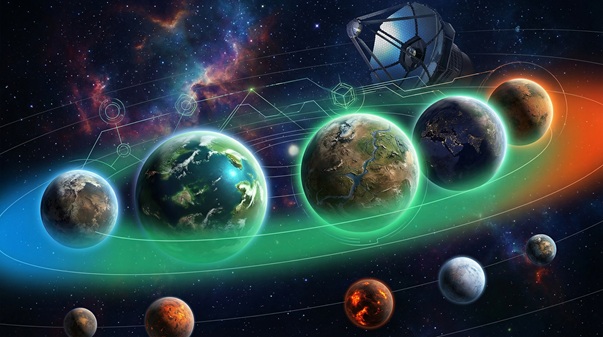
Astronomers now believe they are closer than ever to answering that question. Out of more than six thousand known exoplanets, scientists have identified forty-five rocky worlds that sit in what is known as the habitable zone. This is the narrow orbital region where conditions may allow liquid water to exist—arguably the most essential ingredient for life as we understand it.
However, the concept raises deeper questions. Is water truly the universal requirement for life? Or are we limiting our search by thinking too much like Earth?
A recent study published in Monthly Notices of the Royal Astronomical Society attempts to refine this search. By combining data from the European Space Agency’s Gaia mission and the NASA Exoplanet Archive, researchers have created one of the most targeted catalogs of potentially habitable worlds to date.
Earth-Like Exoplanets List: Which Worlds Are Most Promising for Life?


Among the forty-five candidates, several stand out—not just for their position in space, but for how closely they resemble Earth in terms of energy received from their stars.
The most compelling targets include:
TRAPPIST-one d, e, f, and g
Proxima Centauri b
Kepler one eight six f
LHS one one four zero b
TOI seven one five b
Notably, the TRAPPIST-one system lies only about forty light-years away. In cosmic terms, that is practically our neighborhood. Yet even at this “short” distance, a journey there with current technology would take tens of thousands of years.
So the real question becomes: if we cannot travel there yet, how do we investigate them?
Scientists rely on indirect methods—studying starlight, planetary transits, and atmospheric signatures. But this leads to another puzzle: can we truly detect life from light-years away, or are we interpreting faint signals through a human-biased lens?
Habitable Zone Limits: Where Does Life Begin—and Where Does It End?
The idea of a habitable zone sounds simple, yet its boundaries remain uncertain. Too close to a star, and a planet risks runaway greenhouse heating like Venus. Too far, and it freezes like Mars.
However, reality is rarely so clean-cut.
Some of the newly identified planets sit right on the edge of this zone. These “borderline worlds” are especially valuable. Why? Because they help scientists test the limits of habitability itself.
For example:
Inner-edge planets may reveal how much heat a world can tolerate before losing its atmosphere
Outer-edge planets may show whether subsurface oceans or greenhouse effects can sustain life
This raises a provocative idea: does a planet need to remain constantly habitable, or could life survive in cycles—freezing and thawing over millions of years?
Exoplanet Atmospheres and Water: Can These Worlds Actually Support Life?
Without a stable atmosphere, liquid water cannot persist. Radiation would strip it away. Surface temperatures would fluctuate wildly. Life, at least as we know it, would struggle to survive.
This is where telescopes like the James Webb Space Telescope come into play. By analyzing how starlight filters through a planet’s atmosphere, scientists can detect gases such as:
Water vapor
Carbon dioxide
Methane
Oxygen
But here lies another challenge. These gases do not always indicate life. They can also arise through purely geological processes.
So the deeper question becomes: what combination of signals would truly convince us that we are not alone?
Eccentric Orbits and Alien Life: Can Planets Drift In and Out of Habitability?
Interestingly, not all planets follow stable, circular orbits. Some have highly elliptical paths, meaning their distance from their star changes dramatically over time.
This introduces a fascinating possibility.
Could a planet drift into the habitable zone long enough for life to emerge—and then drift out again without extinguishing it completely?
If so, life might not require stability. It might thrive on extremes.
Scientists are now studying such eccentric planets to determine whether periodic habitability is enough. This challenges long-held assumptions and opens entirely new categories of potential life-bearing worlds.
Future Space Telescopes and Missions: How Will We Find Alien Life?
The catalog of forty-five worlds is not just theoretical—it is a roadmap for future exploration.
Upcoming observatories will focus on these targets, including:
The Nancy Grace Roman Space Telescope
The Extremely Large Telescope
The Habitable Worlds Observatory
The proposed LIFE (Large Interferometer for Exoplanets) mission
Each instrument will push the boundaries of detection. Together, they may finally answer one of humanity’s oldest questions.
But even then, uncertainty will remain.
What if life exists, but in forms we do not recognize?
What if we detect something—but cannot interpret it?
And perhaps most unsettling: what if the universe is full of habitable worlds, yet completely silent?
A Cosmic Question That Refuses to Fade
The identification of these forty-five Earth-like planets marks a turning point. For the first time, we are not just guessing—we are narrowing the search with precision.
Yet the mystery deepens rather than fades.
We now know where to look.
We are beginning to understand how to look.
But we still do not know what we are looking for.
And maybe that is the most important question of all.
Source: What If Life Is Already There? Scientists Reveal the Most Promising Alien Worlds
Earth’s Days Haven’t Lengthened This Fast in 3.6 Million Years — What Changed?
Earth’s Days Haven’t Lengthened This Fast in 3.6 Million Years — What Changed?
What If Life Is Already There? Scientists Reveal the Most Promising Alien Worlds
Sources
Monthly Notices of the Royal Astronomical Society (Kaltenegger et al.)
NASA Exoplanet Archive
European Space Agency Gaia Mission Data
Cornell University – Carl Sagan Institute Research
Observational frameworks from the James Webb Space Telescope program