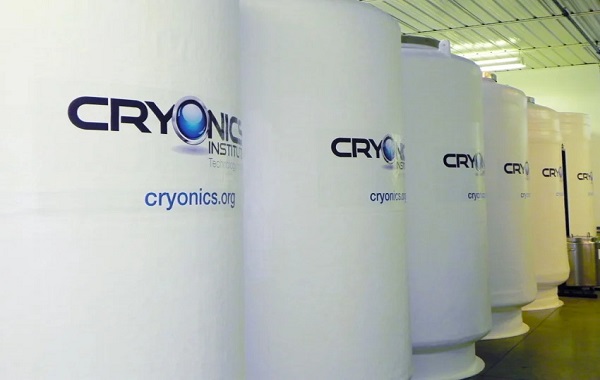
What ever happened to the first cryogenically frozen humans?
Several facilities in the U.S. and abroad maintain morbid warehouse morgues full of frozen human heads and bodies, waiting for the future. They are part of a story that is ghoulish, darkly humorous, and yet endearingly sincere. For a small group of fervent futurists, it is their lottery ticket to immortality. What are the chances that these bodies will be reanimated? Will baseball legend Ted Williams’ frozen head be awakened to coach fighter pilots or fused to a robot body to hit .400 again?
A primer on cryonics
Cryonics — attempting to cryopreserve the human body — is widely considered a pseudoscience. Cryopreservation is a legitimate scientific endeavor in which cells, organs, or in rare cases entire organisms may be cooled to extremely low temperatures and revived somewhat intact. It occurs in nature, but only in limited cases.
Humans are particularly difficult to preserve because of the delicate structure in (most of) our heads. Deprived of oxygen at room temperature, the brain dies within minutes. While the body may be reanimated, the person who “lives” is often in a permanent vegetative state. Cooling the body may give the brain a bit more time. During brain or heart surgery, circulation may be stopped for up to an hour with the body cooled to 20° C (68° F). A procedure to cool the body to 10° C (50 F°) without oxygen for additional hours is still at the experimental research stage.
After a while, he let the bodies thaw out inside the capsule and left the whole thing festering in his vault.
When a cryonic patient dies, a race begins to prepare and cool the body before it decays and then to place it inside a Dewar: a thermos bottle full of liquid nitrogen (LN). The inner vessel of the Dewar contains a body, or bodies, wrapped in several layers of insulating material, attached to a stretcher, and suspended in LN. The head is oriented downward to keep the brain the coldest and most stable.
This vessel lies within a second outer vessel, separated by a vacuum to avoid heat transfer from the outer room-temperature vessel wall to the cold inner vessel wall. Heat gradually transfers across anyway and boils away the LN, which must be periodically refilled. Bodies were originally, and may still be in some cases, cooled and frozen in whatever condition they were in at death, with better or worse preservation, as we shall see.
The grisly fates of the first cryonauts
The early years of cryonics were grisly. All but one of the first frozen futurists failed in their quest for immortality.
Small freezing operations began in the late 1960s. While the practice of storing bodies has become more sophisticated over the past 50 years, in the early days, technicians cooled and prepared corpses with haste on dry ice before eventually cramming them into Dewar capsules. By in large, these “preservations” did not achieve preservation. They were nightmarish, gruesome failures. Their stories were researched and documented by people within the field, who published thorough and frank records.
The largest operation was run out of a cemetery in Chatsworth, California by a man named Robert Nelson. Four of his first clients were not initially frozen in LN but placed on a bed of dry ice in a mortuary. One of these bodies was a woman whose son decided to take her body back. He “hauled (his dead mother) around in a truck” on dry ice for some time before burying her.
The bodies in the container partially thawed, moved, and then froze again — stuck to the capsule like a child’s tongue to a cold lamp post.
Eventually, the mortician was not pleased with the other bodies sitting around on beds of ice, so a LN Dewar capsule was secured for the remaining three. Another man was already frozen and sealed inside the capsule, so it was opened, and he was removed. Nelson and the mortician then spent the entire night figuring out how to jam four people — who may or may not have suffered thaw damage — into the capsule. The arrangement of bodies in different orientations was described as a “puzzle.” After finding an arrangement that worked, the resealed capsule was lowered into an underground vault at the cemetery. Nelson claimed to have refilled it sporadically for about a year before he stopped receiving money from the relatives. After a while, he let the bodies thaw out inside the capsule and left the whole thing festering in his vault.
Another group of three, including an eight-year-old girl, was packed into a second capsule in the Chatsworth vault. The LN system of this capsule subsequently failed without Nelson noticing. Upon checking one day, he saw that everyone inside had long thawed out. The fate of these ruined bodies is unclear, but they might have been refrozen for several more years.
Nelson froze a six-year-old boy in 1974. The capsule itself was well maintained by the boy’s father, but when it was opened, the boy’s body was found to be cracked. The cracking could have occurred if the body was frozen too quickly by the LN. The boy was then thawed, embalmed, and buried. Now that there was a vacancy, a different man was placed into the leftover capsule, but ten months had elapsed between his death and freezing, so his body was in rotten shape — no pun intended — from the get-go and was eventually thawed.
Every cryonic client put into the vault at Chatsworth and looked after by Nelson eventually failed. The bodies inside the Dewar capsules were simply left to rot. Reporters visited the crypt where these failed operations had taken place and reported a horrifying stench. The proprietor admitted to failure, bad decisions, and going broke. He further pointed out, “Who can guarantee that you’re going to be suspended for 10 or 15 years?”
The worst fates of all occurred at a similar underground vault that stored bodies at a cemetery in Butler, New Jersey. The storage Dewar was poorly designed, with uninsulated pipes. This led to a series of incidents, at least one of which was failure of the vacuum jacket insulating the inside. The bodies in the container partially thawed, moved, and then froze again — stuck to the capsule like a child’s tongue to a cold lamp post. Eventually the bodies had to be entirely thawed to unstick, then re-frozen and put back in. A year later, the Dewar failed again, and the bodies decomposed into “a plug of fluids” in the bottom of the capsule. The decision was finally made to thaw the entire contraption, scrape out the remains, and bury them. The men who performed this unfortunate task had to wear a breathing apparatus.
Source: freethink.com
EctoLife: Concept Unveiled for the World’s First Artificial Womb Facility
EctoLife: Concept Unveiled for the World’s First Artificial Womb Facility
What ever happened to the first cryogenically frozen humans?/What ever happened to the first cryogenically frozen humans?/What ever happened to the first cryogenically frozen humans?