
What Do 10,000-Year-Old Symbols in Egypt’s Rock Formations Tell Us? Has Humanity’s Hidden Archive Been Discovered in the Sinai Desert?
A remarkable archaeological discovery has been announced in the rugged landscapes of the Sinai Peninsula. A 10,000-year-old site with rock art has been identified on the Umm Irak Plateau, according to Egypt’s Ministry of Tourism and Antiquities.
This prehistoric rock art site, previously unknown to researchers, is already being described as one of the most important new archaeological discoveries in Egypt. But what do these ancient carvings truly reveal about the first human communities who once moved across this desert landscape?
Prehistoric Rock Art in Egypt: A 100-Metre Rock Formation Spanning Millennia
At the heart of the discovery lies a 100-metre-long natural rock formation. Its carved surface presents a striking chronological sequence. The imagery stretches from prehistoric periods to the Islamic era.
According to Egypt’s Supreme Council of Antiquities, the site represents exceptional historical and artistic value. Secretary-General Hisham El-Leithy described it as an “open-air natural museum.”
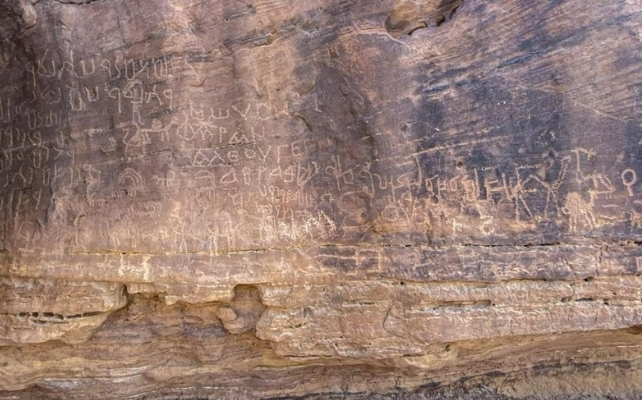
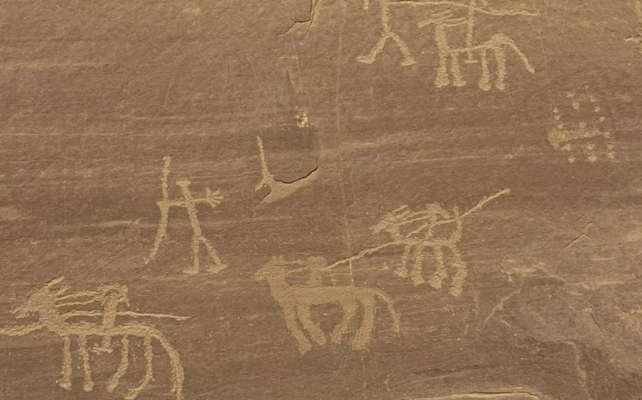
Moreover, the diversity of engravings reflects thousands of years of cultural continuity. Red pigment drawings of animals dominate the ceiling of the rock shelter. Alongside them, inscriptions appear in Arabic and the Nabataean language. As a result, the site offers rare insight into evolving systems of communication and symbolic expression.
Could this long sequence of imagery reveal how belief systems, economies, and identities gradually transformed across generations?
10,000-Year-Old Symbols and Art in Egyptian Rock Formation Reveal Early Human Life
Importantly, the carvings are not merely decorative. Some engravings appear to document daily life. The Ministry of Tourism and Antiquities stated that several scenes reflect the lifestyles and economic activities of early human communities.
Animal droppings, stone partitions, and hearth remains were also identified inside the shelter. Therefore, the site was not simply symbolic. It functioned as a long-term refuge. Evidence suggests repeated occupation over extended periods.
In addition, these material traces strengthen the argument that southern Sinai witnessed continuous human presence across millennia. Tourism and Antiquities Minister Sherif Fathi emphasized that the discovery confirms the succession of civilizations that inhabited this vital region.
If communities repeatedly returned to this shelter, what drew them back? Was it protection, ritual significance, or strategic location along ancient routes?
Egyptian Archaeological Discovery Expands the Map of Egyptian Antiquities
This discovery has been described as a “significant addition to the map of Egyptian antiquities.” Indeed, Egypt’s archaeological narrative is often associated with pharaonic monuments along the Nile. However, the Sinai Peninsula presents a different story.
Unlike monumental temples or pyramids, this rock shelter reflects mobile societies and desert-adapted populations. Consequently, it broadens our understanding of Egyptian heritage beyond dynastic civilization.
Furthermore, the site lies in southern Sinai near the mountain town of Saint Catherine, itself a UNESCO World Heritage site. The region is home to longstanding Bedouin communities. At the same time, Cairo is pursuing a major development initiative aimed at expanding tourism in the area.
How will this new prehistoric rock art discovery influence both heritage preservation and regional development? Can economic ambitions coexist with archaeological protection?
Why the 10,000-Year-Old Rock Art Discovery in Sinai Matters Globally
Globally, rock art sites provide some of the earliest evidence of symbolic thought. Therefore, each new discovery contributes to broader debates in archaeology.
This 10,000-year-old Egyptian rock formation helps scholars trace artistic evolution from prehistoric abstraction to later script-based communication. Moreover, it situates Sinai within larger networks of trade, migration, and cultural exchange across the Near East.
When inscriptions in Nabataean and Arabic appear alongside prehistoric imagery, they illustrate continuity rather than isolation. The rock itself becomes a layered archive. It records shifting identities over thousands of years.
Ultimately, this discovery challenges us to reconsider Sinai not as a peripheral desert, but as a crossroads of civilizations.
And perhaps the most compelling question remains: if a 100-metre rock face can preserve ten millennia of human expression, how many more silent archives are still waiting beneath the sands of Egypt?
Source: What Do 10,000-Year-Old Symbols in Egypt’s Rock Formations Tell Us? Has Humanity’s Hidden Archive Been Discovered in the Sinai Desert?
What Do 10,000-Year-Old Symbols in Egypt’s Rock Formations Tell Us? Has Humanity’s Hidden Archive Been Discovered in the Sinai Desert?
Sources
Ministry of Tourism and Antiquities – Official statement on the Umm Irak Plateau discovery
Supreme Council of Antiquities – Archaeological assessment and remarks by Hisham El-Leithy
Public remarks by Sherif Fathi regarding the significance of the discovery
If this is what one exposed rock shelter can reveal, what deeper chapters of human history still lie hidden across the Sinai Peninsula?