What Did Babylonian Students Learn About Their Gods That We Don’t Know?
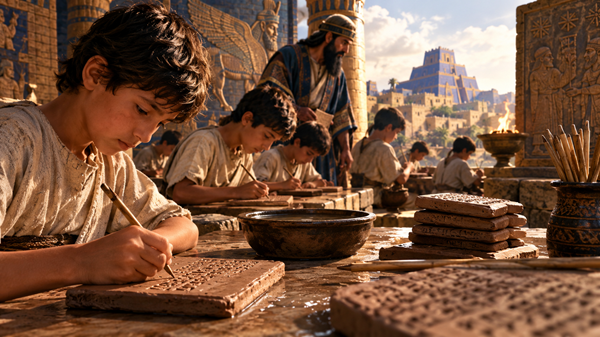
Picture a classroom. No paper. No screens. No holy book. Instead, a pile of wet clay. A reed stylus. Young boys from wealthy families scratch wedge-shaped signs into the tablets. They are learning to write. They are also learning religion. In ancient Babylonia, the two were inseparable.
Dr. Shana Zaia wanted to know exactly how that happened. She studied cuneiform school tablets. She works at Vrije Universiteit Amsterdam. Her research appears in the journal Iraq. She compared assignments from Babylon and Nippur. She traced how lessons changed as students advanced. The results reveal a learning system built on repetition. Therefore, religious knowledge was not a separate subject. It was woven into every lesson.
But what did that mean for a young student? How did a child memorize hundreds of gods while learning basic literacy? The answer lies on clay tablets.
Why Babylonian Students Learned About Their Gods Through Daily Copying
Students copied vocabulary lists. They copied hymns. They copied epic stories. Most importantly, they copied long lists of divine names. Each list included gods, their traits, and their sacred places. The repetition drilled these names into memory. It also taught reading. It taught grammar. It taught composition.
Moreover, this was not a separate religious curriculum. There was no class called “religion.” There was no single holy book. Instead, religious content lived inside every exercise. As Zaia observes, “there was no distinction between ‘secular’ and ‘religious’ education.”
Can you imagine learning math through prayers? Or reading through mythology? That was daily life in Babylonian schools. The gods were not reserved for temple hours. They appeared in spelling drills, in handwriting practice, in literary analysis. Consequently, every scribe graduated with deep religious knowledge.
How Babylonian Students Learned About Their Gods in a World Without the Bible
Many ancient cultures relied on one sacred text. Babylonia did not. The Bible did not exist. The Quran did not exist. Instead, belief rested on a huge library of tablets. Teachers chose from that library. They selected local traditions. They combined grammar with prayer. This made religion flexible. It also made religion deeply personal.
No central authority set a standard syllabus. Each city had its own temples. Each temple had its own gods. Therefore, education varied from place to place. Young scribes learned about the gods their community honored. They also learned the practical skills needed for politics, medicine, and administration.
Hundreds of deities filled the Mesopotamian pantheon. A scribe could not survive with only a handful of names. Kings demanded omens. Temples demanded rituals. People demanded prayers. All of this required specialized knowledge. So students memorized divine genealogies. They learned which god controlled which city. They learned which temple held which statue.
Without that knowledge, an official could not serve properly. A wrong prayer could anger a god. A wrong ritual could ruin a harvest. The stakes were enormous. As a result, schooling was both religious and practical at every level.
Where Babylonian Students Learned About Their Gods: Babylon Versus Nippur
Regional differences appear clearly in the syllabus. Northern schools centered on Babylon. They celebrated Marduk, the city’s patron god. Marduk’s deeds filled their exercises. Southern schools in Nippur ignored this material. They focused on Ninurta instead. Ninurta was a warrior god tied to Nippur’s identity.
This contrast shows how local politics shaped education. No king forced everyone to learn the same texts. Each temple or city had its own priorities. Therefore, students learned religion through a local lens. They also learned loyalty. A Nippur scribe would know Babylon’s gods, but he knew his own first.
The same still happens today. Your school teaches local history before national history. Your community shapes your worldview. Ancient Babylonia was no different.
Some schoolwork carried a dual purpose. Students prepared tablets containing exercises. Then they dedicated those tablets to deities at local temples. This act turned homework into worship. It connected the student to the divine. It also strengthened the bond between school and temple.
Why Babylonian Students Learned About Their Gods for Future Authority
Eventually, these students graduated. They became scribes, advisors, or temple specialists. Their deep religious knowledge gave them authority. They could interpret omens. They could adjust rituals. They could advise kings.
Zaia notes that specialists had considerable agency. Even when they acted on the king’s behalf, they shaped changes. This is a powerful insight. Religious education was not passive memorization. It was training for real influence. The student who copied hymns became the man who rewrote them. The tablet was a stepping stone to power.
A scribe with theological mastery could do more than write. He could decide which tradition mattered. He could choose which prayer to record. He could recommend a new temple celebration. He could even change a myth.
Who gets to change religion today? Priests, scholars, translators? In Babylonia, the answer was broad. A whole class of educated specialists carried that responsibility. Their authority came from years of clay-tablet exercises.
What a Babylonian School Day Taught Babylonian Students About Their Gods
Imagine waking before sunrise. Your father takes you to the temple school. You sit on a mat. A master hands you a tablet. It is wet and smooth. You copy signs from an older tablet. You repeat them under your breath. Mistakes can be erased with water. Good work gets praise. Slow work gets punishment.
Some texts mention students being beaten. Yes, discipline was harsh. But the best students earned respect. They could recite divine genealogies from memory. They could identify temples by their names. They could explain why a god mattered.
This practical knowledge made them valuable. It also made them powerful. A scribe who knew the gods could navigate any situation. He could draft prayers. He could record omens. He could manage temple finances. All because he had spent years copying names.
The process was not glamorous. Still, it transformed a boy into an expert. Every list, every hymn, every repeated sign built a foundation. On that foundation rested kingship, law, medicine, and worship.
The Lasting Question: Who Governed How Babylonian Students Learned About Their Gods?
Zaia’s study raises a fascinating question. Who actually controls religion? In ancient Babylonia, it was not a single priest. It was not a king. It was a network of educated specialists. Their training was local. Their authority was personal.
This might feel strange to modern readers. Many people today expect religion to be fixed. They expect one book and one set of rules. Babylonia offers a different model. Religious knowledge was alive. It changed with each school, city, and generation.
The clay tablets prove it. They show learning in action. They show students copying names, traits, and places. They also show a society that trusted specialists to reshape religion as needed.
Does that sound familiar? Think of modern lawyers, doctors, or scientists. They interpret knowledge for society. Ancient scribes did the same. Their tools were not code or lab equipment. They used a stylus and a lump of clay. Yet their impact was enormous.
So the next time you see a museum display of cuneiform tablets, pause. Those small, brown objects were once classroom exercises. They were homework. They were prayers. They were stepping stones to power. They reveal how Babylonian students learned about their gods in a way that shaped an entire civilization.
Source: What Did Babylonian Students Learn About Their Gods That We Don’t Know?
Arkeologlar 10.000 Yıllık Bu Tapınağın ‘Kafatası Kültüne’ Ait Olduğunu Düşünmüştü. Yanılmışlar!
Arkeologlar 10.000 Yıllık Bu Tapınağın ‘Kafatası Kültüne’ Ait Olduğunu Düşünmüştü. Yanılmışlar!
What Did Babylonian Students Learn About Their Gods That We Don’t Know?
Sources That Reveal How Babylonian Students Learned About Their Gods
- Zaia, S. “Religious Education in Babylonian Schools.” Iraq, British Institute for the Study of Iraq.
- Arnold, P. “Clay Tablets Reveal How Babylonian Students Learned About Their Gods.” Edited by Gaby Clark, fact-checked by Robert Egan.
- George, A. R. The Epic of Gilgamesh: The Babylonian Epic Poem and Other Texts. Penguin Classics, 1999.
What Did Babylonian Students Learn About Their Gods That We Don’t Know?