
What Are Dark Comets, and Could They Change Everything We Know About Water?
Exploring the Role of Dark Comets in Earth’s Ocean Origins
The oceans, vital for life on Earth, remain a mystery in terms of their origins. While scientists have speculated on various possibilities, one leading hypothesis suggests that water was delivered through impacts from space rocks such as comets and asteroids. A recent study sheds light on a new type of space object called “dark comets” that may have played a critical role in this process.
What Are Comets? Key Features of These Space Travelers
The solar system is abundant with small celestial bodies, including comets and asteroids. These remnants from the formation of planets are not just inert debris; they also transport critical materials such as ice and organic compounds throughout the solar system. This ability makes them prime candidates for delivering water and other essential elements to Earth during its formative years.
Comets are traditionally distinguished by their icy compositions, which sublimate when they approach the Sun, creating striking tails of gas and dust. This outgassing, caused by the Sun’s heat, generates a visible trail and contributes to a phenomenon known as nongravitational acceleration. This acceleration, driven by the recoil effect of the outgassed material, influences the motion of comets in ways beyond the gravitational pull of the Sun.
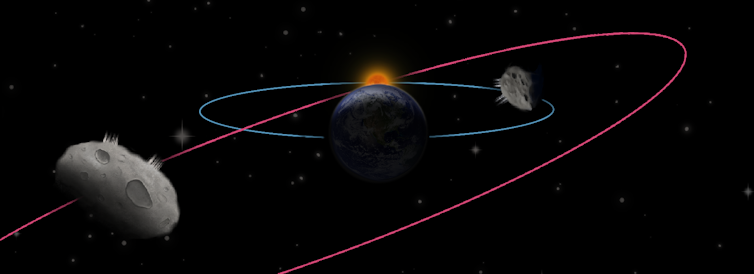
In contrast, asteroids are thought to lack significant ice and, consequently, do not exhibit cometary tails, making them resemble typical rocks in space.
Nongravitational Acceleration: The Rocket Effect in Comets
Outgassing not only creates cometary tails but also exerts a physical push on the comet’s surface. This “rocket effect” explains their nongravitational acceleration. Planetary scientists often measure this acceleration to differentiate comets from other celestial bodies, relying on the presence of their tails as a visual indicator of activity.
The Discovery of Dark Comets: A Mysterious New Class
Recent observations have identified a group of objects that combine characteristics of both comets and asteroids. Dubbed “dark comets,” these objects exhibit nongravitational accelerations similar to traditional comets. However, they lack the characteristic dusty tails that make comets visually distinctive. Essentially, dark comets appear asteroid-like but defy expectations based on their movement.
The enigmatic ’Oumuamua, the first interstellar object detected within our solar system, showcased similar traits. It lacked a visible tail but exhibited comet-like nongravitational acceleration. Since its discovery in 2017, researchers have identified 14 dark comets, including seven newly classified examples in a December 2024 study.
Two Populations of Dark Comets: Inner and Outer Variants
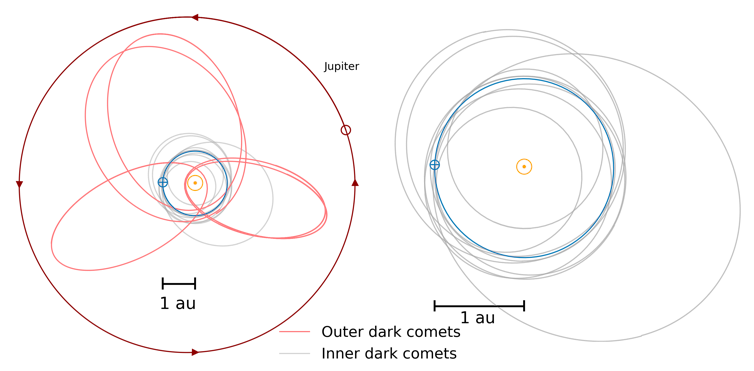
Dark comets can be categorized into two distinct groups:
Outer Dark Comets: These are larger, about a mile in diameter, and follow elliptical orbits farther from the Sun.
Inner Dark Comets: Smaller, approximately 1,000 feet in size, these comets occupy circular orbits closer to Earth.
Dark Comets and Earth’s Oceans: Could They Be the Source?
One of the most compelling questions about dark comets is whether they contributed to Earth’s oceans. The absence of visible tails does not necessarily mean these objects lack ice. They might still be outgassing water, albeit without producing detectable dust trails. If dark comets do harbor water, they could have been a significant source of Earth’s early water supply.
Future Discoveries and Scientific Opportunities
The exploration of dark comets is still in its infancy, with numerous opportunities for groundbreaking discoveries. The upcoming Vera C. Rubin Observatory, set to begin operations in 2025, promises to revolutionize the study of moving objects in the night sky. Equipped with the largest camera ever built, it will vastly improve the detection of dark comets and other elusive celestial bodies.
Existing telescopes, such as the Hubble Space Telescope and the James Webb Space Telescope, also hold potential for analyzing the surface characteristics of dark comets. Additionally, the Japanese space agency JAXA’s Hayabusa2 extended mission aims to study 1998 KY26, an inner dark comet, in 2031. This mission will provide unprecedented detail about these mysterious objects.
Unlocking the Secrets of Earth’s Water Origins
The identification of dark comets opens a new chapter in the quest to understand Earth’s oceans and the origins of life. These objects, masquerading as asteroids, may hold clues to the solar system’s history and the mechanisms that delivered water to our planet. As technology and observation capabilities advance, researchers are poised to uncover the secrets hidden within these enigmatic travelers of the cosmos.
Source: What Are Dark Comets, and Could They Change Everything We Know About Water?
Saturn’s Rings May Be Billions of Years Older Than They Seem
Saturn’s Rings May Be Billions of Years Older Than They Seem