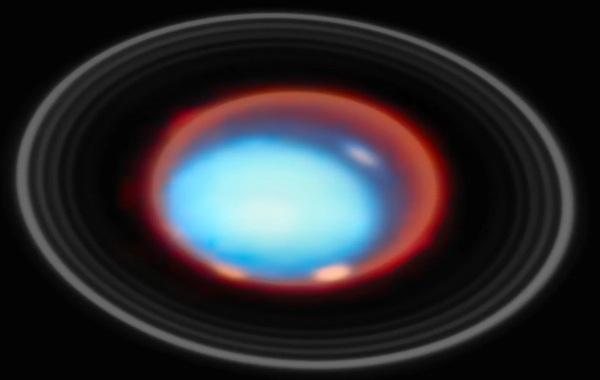
Webb Maps Uranus’ Upper Atmosphere and Finds a Magnetic Surprise
Forget what you thought you knew about the “boring” blue planet. The James Webb Space Telescope (JWST) has just delivered a groundbreaking 3D map of Uranus’s upper atmosphere, revealing a world of warped magnetic forces, glowing infrared auroras, and a cooling trend that defies expectations.
For decades, Uranus was seen as the quietest of the giants. But beneath its pale blue exterior lies a magnetic nightmare that has puzzled scientists since the Voyager 2 flyby in 1986. Now, using the ultra-sensitive NIRSpec instrument, an international team of researchers has watched the planet for a full 15-hour rotation, capturing the first-ever vertical profile of its ionosphere.
Mapping the 5,000-Kilometer High Frontier
The study, led by Paola Tiranti of Northumbria University, successfully mapped the temperature and ion density up to 5,000 kilometers above the planet’s cloud tops. This isn’t just a flat photo; it’s a detailed 3D structure that shows how energy moves through the planet’s layers.
The findings are as strange as the planet itself:
The Thermal Peak: Surprisingly, temperatures reach their highest levels between 3,000 and 4,000 kilometers—far above where most activity was expected.
Ion Hotspots: The highest concentration of charged particles (ions) was found much lower, at about 1,000 kilometers.
The Cooling Mystery: Webb confirmed that Uranus’s upper atmosphere is still cooling—a trend that began in the 1990s. With an average temperature of about 150°C (426 Kelvin), it is significantly colder than previous records suggested.
A Magnetic “Lopsided” Surprise
The most startling discovery involves Uranus’s magnetosphere, which is arguably the weirdest in the Solar System. Unlike Earth, where the magnetic field is roughly aligned with the axis of rotation, Uranus’s field is tilted at a staggering 60 degrees and offset from the planet’s center.
Webb’s high-resolution data revealed two bright auroral bands near the magnetic poles. However, between these glowing ribbons lies a “dark zone”—a region of reduced emissions and fewer ions. This gap is a direct footprint of how the planet’s “lopsided” magnetic field lines warp the flow of solar energy, creating a chaotic light show that sweeps across the planet’s mid-latitudes rather than staying at the poles.
Why This Matters: Beyond Our Solar System
Understanding the energy balance of an “ice giant” like Uranus isn’t just about our own backyard. Most of the exoplanets we discover orbiting other stars are similar in size and composition to Uranus and Neptune.
By cracking the code of how Uranus interacts with its magnetic environment, Webb is giving us a “master key” to understanding thousands of distant worlds across the galaxy. We are finally moving from seeing Uranus as a static ball of ice to a dynamic, ever-changing laboratory of extreme physics.
Source: SciTechDaily
A Miocene Cosmic Collision in Brazil — Why Did It Go Undetected for Millions of Years?
Webb Maps Uranus’ Upper Atmosphere and Finds a Magnetic Surprise