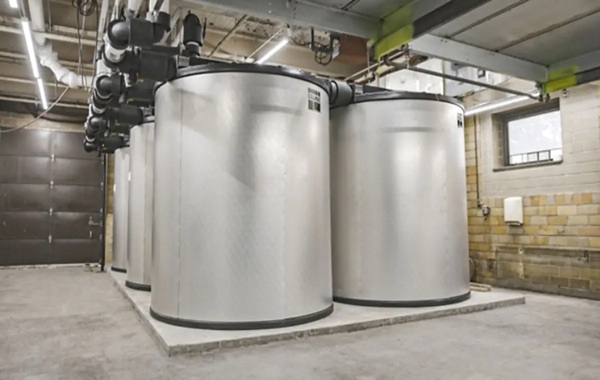
US scientists build efficient ice battery system to cut building energy bills
Ice has long been the go-to solution for keeping drinks cold in summer, but researchers are now pushing the idea much further.
Scientists at Texas A&M University are developing advanced “ice batteries” that can store and release thermal energy with far greater efficiency.
Their work could change how large buildings manage heating and cooling while easing stress on the power grid.
Dr. Patrick Shamberger, associate professor in the Department of Materials Science and Engineering, is leading research to improve the materials used in these systems. His team’s findings could improve how these systems work in real-world applications.
He explained that while ice battery technology has existed for years, its performance still depends heavily on the materials used. His research focuses on finding better solutions that make the systems efficient, stable, and long-lasting.
How ice batteries work
An ice battery operates on a simple idea. Water or other materials are frozen at night, when electricity demand is low and power is cheaper. During the day, the stored cold energy is released to cool buildings. This reduces strain on the grid during peak hours and lowers costs for consumers.
“The ice battery technology has been around for a while,” Shamberger said. “But there are problems on the material side that I’m interested in: what’s the right material at the right temperature? Can we make it reversible? Can we make it last for 30 years?”
Although these systems save energy by cutting daytime demand, they still require significant power at night. Large-scale versions can freeze nearly 500,000 pounds of ice every night.
This makes efficiency at the material level critical, since small improvements in storage and release can translate into large savings and more reliable performance.
Finding the right mix of materials
The research team is testing compounds such as salt hydrates. These are salts that naturally contain water molecules within their crystal structures. They can absorb and release thermal energy depending on the conditions.
By adjusting the chemical composition, the researchers aim to design materials that work at temperatures best suited for real-world cooling and heating systems.
“We’re putting it at a specific temperature so it’s compatible with a particular HVAC system integration approach,” the lead researcher explained.
This compatibility is important for buildings that use advanced HVAC systems or heat pumps, which can both heat and cool spaces. With better-tailored materials, an ice battery system could do more than just store cold—it could support flexible energy use across different building needs.
One of the main technical hurdles is “phase segregation.” In many salt hydrate systems, the material separates into solid and liquid phases with different densities and compositions. This separation reduces the reliability and efficiency of the system over repeated cycles.
The study digs into the thermodynamics of these changes, aiming to find compositions that avoid degradation. The ultimate goal is to create materials that can cycle reliably for decades without losing performance.
Building toward a cooler energy future
Beyond buildings, ice batteries could play a significant role in stabilizing the entire power grid. As more renewable energy sources like wind and solar come online, the grid is becoming more variable. Storing thermal energy at predictable times and releasing it when demand spikes offers a way to balance this variability.
“We don’t want to solve grid problems by building more power plants,” the researcher stated. “That’s a very costly solution, and they’d have to charge higher rates overall.”
Instead, systems like ice batteries can help reduce the need for new plants while keeping electricity more affordable. By freezing water when energy is cheap and using it when demand is high, building owners can cut costs and contribute to a more resilient grid.
Some systems are already in use. For example, the 30-story Eleven Madison building in New York City has installed an ice battery system to help manage its energy use. Shamberger hopes that with new material improvements, these systems can be deployed more widely and operate seamlessly with modern HVAC setups.
Source: Interesting Engineering
Chemists create new high-energy compound to fuel space flight
US scientists build efficient ice battery system to cut building energy bills