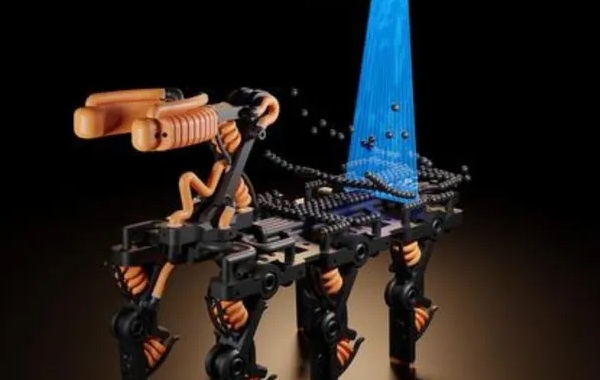
This new 3D printer has eyes, a brain, and prints perfectly
Researchers from MIT, the MIT spinout Inkbit, and ETH Zurich have unveiled a cutting-edge 3D inkjet printing system that expands the range of materials available and boasts an astonishing speed advantage over traditional systems.
Traditional systems use nozzles to deposit tiny drops of resin, smoothed over with a scraper or roller and then curved with UV light. However, this smoothing limits the materials that could be used since slow-curing resins could be squished or smeared.
The new technology addresses this concern by eliminating the need for mechanical smoothing components.
The heart of this innovation lies in the printer’s ability to utilize computer vision, transforming it into a contactless system. Unlike its predecessors, the new technology scans the 3D printing surface in real-time. It adjusts the amount of resin each nozzle deposits dynamically, ensuring that each area gets exactly the right amount of resin.
A leap forward in precision printing.
Building upon their previous success with the MultiFab 3D printer introduced in 2015, the researchers introduced a new technique named “vision-controlled jetting.”
This technique employs four high-frame-rate cameras and two lasers to scan the print surface continuously. The computer vision system then analyzes the data, creating a high-resolution depth map that guides the 16,000 nozzles in real-time.
“Our key insight here was to develop a machine vision system and completely active feedback loop,” said Wojciech Matusik, a professor of electrical engineering and computer science at MIT and co-author of the study, in a statement.
“This is almost like endowing a printer with a set of eyes and a brain, where the eyes observe what is being printed, and then the brain of the machine directs it as to what should be printed next.”
The absence of mechanical smoothing parts allows slow-curing materials such as thiol-based materials, where greater elasticity, durability, or longevity are desired over acrylates typically used in 3D printing. Even more impressive is the level of control achieved by this system, allowing for the precise printing of intricate structures using various materials.
The team demonstrated this capability by creating complex robotic devices, such as a tendon-driven robotic hand with soft fingers and load-bearing bones and a six-legged walking robot with airtight, smooth, and rigid materials interfaces.

Expanding material horizons.
Professor Wojciech Matusik emphasizes that this breakthrough is just the beginning, stating, “There is an amazing number of new types of materials you can add to this technology. This allows us to bring in whole new material families that couldn’t be used in 3D printing before.”
“Geometrically, it can print almost anything you want made of multiple materials,” said co-author Rober Katzschmann, assistant professor of robotics who leads the Soft Robotics Laboratory at ETH Zurich.
The researchers look to venture into printing with silicon materials, epoxies, and durable polymers, in addition to exploring applications in tissue engineering with hydrogels. The possibilities seem limitless, ranging from custom medical devices to semiconductor polishing pads and even more intricate robots.
Source: Interesting Engineering
This new 3D printer has eyes, a brain, and prints perfectly