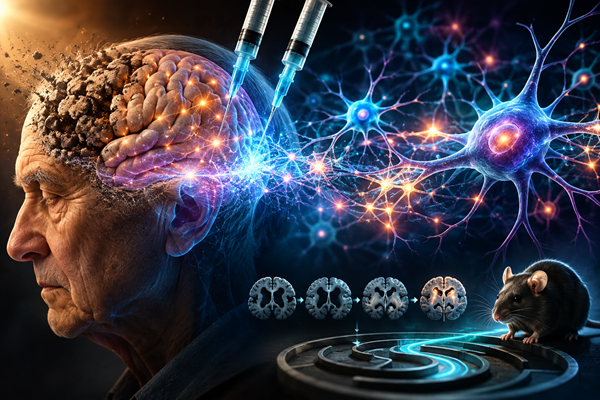
They fixed a broken brain with two injections. So why is your memory still at risk?
Could a single shot turn back the clock on Alzheimer’s disease? Most treatments only slow progression, but new research suggests reversal is possible. Scientists at the University of South Carolina have developed a technique called Nano-ERASER. After just two injections, mice with Alzheimer’s-like conditions regained memory and cognitive function. The study, published in Cell Biomaterials, offers a bold new path for neurodegenerative therapy.
Nano-ERASER: A Novel Approach to Reversing Alzheimer’s Damage
The adult brain rarely replaces lost neurons. That limitation makes Alzheimer’s particularly devastating. However, the new method targets a protein called PTBP1. By degrading PTBP1, the researchers triggered astrocytes—support cells in the brain—to transform into functional neurons.
“We saw these mice become smarter after two injections,” says Peisheng Xu, the study’s corresponding author. “Even after one injection, their behavior differed from untreated mice.”
The team built on a technique called Trim-Away, developed in two thousand seventeen. Trim-Away uses antibodies to degrade specific proteins inside mammalian cells. In two thousand twenty-three, Xu’s group created Nano-ERASER—an injectable polymer nanogel packed with nanoparticles. Initially, they tested it against breast cancer cells. Now, they have repurposed it for Alzheimer’s.
Targeting PTBP1 to Regrow Lost Neurons
Why PTBP1? This protein normally prevents astrocytes from becoming neurons. During early development, neuron generation is active. In mature brains, PTBP1 suppresses that process. Consequently, the team designed Nano-ERASER to reduce PTBP1 levels.
In laboratory-dish-cultured brain cells and three-dimensional organoids, the treatment worked. Levels of PTBP1 dropped. Astrocytes began converting into new neurons. A microelectrode array confirmed that these converted neurons fired signals like normal ones. They even formed connected networks. But would this translate to real symptom improvement?
From Brain Organoids to Mouse Models: Real Cognitive Gains
The next step involved mouse models of Alzheimer’s. These mice typically struggle with nest-building—a sad parallel to human patients who forget daily tasks. The team also tested memory using water maze experiments.
Over a few weeks, treated mice recovered nest-building ability. They completed mazes more efficiently. Moreover, biological markers improved. Inflammation decreased. Problematic protein buildup, such as amyloid plaques, lessened inside their brains.
“The new neurons can become mature and survive,” Xu explains. “We confirmed much higher neuron density in the brains of treated mice.”
Could This Work for Humans? Questions Remain
Exciting as these results are, they come with caution. Earlier research by other teams showed that reducing PTBP1 regenerated neurons in Parkinson’s disease mouse models. However, later studies failed to replicate those findings. This new work supports the original claims, but the gap between mice and humans remains wide.
What obstacles lie ahead? For one, the human brain is far more complex. The immune response to Nano-ERASER must be evaluated. Long-term safety and efficacy need testing. The team plans to test the technique over longer periods and in primates before considering human trials.
“If we can advance it to the clinic, then we can have hope for patients with Alzheimer’s disease,” Xu says.
A Deeper Look at the Mechanism: How Nano-ERASER Works
The nanogel delivery system is key. It contains antibodies that enter cells and bind to PTBP1. Once bound, the cellular machinery degrades the protein. This process is precise and temporary. After the protein is removed, astrocytes switch fate. They stop supporting neurons and start becoming them.
Why does this matter? Because astrocytes are abundant in the brain. They outnumber neurons. If even a fraction convert, the impact could be substantial. The study showed higher neuron density in treated mice. That suggests the conversion is efficient enough to restore lost circuits.
Furthermore, the reduction in inflammation and protein buildup indicates that new neurons help clear pathological hallmarks. This dual effect—regeneration and cleanup—makes Nano-ERASER particularly promising.
What This Means for Neurodegenerative Diseases
Alzheimer’s is not the only condition that might benefit. Parkinson’s, Huntington’s, and even stroke could theoretically be targeted. The ability to regenerate neurons opens doors for many disorders where cell death is central.
However, each disease has unique pathology. The timing of treatment, the brain region involved, and the type of neurons needed all vary. For Alzheimer’s, the hippocampus and cortex are primary targets. The study focused on those areas. For Parkinson’s, the substantia nigra would be the target.
The next big question: Can we control exactly which astrocytes convert? Too many new neurons in the wrong place could cause problems. The researchers believe the system is self-regulating, but more work is needed.
Source: They fixed a broken brain with two injections. So why is your memory still at risk?
Japanese scientists use tiny silver particles to make DNA assembly up to 5x more efficient
Japanese scientists use tiny silver particles to make DNA assembly up to 5x more efficient
They fixed a broken brain with two injections. So why is your memory still at risk?