The Motorways Of Neurons İn The Brain: Can Mapping 150 Million Synapses Of Blood Vessels On Nanoscale Brain Maps Decode Human Consciousness?
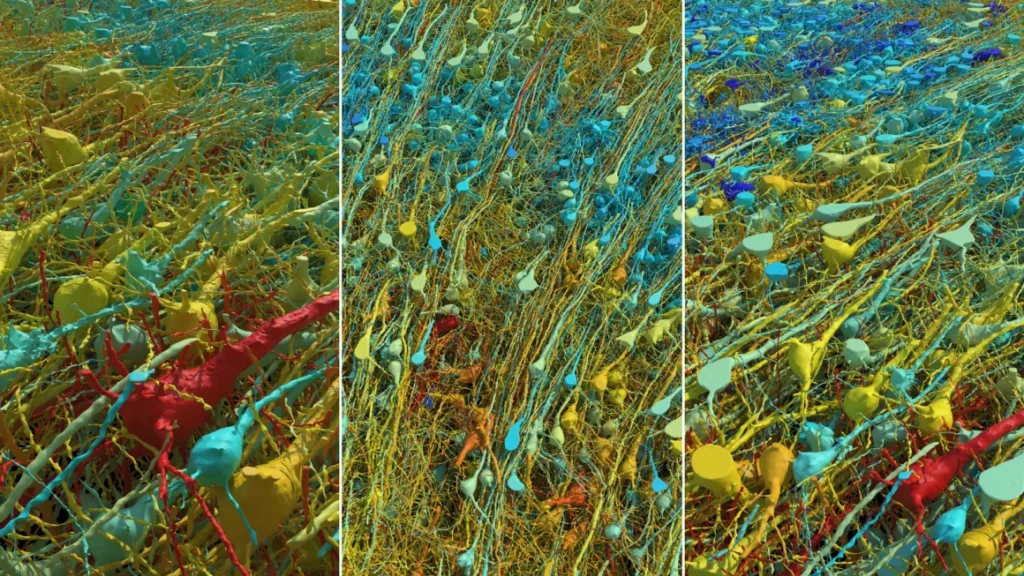
Ten years ago, Dr. Jeff Lichtman, professor of molecular and cellular biology at Harvard University, received a tiny but revolutionary 1 mm³ brain sample. This specimen, extracted during standard epilepsy surgery, contained 57 000 cells, 230 mm of blood vessels, and 150 million synapses. “It was less than a grain of rice, but we began to cut it and look at it, and it was really beautiful,” Lichtman recalls. However, the dataset quickly ballooned to 1 400 terabytes—about the equivalent of over 1 billion books—demanding novel solutions for storage and analysis.
High-Resolution Brain Imaging Techniques and Synaptic Connectome Reconstruction
To reveal the brain’s microarchitecture, Lichtman’s team employed cutting-edge imaging and tissue processing. They cut the sample into ultrathin 30 nm sections using a diamond-edged knife, embedded each slice in resin, and stained them with heavy metals to enhance contrast for electron microscopy. Capturing thousands of overlapping micrographs and aligning them in three dimensions created an unprecedented view of human cortical tissue at synaptic resolution. This high-resolution brain imaging approach laid the foundation for mapping the human connectome at the nanoscale.
Tackling the Data Deluge: AI-Powered Neuroinformatics Solutions
Faced with 300 million separate images and 150 million synaptic connections, Lichtman reached out to Google’s neuroinformatics team. Viren Jain, a senior research scientist, brought expertise from mapping the fruit fly brain. Together, the Harvard–Google collaboration harnessed advanced AI algorithms and cloud computing to process, segment, and colorize the enormous dataset. These tools accelerated neuron tracing, synapse detection, and vascular mapping, demonstrating how machine learning can transform high-resolution brain mapping.
Surprising Discoveries in Human Neuroconnectivity
The connectome dataset yielded unexpected findings. Neuron pairs often formed more than 50 synapses—akin to two houses linked by dozens of phone lines. What functional advantages might such dense connectivity provide? This question remains unanswered, but its implications for signal integration and circuit robustness could redefine our understanding of human neuroconnectivity. Transitioning from animal models to human tissue offers unparalleled insights into the complexity of our own brains.
Implications for Neurological Disorders and Psychiatric Diseases
What does a detailed human brain map mean for medicine? By comparing healthy and disordered connectomes, researchers hope to pinpoint structural differences underlying conditions such as autism spectrum disorder, schizophrenia, and epilepsy. Active investigation into synaptic patterns may reveal biomarkers for early diagnosis and targets for precision therapies. Moreover, interrogating this dataset could uncover the architectural principles that support learning, memory, and behavior.
Democratizing Access: Online Sharing and Collaborative Discovery
Recognizing that hidden gems may lie buried in petabytes of data, the team has made the entire connectome publicly accessible online. This open-science approach invites neuroscientists worldwide to explore rare features, generate new hypotheses, and contribute to a collective understanding of brain architecture. Who will discover the next breakthrough hidden within the dataset?
Scaling Up: From Human Samples to Mammalian and Whole-Brain Connectomes
Building on this milestone, the collaboration aims to map an entire mouse brain over the next five-year proof-of-principle, requiring between 500 and 1 000 times more data—an exabyte-scale challenge. Ultimately, charting a full human brain connectome would entail a zettabyte of information, rivaling global internet traffic. How will neuroscience overcome the storage, computation, and ethical hurdles to achieve this vision? Addressing these questions will catalyze a new era of connectomics.
Expert Perspectives: Advancing the Field of Human Connectomics
Neuroscientists outside the project have hailed the work as a watershed moment. Professor Michael Bienkowski (USC Keck School of Medicine) emphasizes its critical role in moving beyond animal extrapolations to reveal human-specific neural architectures. Professor Andreas Tolias (Stanford University) highlights the computational implications of rare multi-synaptic axons. Distinguished Professor Olaf Sporns (Indiana University) underscores the importance of mapping the human connectome for understanding memory, thought, and behavior. Their insights underscore how this high-resolution human brain map will shape future explorations.
Conclusion: Toward a New Frontier in Brain Research
The Google–Harvard human brain map represents a monumental leap in neuroscience, offering a detailed blueprint of synaptic wiring in human cortex. By combining innovative imaging, AI-driven analysis, and open data sharing, the project sets the stage for transformative discoveries in brain function and disease. As researchers worldwide delve into this rich connectome, the quest to understand the human brain enters a promising new chapter. What will the next decade of connectomics reveal?
Source: The Motorways Of Neurons İn The Brain: Can Mapping 150 Million Synapses Of Blood Vessels On Nanoscale Brain Maps Decode Human Consciousness?
US baby receives first-ever customized CRISPR treatment for genetic disease
US baby receives first-ever customized CRISPR treatment for genetic disease
The Motorways Of Neurons İn The Brain: Can Mapping 150 Million Synapses Of Blood Vessels On Nanoscale Brain Maps Decode Human Consciousness?