The Brains Of People Born Blind Have A Unique Plasticity
There is a common myth that we use our brains at 10%, and only certain brilliant people can use their brains more efficiently.
Scientists have repeatedly disproved this myth: there are no regions in the brain that do not work. But they work differently in different people. Observations of the visual cortex in blind people have confirmed this.
Neurobiologists at Georgetown University have shown that the visual cortex in people born blind is not idle, but actively working.
It solves many tasks that in a normal person solve quite other regions of the brain. Scientists have shown that the neural patterns of the visual cortex in blind people are never the same, they are unique, but they do not change over time. The work is published in the journal PNAS.
The findings not only provide a deeper understanding of how the brain works, but will help trigger personalized strategies to rehabilitate and even restore vision.
For decades, scientists have known that the visual cortex in people born blind responds to a variety of stimuli. These include touch, smell, localization of sound in space, memory and response to speech.
But it was unclear what still links such different tasks, and why the visual cortex does not specialize in humans the way other areas of the brain do. The answer turned out to be simple and unexpected.
“We don’t see this level of variation in the connectivity of visual cortex neurons in people who can see – the visual cortex network is usually pretty constant and roughly the same across people,” says paper co-author Ella Stream-Amit.
The neuroscientist says, “The pattern of connections in people born blind varies so much from person to person, and is so individualized, like a fingerprint, and so stable over time, that you can identify a particular person from the pattern of connections.”
The formation of the system of connections in the visual cortex of a blind person does not depend on the direct task that this cortex has to solve: it does not process the visual signal, it simply does not exist.
Therefore, remaining free, it takes up any work that needs to be solved right now. And is trained to do this work. And since this work is “random” and different for different people, neural patterns are formed differently. But once formed, the visual cortex is not retrained. Its patterns remain constant.
The gaze of a blind person

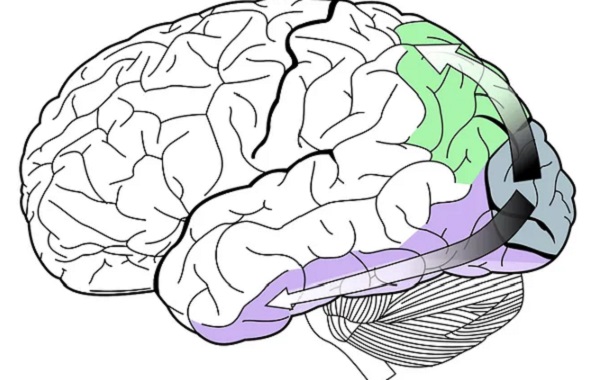
The analysis showed that extensive cortical regions, including the ventral and dorsal visual pathways, as well as the dorsolateral and ventrolateral prefrontal cortex, had different V1-FC patterns in different blind people.
The study included a small sample of people born blind who underwent periodic functional MRI scans for two years. The researchers used a neuroimaging technique to analyze neural connections throughout the brain.
“The visual cortex in people born blind showed remarkable stability in its connectivity patterns over time,” says paper co-author Leni Amaral.
“Our study showed that these patterns did not change significantly depending on the task at hand – whether participants were localizing sounds, identifying shapes, or simply resting. But these patterns were unique to each individual and remained stable over the two-year study period.”
Stream-Amit says this shows how the brain develops. “If a person grew up without vision the brain is given remarkable freedom to develop and takes advantage of it to develop unique plasticity.”
The researchers argue that understanding the individual connections of a particular person’s visual cortex is important for accurately tailoring rehabilitation and vision restoration solutions: there is no single prescription; each solution must be based on the individual pattern of visual cortex connections.
Source: The Brains Of People Born Blind Have A Unique Plasticity