Scientists Discovered Ancient Families Traveling Hundreds of Kilometers Before the Inca Empire… But What Were They Escaping?
For decades, historians believed that large-scale movement across the Peruvian Pacific coast only intensified after the rise of the powerful Inca Empire. However, a groundbreaking genetic study is now challenging that assumption in dramatic fashion. What if the coastlines of ancient Peru were already connected by vast human networks centuries earlier? What if migration, marriage, trade, and cultural exchange had already woven together distant societies long before imperial expansion?
A new international study published in Nature Communications has revealed astonishing evidence that ancient coastal populations in Peru traveled extraordinary distances, maintained deep kinship networks, and preserved cultural traditions over generations. Even more fascinating, these communities remained socially connected while still protecting distinct identities. The discovery paints a picture of a far more dynamic and interconnected ancient Andes than researchers once imagined.
Could this force historians to rethink the origins of social complexity in South America? And how many hidden migration stories are still buried beneath the sands of Peru?
Ancient DNA Migration Evidence Reveals Long-Distance Coastal Networks in Peru
The study focused on the Chincha Valley, located along Peru’s southern coast. Researchers analyzed ancient DNA, archaeological evidence, and radiocarbon dating from the remains of twenty-one individuals recovered from burial sites in the region. What they discovered was extraordinary.
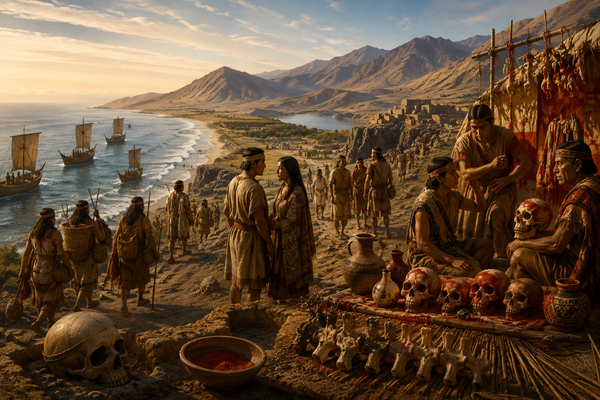
The genetic data revealed that migrants had traveled from Peru’s northern coast to the Chincha Valley by at least the thirteenth century, centuries before the expansion of the Inca Empire. These people journeyed more than seven hundred kilometers along the Pacific coastline. Such distances would have required knowledge of maritime routes, environmental conditions, and regional alliances.
Even more remarkable, the earliest migrants showed almost no evidence of mixing with local populations when they first arrived. This suggests they may have migrated as tightly connected communities rather than isolated individuals. Why would entire groups relocate so far from their homeland? Were they escaping conflict, searching for resources, or following expanding trade routes?
Researchers believe several forces may have triggered these movements. Climate instability likely played a role. Meanwhile, the expansion of powerful northern states such as the Chimú Empire may have pushed communities southward. Access to valuable coastal resources, including seabird guano used for agriculture, may also have attracted migrants toward new territories.
Yet despite these possibilities, many questions remain unanswered. What kind of political systems coordinated such migrations? How dangerous were these journeys? And how many generations did it take for newcomers to establish themselves in unfamiliar lands?
Ancient Marriage Networks and Genetic Mixing Along Peru’s Pacific Coast
Although the first migrants remained genetically isolated, later generations began to intermarry with neighboring groups from central and southern coastal regions. Over time, the Chincha Valley became a crossroads of ancestry and culture.
This finding changes how archaeologists understand pre-Inca societies. Rather than isolated settlements divided by geography, coastal communities appear to have formed extensive social webs stretching across large portions of Peru. Families maintained relationships over vast distances, creating networks of marriage and exchange that endured for centuries.
Dr. Jacob Bongers, a digital archaeologist associated with the University of Sydney and the Australian Museum Research Institute, explained that the study reveals “close-knit and far-reaching social networks” among pre-Inca populations.
The discoveries also uncovered evidence of endogamy, or close-kin unions, within one burial group. Genetic data showed that some individuals buried together were closely related biologically. According to researchers, these unions may not have been accidental. Instead, they could have represented deliberate social strategies designed to preserve resources, territory, and power within a kinship group.
Assistant Professor Jordan Dalton from the State University of New York at Oswego suggested these individuals likely belonged to an ayllu, a traditional Andean kin-based social organization. In Andean societies, ayllus often controlled shared land, labor, and ancestry. Maintaining strong blood ties may have helped preserve authority and economic stability.
However, this raises another intriguing question. Did these communities see family not simply as biology, but as a political institution essential for survival? If so, how different were ancient Andean concepts of identity from modern ideas of nation and ethnicity?
Ancient Cultural Traditions Survived Centuries of Migration and Intermarriage
One of the most fascinating aspects of the study involves cultural continuity. Even after generations of migration and intermarriage, northern coastal traditions remained deeply visible in the Chincha Valley population.
Researchers observed cranial modification among several individuals. This practice involved shaping the skull during infancy using bindings and boards. While shocking to modern eyes, cranial modification carried powerful symbolic meaning in many ancient societies. It often signaled identity, social status, or regional affiliation.
The study also documented postmortem rituals involving the application of red pigment to skulls. Additionally, archaeologists found human vertebrae threaded onto reed sticks, a practice connected to mortuary traditions along Peru’s northern coast.
These rituals demonstrate that migrants preserved strong cultural memories even after relocating hundreds of kilometers away. Why were these traditions so important that communities maintained them for generations? Did they help migrants preserve a sense of belonging in unfamiliar territory? Or were they visible markers used to distinguish insiders from outsiders?
Cultural identity clearly mattered deeply to these ancient peoples. Despite living among diverse populations, they continued to express who they were through ritual, body modification, and funerary practices.
This discovery challenges older assumptions that migration automatically erased cultural boundaries. Instead, the evidence suggests something far more complex: ancient societies could integrate biologically while remaining culturally distinct.
Ancient DNA Research Is Transforming the History of Pre-Inca Civilizations
The implications of this research extend far beyond Peru. Across the ancient world, historians have often underestimated the mobility of premodern societies. However, ancient DNA research is now rewriting that narrative at astonishing speed.
For years, many scholars assumed large-scale interaction required centralized empires and advanced state systems. Yet the Chincha Valley evidence suggests complex regional networks already existed long before imperial domination by the Inca Empire.
This changes how scientists interpret trade, diplomacy, and cultural transmission throughout the ancient Andes. Coastal societies were not passive populations waiting to be unified by imperial power. Instead, they were already deeply connected through migration, marriage alliances, ritual practices, and economic exchange.
The research also demonstrates the growing importance of ancient DNA science in archaeology. By combining genetic evidence with radiocarbon dating and cultural analysis, scientists can now reconstruct hidden chapters of human history with unprecedented detail.
Still, every discovery creates new mysteries.
How many other ancient migrations remain invisible in the archaeological record? Could similar networks have stretched across larger portions of South America? And if communities moved so extensively before the Inca period, how much of human history has been misunderstood simply because ancient mobility left few written records?
Did Ancient Peru Have a Hidden Coastal Civilization Network Before the Inca Empire?
The emerging picture is both breathtaking and deeply human. Long before imperial armies marched across the Andes, families traveled immense distances along Peru’s coastline. They carried traditions, rituals, identities, and genetic lineages with them. They formed alliances through marriage. They adapted to changing climates and shifting political landscapes. Yet they also fought to preserve who they were.
The study reveals a world that was already connected centuries before historians once believed possible. Ancient Peru was not a collection of isolated settlements separated by geography and time. Instead, it may have been part of an evolving network of migration corridors, cultural identities, and kinship systems stretching across the Pacific coast.
And perhaps the most haunting question remains unanswered.
If ancient DNA can uncover forgotten human journeys after hundreds of years beneath the earth… what other lost stories are still waiting to emerge from the silent graves of the ancient Andes?
Source: Scientists Discovered Ancient Families Traveling Hundreds of Kilometers Before the Inca Empire… But What Were They Escaping?
Scientists Discovered Ancient Families Traveling Hundreds of Kilometers Before the Inca Empire… But What Were They Escaping?
Sources
Nature Communications
University of Sydney Research News
Australian Museum Research Institute
State University of New York at Oswego
Scientists Discovered Ancient Families Traveling Hundreds of Kilometers Before the Inca Empire… But What Were They Escaping?