Scientists create a hexagonal diamond that could be even harder than the real thing
To misquote a famous song, “Diamonds are industry’s best friend.” Cubic diamond is the hardest mineral on Earth and is used in everything from precision cutting tools to high-performance semiconductors as well as expensive jewelry. But there is a rare and potentially tougher form called hexagonal diamond (HD), which has long been the subject of theories and debate over its actual existence. But now researchers from China claim to have created this elusive form of carbon in the lab.
Hexagonal diamond (also known as lonsdaleite) is usually found at sites of meteorite impacts. But because the quantities are so small and mixed with minerals, some scientists doubted it was a distinct material. In a paper published in the journal Nature, researchers describe how they made a bulk piece of pure HD using extreme pressure and heat.
Making a new kind of diamond
Their starting material was highly oriented graphite, which is a highly ordered form of graphite similar to the carbon found in pencils. They placed it between anvils made of tungsten carbide and applied 20 gigapascals of pressure (around 200,000 times the pressure of our atmosphere) at temperatures between 1,300–1,900 °C. The material was squeezed along its c-axis, which means the pressure came from the top of the stacked carbon layers, not the sides. The result, the team says, was a millimeter-sized piece of pure HD.
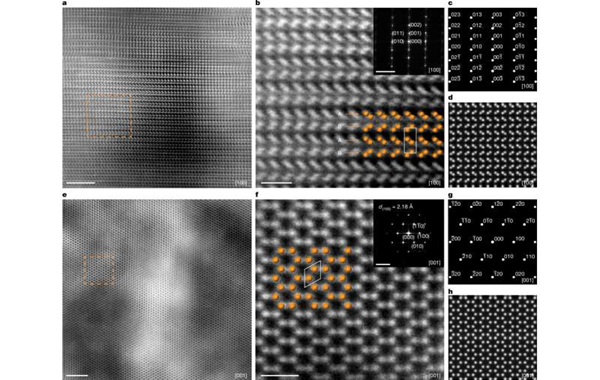
To confirm that they really had synthesized HD, the team used X-ray diffraction. This technique bounces X-rays off atoms to map their positions and proved the sample was structurally pure. They also used atomic-resolution electron microscopy to clearly see the unique hexagonal stacking patterns of the carbon atoms.
Harder than natural diamonds
The scientists also tested the mechanical properties of their HD with the Vickers hardness test. They pressed a diamond tip into the sample to assess how much it resisted scratching or denting. This showed that it had a hardness of around 114 gigapascals. Many natural diamonds are typically 110 gigapascals, meaning the team may have created a substance slightly harder than natural diamonds.
“These findings resolve the long-standing controversy on the existence of HD as a discrete carbon phase and provide new insight into the graphite-to-diamond phase transition, paving the way for future research and practical use of HD in advanced technological applications,” commented the study authors in their paper.
If the work holds up, this new material could find use in a range of applications, from cutting tools and abrasives to high-performance electronics.
Source: phys.org
Edison’s Unintended Ghost: The 19th-Century Genesis of a 21st-Century Miracle
Scientists create a hexagonal diamond that could be even harder than the real thing