Scientists Can Now Read Your Body Clock From a Single Hair
A new hair-based test offers a surprisingly simple way to peer into the body’s internal clock.
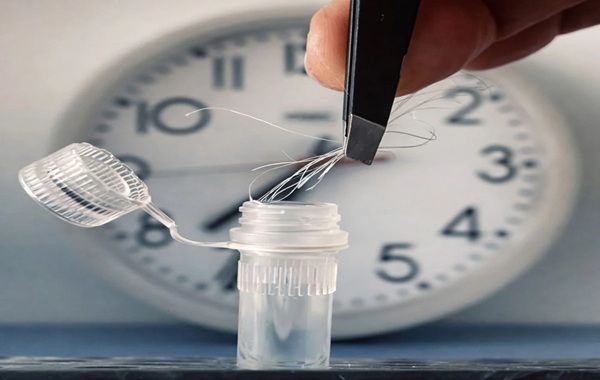
A team at Charité – Universitätsmedizin Berlin has developed a new way to read the body’s internal clock using something surprisingly simple: a few strands of hair. The test identifies a person’s chronotype, or natural daily rhythm, and could help shape a new era of circadian medicine – care that is timed to match how the body actually functions throughout the day.
In a study involving around 4,000 participants, the researchers found that biological timing differs slightly between men and women and is more strongly shaped by lifestyle than previously believed. The results were published in the journal PNAS.
The Body’s Clock and Its Medical Importance
Most people notice their internal clock only when it is disrupted, such as after daylight saving time shifts or long-distance travel. That groggy, out-of-sync feeling is a sign that the body’s roughly 24-hour cycle is misaligned with external time.
But this internal rhythm does far more than regulate sleep. It influences hormone release, digestion, body temperature, and even how drugs are processed. In some cases, timing can change how well a treatment works.
“For example, studies show that the time of day at which certain cancer immunotherapies are administered can have a substantial impact on their effectiveness,” says Prof. Achim Kramer, head of the Division of Chronobiology at the Department of Anesthesiology and Intensive Care Medicine at Charité. “This is likely because – like most of our body’s organs – the immune system also follows a roughly 24-hour rhythm. And that rhythm varies from person to person.”
Circadian medicine aims to factor this personal timing into diagnosis and treatment. Researchers at Charité and the Universität zu Lübeck, led by Kramer, are working together in a Collaborative Research Center to move this field forward. A key challenge has been finding simple ways to measure an individual’s biological rhythm.
So far, that has not been easy. “The standard method to date measures the ‘dark hormone’ melatonin in saliva under dim light over several hours,” Kramer explains. “This can only be done in a laboratory and is too cumbersome for widespread use.”
17 genes in hair roots indicate the internal time
Kramer’s team developed a more practical alternative using hair samples, specifically cells from a small number of hair follicles. “In these cells, we measure the activity of 17 genes that are part of the molecular clock or are controlled by it,” he says. “Using machine learning, this pattern can be used to calculate at what point in the daily rhythm the person is currently at. A single sample is sufficient for this.”
In the study, the test measured circadian rhythm nearly as accurately as the standard lab method. “Hair analysis is, however, far easier to perform, which is what makes the method so valuable,” Kramer notes.
The approach has already been tested on a large scale. More than 4,000 participants collected hair samples at home and submitted them for analysis, showing that the method can be widely used.
Genetic predisposition, age, gender, and lifestyle shape the internal clock
The results confirmed patterns previously suggested by surveys, now supported by biological data. Age plays a role, with people in their mid-20s tending to fall asleep about an hour later than those over 50.
Women in the study also showed slightly earlier internal timing than men. However, the difference was only about six minutes, smaller than earlier estimates based on questionnaires. “We nevertheless assume that gender affects the internal clock, as sex hormones have also been shown to influence biological rhythms in other studies,” Kramer says.
Chronotype is shaped by several factors. “Genetic predisposition, age, gender, and lifestyle all play a role,” he explains. “And that’s why individual people’s internal clocks can differ significantly.”
One unexpected finding was how strongly lifestyle affects timing. The data showed that working individuals tend to have internal clocks that run about half an hour earlier than those who are not employed.
Next step: circadian medicine
The research team is now working to standardize the test for routine lab use. This could make it easier to apply in clinical settings, such as for sleep counseling or diagnosing irregular sleep patterns. Circadian medicine is becoming more practical.
The test may also help determine whether treatments timed to a person’s internal clock are more effective or cause fewer side effects than those given without considering timing.
Source: SciTechDaily
Scientists map the brain’s hidden wiring using RNA barcodes in major breakthrough
Scientists Can Now Read Your Body Clock From a Single Hair