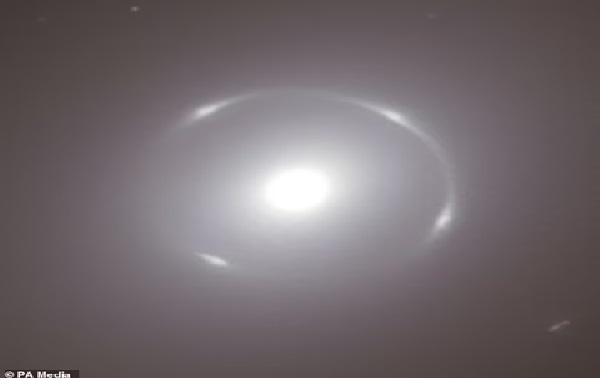
Scientists are AMAZED to discover a stunning ‘Einstein Ring’ hiding in our cosmic backyard
Space rarely displays anything as near-perfect as this ‘jaw-dropping’ ring of light.
But astronomers have found an incredibly rare complete ‘Einstein ring’ – predicted by Albert Einstein more than 100 years ago.
The glimmering circle is formed by light from a faraway galaxy, hitting a second galaxy closer to Earth, called NGC 6505.
There are only a handful of complete Einstein rings which have ever been seen from Earth, because two galaxies and our own planet have to align perfectly to show the full circle.
The image, revealed by the European Space Agency’s Euclid space telescope, shows a phenomenon famously predicted by Albert Einstein in a letter from 1915, where he described how the gravitational field from a massive object like a galaxy could warp the fabric of space, so that light travelling towards it has to follow a curved path.
This is called ‘gravitational lensing’, and an Einstein ring is one of the most dramatic examples of it.
Stephen Serjeant, professor of astronomy at the Open University, who has co-authored a research paper on the Einstein ring, said: ‘This Einstein ring is jaw-dropping, it is so perfect it looks like a simulation.
‘It is pretty incredible that the galaxy NGC 6505 was discovered in 1884, but we have only just found this thrilling phenomenon which was staring us in the face for more than a century, waiting to be seen.
‘It is such a perfect circle because of the alignment of the galaxies, and it’s extremely bright and very sharp, with little fuzz around the image.
‘This ring and other galaxies which warp light will help us to gain valuable insights about dark matter and dark energy in space.’
Most gravitational lensing has a very small effect, with one ray of light from a distant galaxy producing just a visible pinprick in the night sky.
But when the gravitational pull is strong enough, and the two galaxies involved line up properly together, multiple rays of light get through and appear as curved lines.
These curved lines join up to form a ring.
The newly discovered Einstein ring is a showstopper because it is so rare, so unusually bright, unusually close to us, and photographed in rare high-resolution, which was not possible before the current generation of high-tech telescopes.
But astronomers are also excited about the ring, and other examples of gravitational lensing in the universe, because they will help to better understand the ‘dark universe’.
This dark universe is the mysterious 95 per cent of space which is not planets, stars, asteroids, dust or gas.

It is made up of dark matter – an unknown material which has a gravitational pull – and dark energy – an unknown force which is speeding up the rate at which the universe is expanding.
The newly discovered Einstein ring brings more confirmation that much of a typical galaxy – in this case the galaxy NGC 6505 – is made up of dark matter, based on the gravitational pull needed to warp light into the ring shape.
This information about dark matter will help the floating space telescope Euclid in its mission to create a 3D map of more than a third of the sky.
Gravitational lensing is also important for understanding how the universe – which has been expanding since the Big Bang – is expanding faster than expected.
Dark energy is believed to be the force speeding up the expansion, and pulling galaxies away from each other.
The distance between the two galaxies which produced the Einstein ring helps to understand the effect of dark energy.
And that matters because, many billions of years in the future, dark energy is the force which could cause the ‘Big Rip’ where the universe tears itself apart.
The light forming the Einstein ring comes from a galaxy an incredible 4.42 billion light-years away, which does not yet have a name because it had never been seen before.
The gravitational lensing was the phenomenon which allowed it to be discovered – when light from it hit NGC 6505 and was distorted into a ring.
The lensing, named because it is similar to the lens in an eye, magnified the light from the distant galaxy, acting like a microscope, so it could be seen and investigated.
The light, which appears in the shape of the distant galaxy, should form an oval, but the gravitational pull of NGC 6505 flattens it into a ring.
That’s because the gravity bends the fabric of space, called ‘spacetime’ by Einstein, so the light, which normally travels in a straight line, gets deflected.
NGC 6505 is around 590 million light-years from Earth, which is just a stone’s throw away in cosmic terms.
Euclid blasted off on its six-year mission to explore the dark Universe on 1 July 2023.
Before the spacecraft could begin its mission, there was a testing phase to make sure it worked properly, which produced a set of images in September 2023.
This first revealed the Einstein ring, which had only a one in 2,000 chance of being seen, and was spotted by Euclid Archive Scientist Bruno Altieri.
He said: ‘Even from that first observation, I could see it, but after Euclid made more observations of the area, we could see a perfect Einstein ring.
‘For me, with a lifelong interest in gravitational lensing, that was amazing.’
Euclid will examine galaxies up to 10,000 billion light years away.
A light year is around six trillion miles.
The telescope is expected to find around 100,000 ‘strong’ gravitational lenses, which form arcs or circles of light.
Euclid’s main job is searching for the more subtle effects of weak gravitational lensing, where background galaxies appear only mildly stretched, to gradually create the most extensive 3D map of the Universe yet.
Source: daily mail
Is Europa the Key to Finding Life Beyond Earth?
Scientists are AMAZED to discover a stunning ‘Einstein Ring’ hiding in our cosmic backyard/Scientists are AMAZED to discover a stunning ‘Einstein Ring’ hiding in our cosmic backyard