Science shocker: Light can vaporize water without heat, says MIT study
For millennia, humans have observed and utilized evaporation, the process by which water transforms from a liquid to a vapor. From witnessing the sun’s dry morning fog to extracting salt from evaporated seawater, this fundamental process has been a constant presence. However, a recent groundbreaking discovery by MIT researchers challenges our traditional understanding of evaporation. Their findings reveal that light, not just heat, plays a crucial role in driving this phenomenon.
Light-triggered evaporation
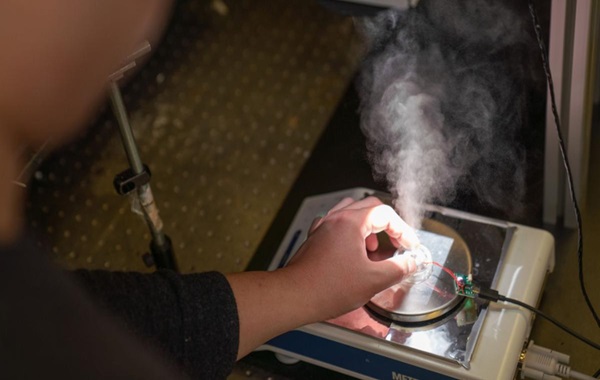
This research, published in the journal PNAS, sheds light on a previously unknown mechanism – the photomolecular effect. The MIT team, led by Professor Gang Chen, demonstrated that light striking the water’s surface can directly liberate water molecules, causing them to evaporate into the air. This effect occurs independently of heat, upending our long-held belief that thermal energy is the sole driver of evaporation.
“I think this has a lot of applications,” Chen says. “We’re exploring all these different directions. And of course, it also affects the basic science, like the effects of clouds on climate, because clouds are the most uncertain aspect of climate models.”
The researchers meticulously conducted a series of experiments to validate this surprising phenomenon. They employed fourteen different tests and measurements, observing consistent evidence of light-induced evaporation across various conditions—notably, a key indicator involved measuring the air temperature above the water during evaporation under visible light. Instead of rising, the temperature plateaued, demonstrating that thermal energy wasn’t the cause.

Furthermore, the team observed variations in the evaporation rate based on the light’s angle, color, and polarization. These characteristics should be independent of heat-driven evaporation, yet the researchers documented these dependencies. For instance, the effect peaked at a 45-degree angle with green light, even though water minimally absorbs green wavelengths.
The researchers have proposed a theoretical explanation for the angle and polarization dependence. They suggest that light photons transfer sufficient force to water molecules at the surface, dislodging them from the liquid body. However, color dependence remains a mystery, requiring further investigation.
Repercussions for climate science and beyond
This discovery holds immense significance for various fields. Unaffiliated with the study, Professor Xiulin Ruan of Purdue University emphasizes its potential impact on understanding light-water interactions in clouds, fog, and natural water bodies, ultimately influencing weather and climate.
The photomolecular effect could explain a long-standing discrepancy in climate science – the observed higher absorption of sunlight by clouds than conventional models predict. This discrepancy has been a subject of debate due to the complexity of cloud measurements. Chen suggests the newly discovered mechanism might account for this excess absorption, potentially improving cloud-related climate calculations.
“Those experiments are based on satellite data and flight data,“ Chen explains. “They fly an airplane on top of and below the clouds, and there are also data based on the ocean temperature and radiation balance. And they all conclude that there is more absorption by clouds than theory could calculate.”
” However, due to the complexity of clouds and the difficulties of making such measurements, researchers have been debating whether such discrepancies are real or not. And what we discovered suggests that hey, there’s another mechanism for cloud absorption, which was not accounted for, and this mechanism might explain the discrepancies,” Chen adds.
The team’s experiments with LEDs illuminating an artificial cloud chamber observed fog heating, contradicting expectations as water doesn’t absorb visible light thermally. The photomolecular effect offers a more plausible explanation for this observation.
Potential applications and future directions
Beyond its scientific significance, the photomolecular effect presents exciting practical possibilities. Companies have already approached the research team, envisioning applications in areas like syrup evaporation and paper drying. Solar desalination systems and industrial drying processes are prime candidates for harnessing this effect. Since drying consumes significant industrial energy, optimizing this process using light holds immense promise.
Professor Chen acknowledges the nascent stage of this discovery, highlighting the need for further exploration. The team recognizes the vast number of variables to consider, encompassing a deeper understanding of water and its potential application to other materials, both liquids and solids.
This research has garnered praise from the scientific community. Professor Shannon Yee of Georgia Tech applauds the work for introducing a new physical mechanism, prompting a reevaluation of our understanding of evaporation kinetics. Professor Janet Elliott of the University of Alberta commends the study’s meticulous approach and the potential for significant practical and scientific advancements.
Source: Interesting Engineering
How logic alone may prove that time doesn’t exist
Science shocker: Light can vaporize water without heat, says MIT study/Science shocker: Light can vaporize water without heat, says MIT study