Rumbles Deep Inside Mars Hint at a Vast, Ancient Magma System—Has the Red Planet Been Alive All Along?
For decades, Mars has been portrayed as a silent and geologically exhausted world. Its rivers disappeared billions of years ago. Its global magnetic field faded into isolated remnants. Massive volcanoes that once reshaped its landscape eventually fell quiet. Unlike Earth, Mars never developed a system of moving tectonic plates capable of continuously recycling its crust.
As a result, scientists believed the Red Planet possessed a simple interior. Beneath its thick, motionless crust—often described as a stagnant lid—magmatic activity was assumed to be relatively limited, localized, and short-lived.
However, a remarkable new study is challenging that long-standing view.
Seismic vibrations detected deep beneath the Martian surface now point toward the existence of an enormous, ancient underground magma system that survived for an incredibly long period of geological time. If confirmed, the discovery could fundamentally reshape our understanding not only of Mars, but also of how rocky planets throughout the universe evolve.
Could Mars have developed a surprisingly complex interior without ever possessing Earth’s plate tectonics? And if so, how many other seemingly lifeless worlds have we misunderstood?
NASA’s InSight Mission Revealed That Mars Is Far More Seismically Active Than Expected
When NASA successfully landed the InSight spacecraft on Mars, its primary goal was unlike any previous mission. Instead of studying rocks on the surface, InSight was designed to listen to the planet itself.
Using one of the most sensitive seismometers ever deployed on another world, the lander patiently monitored vibrations traveling through the Martian interior.
Scientists expected occasional tremors.
Instead, Mars delivered a surprise.
During a little more than four years of operation, InSight detected one thousand three hundred nineteen marsquakes, revealing that the planet is far more geologically dynamic than researchers had imagined.
Every quake generated seismic waves that traveled through different layers beneath the surface. Much like medical ultrasound allows doctors to see inside the human body, these seismic waves allowed planetary scientists to construct an increasingly detailed picture of Mars’ hidden interior.
Each vibration became another clue.
Each wave carried information from regions humans have never seen.
Why Mars’ Seismic Waves Point Toward an Ancient Magma System
While analyzing the growing seismic database, researchers noticed something unexpected.
The seismic waves accelerated dramatically while passing through Mars’ lower crust.
Initially, this seemed difficult to explain.
If Mars truly possessed a relatively simple basaltic crust, the wave speeds should have been much lower. Instead, the observations suggested that the deep crust consisted of materials with very different physical properties.
This discrepancy immediately raised an intriguing possibility.
Perhaps scientists were not observing a single uniform crust.
Perhaps they were detecting two distinct geological layers created by an ancient process of magma evolution.
That question became the foundation of the new research.
How Ancient Magma Could Have Built Mars’ Complex Crust Without Plate Tectonics
To investigate the mystery, researchers developed hundreds of computer simulations that recreated how seismic waves would travel through numerous combinations of rock layers.
The models repeatedly pointed toward one particular explanation.
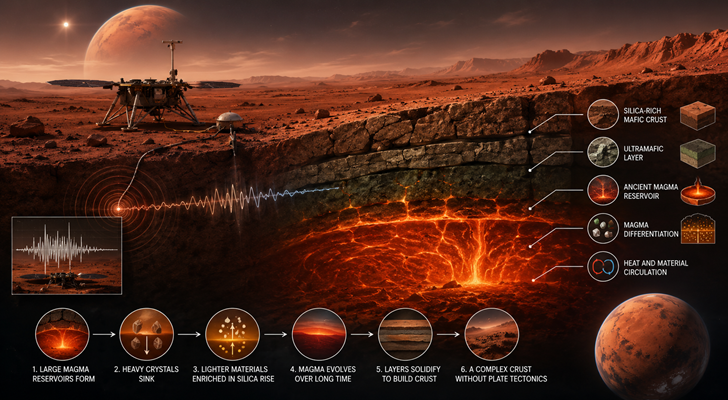
Deep beneath the Martian crust lies an unusually thick layer of ultramafic rock, rich in iron and magnesium but relatively poor in silica.
Above it rests a more silica-rich mafic crust.
How could such a layered structure form?
Scientists propose that Mars once contained enormous underground magma reservoirs.
Inside these reservoirs, gravity gradually sorted minerals by density.
Heavier crystals slowly sank toward the bottom.
Meanwhile, lighter materials remained suspended higher within the molten rock, becoming progressively enriched in silica as differentiation continued over long periods.
This process resembles the slow separation of ingredients inside an enormous underground cauldron.
Instead of erupting immediately, magma appears to have remained stored beneath the surface for immense spans of time, continuously evolving chemically before eventually solidifying.
The result would have been a remarkably sophisticated underground plumbing network—one that previously was believed possible only on planets with active plate tectonics.
Mars’ Ancient Magma Plumbing System May Be Much Larger Than Scientists Expected
One of the study’s biggest surprises concerns the scale of the buried magma system.
Researchers estimate that the ultramafic layer alone measures approximately fourteen kilometers in thickness.
Such a massive accumulation cannot easily be explained by isolated volcanic eruptions.
Instead, it strongly suggests that Mars maintained extensive magma chambers capable of storing, mixing, differentiating, and recycling molten rock over extraordinarily long periods.
Rather than a collection of disconnected volcanic pockets, Mars may once have possessed continent-scale magmatic systems hidden beneath its crust.
If that interpretation proves correct, Mars begins to resemble Earth far more than scientists previously imagined—despite lacking tectonic plates.
Could the Red Planet have quietly developed geological complexity through an entirely different evolutionary pathway?
Mars’ Lower Crust May Rewrite Our Understanding of Planetary Evolution
For decades, planetary scientists believed Earth’s plate tectonics were essential for producing chemically evolved crust.
On Earth, subduction continually drags crust deep into the mantle, where heat and pressure generate new magma with increasingly complex compositions.
Mars, however, lacks this recycling system.
The new research suggests that another mechanism may accomplish many of the same geological outcomes.
Long-lived magma chambers alone may be capable of generating chemically diverse crust without requiring moving tectonic plates.
This finding dramatically expands the range of geological processes available to rocky planets.
Consequently, planetary evolution may be much more flexible than researchers previously believed.
Instead of following Earth’s blueprint, planets could build complex crust through multiple evolutionary pathways.
Could Ancient Mars Have Been More Habitable Than We Once Believed?
The implications extend well beyond geology.
Scientists often consider plate tectonics one of the major ingredients necessary for long-term planetary habitability.
Plate movements recycle carbon, regulate atmospheric chemistry, transport minerals, and maintain internal heat.
If Mars achieved similar geological complexity without plate tectonics, that assumption becomes far less certain.
Long-lived magma reservoirs could have provided sustained heat.
They also could have circulated volatile compounds, generated chemically diverse environments, and produced hydrothermal systems capable of supporting microbial ecosystems.
Importantly, this study does not demonstrate that Mars was inhabited.
Nor does it prove that life ever emerged there.
However, it does suggest that many ingredients associated with habitable environments may arise through alternative geological mechanisms.
If Mars accomplished this, could countless rocky exoplanets have done the same?
Mars May Still Be Geologically Alive Beneath Its Quiet Surface
Although no active volcano has been directly observed on Mars today, several recent discoveries suggest the planet’s interior may not be completely dormant.
Previous analyses of InSight data identified evidence consistent with a giant mantle plume rising beneath Elysium Planitia.
More recent gravity measurements have hinted that another mantle plume could exist beneath the enormous Tharsis volcanic province.
If these interpretations are correct, Mars may still possess slowly moving internal heat engines deep below its apparently lifeless surface.
The planet’s silence could simply conceal activity occurring far beneath the crust.
What other surprises remain hidden where no spacecraft has yet listened?
Why This Mars Discovery Could Transform the Search for Habitable Worlds
Perhaps the most exciting consequence of this research extends beyond Mars itself.
Astronomers have now discovered thousands of rocky exoplanets orbiting distant stars.
Many appear too small, too old, or too tectonically inactive to resemble Earth.
Until recently, these planets may have been dismissed as poor candidates for long-term habitability.
This new work encourages scientists to reconsider those assumptions.
If complex crust, long-lived magma systems, volatile cycling, and chemically diverse environments can all emerge without plate tectonics, then the number of potentially habitable rocky planets throughout the galaxy could be significantly larger than previously estimated.
Mars, once regarded as a simple geological failure, may instead represent an alternative blueprint for planetary evolution.
Perhaps Earth is not the only successful recipe after all.
Perhaps the universe has been creating habitable worlds in ways we are only beginning to understand.
And if Mars still holds secrets beneath its surface today, what astonishing discoveries await future missions that can listen to the planet from entirely new locations?
Conclusion: Mars Is No Longer the Simple, Silent Planet We Once Imagined
This new seismic study transforms Mars from a world defined by stagnant cooling into one shaped by long-lived internal complexity.
Evidence gathered by NASA’s InSight mission suggests that enormous underground magma systems may have built an unexpectedly evolved crust without requiring Earth’s plate tectonics. That finding not only changes how scientists interpret Mars’ geological history but also broadens the search for habitable environments across the universe.
Every marsquake recorded by InSight has become another piece of an enormous planetary puzzle.
Yet many questions remain unanswered.
How widespread were these ancient magma reservoirs?
Could they have persisted for hundreds of millions of years?
Did they create hydrothermal environments capable of supporting microbial life?
And perhaps the biggest question of all remains unanswered:
If Mars has already surprised us this much beneath a single landing site, what remarkable secrets are still waiting beneath the rest of the Red Planet?
Source: Rumbles Deep Inside Mars Hint at a Vast, Ancient Magma System—Has the Red Planet Been Alive All Along?
Meteorite reveals a lost moon-sized world from the dawn of the solar system
Meteorite reveals a lost moon-sized world from the dawn of the solar system
Rumbles Deep Inside Mars Hint at a Vast, Ancient Magma System—Has the Red Planet Been Alive All Along?