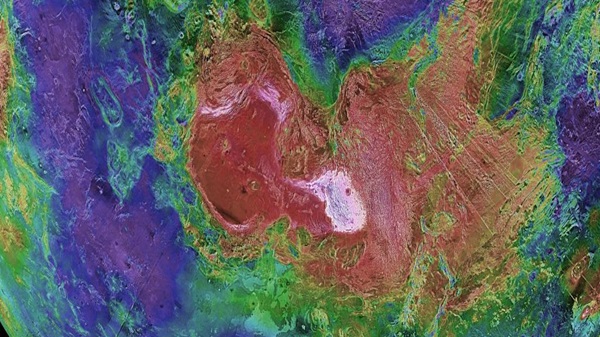
New Study Reveals Surprising Earth-Venus Geological Connection
Venus and Earth seem like twins who, through dramatically different circumstances, ended up leading dramatically different lives.
Earth is bountiful and welcoming, with a soft, safe atmosphere, sloshing oceans, forgiving temperatures, and land masses carpeted with growth. Venus, in contrast, is choked by clouds of toxic gas, rains acid, has crushing atmospheric pressure, and burns with temperatures more befitting Dante’s inferno, reaching into the hundreds of degrees.
These differences are more than skin deep. Venus lacks Earth’s tectonics, including the large, separate areas of planetary crust that grind against each other and help maintain a stable climate on Earth. The oldest parts of Venus’ surface, the vast plateaus known as tesserae, seem to have tectonic features, but how they emerged has been a mystery.
“The study challenges our understanding of how planets evolve,” says geoscientist Fabio Capitanio of Monash University in Australia. “We did not expect Venus, with its scorching 460 °C (860 °F) surface temperature and lack of plate tectonics, to possess such complex geological features.”
Earth’s crust is quite complex compared to other planets. It’s broken into pieces that rub up against each other, slip under each other in a process known as subduction, and slowly rearrange themselves into different configurations.
The very oldest parts of Earth’s continental crust are regions known as cratons. These are areas where the rock is older, denser, and stronger, providing seeds around which the continents could find purchase and grow.
Our knowledge of Venus is limited – it’s not a planet that invites human exploration – but for 15 years, between 1989 and 1994, NASA’s Magellan spacecraft used a radar probe to map, in detail, the surface of Venus beneath its cloak of sulfuric acid clouds.
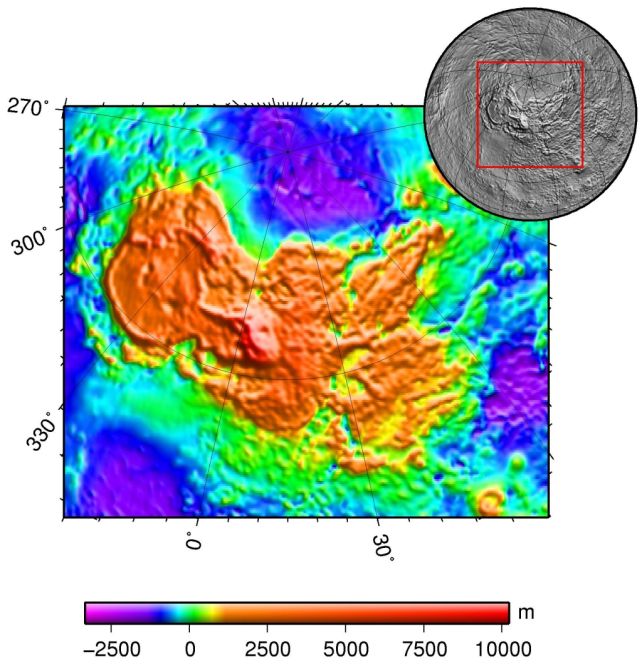
Capitanio and his colleagues tapped into this data, focusing on a tesserae region known as the Ishtar Terra, the largest plateau on Venus. They used computer simulations to explore how this region formed billions of years ago, when the Solar System was still in its early years.
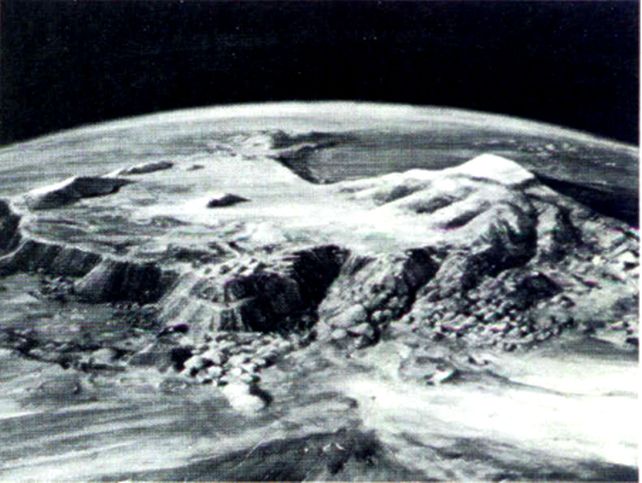
Their results suggest that the tesserae may have formed like the cratons, surging upwards from within the molten interior of Venus to emerge on the surface and harden into the planetary crust.
“This finding provides a fascinating new perspective on Venus and its potential links to early Earth,” Capitanio explains. “The features we found on Venus are strikingly similar to Earth’s early continents, suggesting that the dynamics of Venus’ past may have been more similar to Earth’s than previously thought.”
This gives us a clue for understanding planetary evolution: it suggests that, however Earth and Venus diverged along their separate crustal journeys, it happened after the process of craton formation but before the formation of plate tectonics.
This timing matters because the emergence of different planetary characteristics could be a significant clue about how habitability is established and maintained on rocky planets like Earth. The strongest tool we have for this is finding when and where the two planets match up.
“By studying similar features on Venus, we hope to unlock the secrets of Earth’s early history,” Capitanio says.
Source: New Study Reveals Surprising Earth-Venus Geological Connection