New Horizons conducts first-ever successful deep space stellar navigation test
As NASA’s New Horizons spacecraft traveled through the Kuiper Belt at a distance of more than 5.5 billion miles from Earth, an international team of astronomers used the far-flung probe to conduct an unprecedented experiment: the first-ever successful demonstration of deep space stellar navigation.
A paper describing the results was accepted for publication in The Astronomical Journal. The pre-print is available on the server arXiv.
As a proof-of-concept test, the researchers took advantage of the spacecraft’s unique vantage point as it traveled toward interstellar space to image two of our nearest stellar neighbors, Proxima Centauri, which is 4.2 light-years from Earth, and Wolf 359, which is 7.86 light-years away.
From New Horizons’ perspective, the two nearby stars shifted their apparent positions in the sky as they appear to astronomers here on Earth, an effect known as stellar parallax.
Using the positions of the two stars and referencing a three-dimensional model of the solar neighborhood, the team calculated the spacecraft’s position relative to nearby stars with an accuracy of about 4.1 million miles. (This is comparable to an accuracy of about 26 inches as measured from New York to Los Angeles.)
Although this demonstration did not yield research-grade results, the researchers note that directly observing large stellar parallaxes from widely separated simultaneous observers is vividly educational.

According to Tod Lauer, an astronomer with NSF’s NOIRLab in Tucson, Ariz., and lead author on the paper, “Taking simultaneous Earth/Spacecraft images we hoped would make the concept of stellar parallaxes instantly and vividly clear.”
“It’s one thing to know something, but another to say “Hey, look! This really works!'”
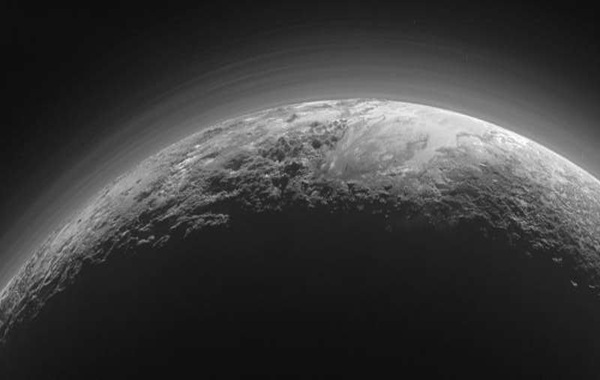
New Horizons is the fifth robotic spacecraft to leave Earth that will eventually reach interstellar space. Its primary mission was to study the dwarf planet Pluto and its largest moon, Charon.
After a journey of nine and a half years and over 3 billion miles, it captured amazing first images of these icy worlds and expanded our understanding of their geology, composition, and tenuous atmospheres.
Now in its extended mission, New Horizons will continue studying the heliosphere and is expected to cross the “termination shock,” the point that marks the boundary of interstellar space, in the next few years.
Source: phys.org
Could Gamma‑Ray Beacons Be Our First Contact with Alien Civilizations?
New Horizons conducts first-ever successful deep space stellar navigation test