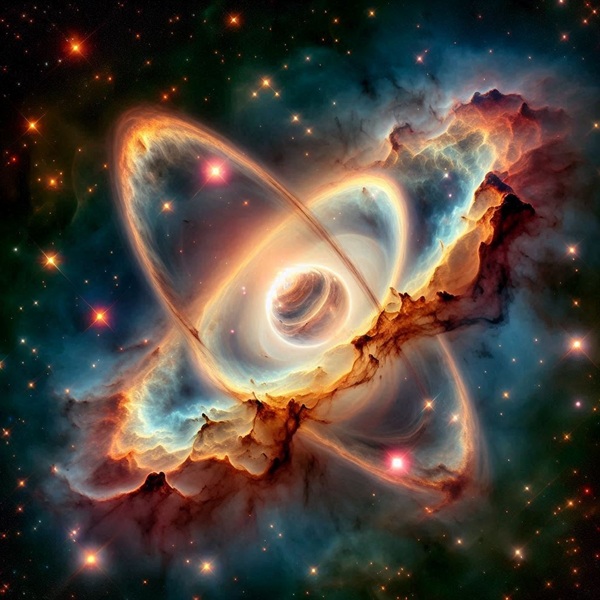
NASA’s JWST Discovers Strange Structures in a Distant Nebula – What Do They Mean?
A Cosmic Mystery: The Mid-Infrared Rings of NGC 1514
The James Webb Space Telescope (JWST) has uncovered fascinating new details about mysterious rings in the planetary nebula NGC 1514. These enigmatic structures, visible in the mid-infrared spectrum, have puzzled astronomers for years. The latest observations, published on February 28 in the arXiv pre-print server, shed new light on their properties and possible origins.
What Are Planetary Nebulae and Why Are They Important?
Planetary nebulae (PNe) are expanding shells of gas and dust expelled from a dying star as it transitions from a main-sequence star to a red giant or white dwarf. Although relatively rare, these nebulae play a crucial role in understanding the chemical evolution of stars and galaxies.
NGC 1514: The Crystal Ball Nebula and Its Binary Origins
Located approximately 1,500 light-years away, NGC 1514—also known as the Crystal Ball Nebula—is a large and complex elliptical planetary nebula. It originates from a binary star system, HD 281679. The system’s visible giant star has a spectral type of A0III, while its companion, responsible for creating the nebula, is a hot, sub-luminous O-type star.
The Infrared-Bright Rings: A Unique Cosmic Phenomenon
Previous studies revealed a pair of infrared-bright, axisymmetric rings within the outer shell of NGC 1514. These rings, known as R10, measure between 0.65 and 1.3 light-years in diameter and are only prominent in the mid-infrared spectrum. Their distinct morphology and unknown properties prompted further investigation using JWST.
How JWST’s Advanced Instruments Captured New Insights
Led by Michael E. Ressler from NASA’s Jet Propulsion Laboratory (JPL), a team of astronomers utilized JWST’s Mid-Infrared Instrument (MIRI) for high-resolution imaging and spatially resolved spectroscopy. Their goal? To unlock the secrets of these bizarre rings and their formation process.
What Did JWST Reveal? Turbulence, Cohesion, and Ejecta
JWST’s observations revealed turbulent yet surprisingly cohesive structures within the rings. The rings appeared exceptionally bright compared to the nebula’s inner shell. Additionally, faint emissions extending beyond the ring boundaries were detected at all wavelengths, suggesting they may be remnants of earlier ejections or interactions with high-velocity winds.
The Role of Dust: What Do the Rings Consist Of?
Analysis of the data confirmed that the rings are composed purely of dust, with a temperature ranging between 110 and 200 K. These findings reinforce the idea that dust plays a vital role in the nebula’s intricate structure.
How Were These Rings Formed? A Closer Look at Their Origins
Researchers propose that the rings formed during a slow, heavy mass-loss phase of the planetary nebula’s progenitor star. Later, faster stellar winds sculpted the rest of the optically visible nebula, shaping the current structure of NGC 1514.
What’s Next? Unraveling More Secrets of Planetary Nebulae
With JWST’s unprecedented capabilities, astronomers are closer than ever to understanding the life cycles of stars and the intricate details of planetary nebulae. Could similar rings exist in other nebulae, waiting to be discovered? The findings from NGC 1514 may hold the key to unlocking even more cosmic mysteries in the future.
Source: NASA’s JWST Discovers Strange Structures in a Distant Nebula – What Do They Mean?
‘World’s first’ fully autonomous AI agent unveiled in China, handles real-world tasks
‘World’s first’ fully autonomous AI agent unveiled in China, handles real-world tasks