NASA studies Earth’s deep-sea volcanoes to uncover alien life on Jupiter’s moon
The deep-sea volcanoes beneath Earth’s oceans may offer vital clues in the search for alien life on Europa, one of Jupiter’s moons.
With a $621,000 award from NASA, University of Massachusetts Amherst microbiologist James Holden will dedicate the next three years to “predicting” the nature of life on Europa.
Earth often acts as a natural laboratory for planetary science and space exploration.
Scientists identify “analogue sites” on our planet – places with geological, environmental, or biological conditions similar to those found on other celestial bodies like Mars, the Moon, or even icy moons like Europa.
“We have long had a basic interest in knowing if there is life beyond our planet and how that life would function. It’s exciting to think that the answer to the secret might be here on our own planet,” Holden stated.
“We think, based on our own planet, that Europa may have conditions that can support life,” said Holden.
Hydrothermal vents
The search for extraterrestrial life often conjures images of distant galaxies and advanced civilizations. But forget the little green men. It’s far more probable that any life beyond Earth but within our solar system is microbial.
Astronomers theorize that beneath the frozen surface of Jupiter’s moon Europa lies a salty, liquid ocean that is in contact with a hot molten core. A place where life, just maybe, could thrive.
NASA’s recently launched Europa Clipper spacecraft is on a dedicated mission to ascertain just how habitable Europa truly is.
And now NASA has awarded this grant to tackle one of astrobiology’s biggest questions: What might life on Europa look like?
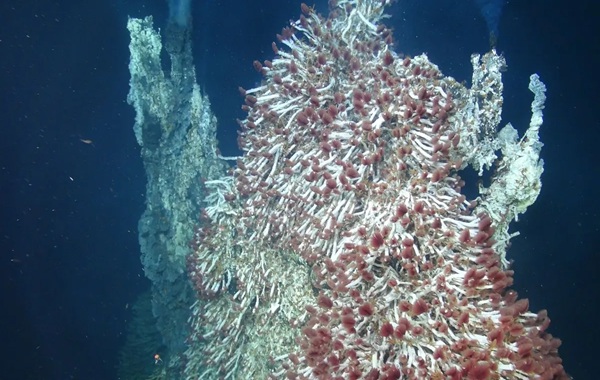
Dr. Holden’s answer takes us a mile beneath our own oceans, to the most extreme environments on Earth, particularly the deep-sea vents.
Hydrothermal vents, which are sources of chemical energy and heat on Earth, are considered one of the most plausible locations for life’s origin here.
Planetary scientists theorize that similar hydrothermal vents could exist on the seafloors of the subsurface oceans on icy moons like Europa and Ganymede (around Jupiter) and Enceladus (around Saturn).
These vents could provide the necessary warmth and chemical ingredients to trigger the biochemistry required for life in these otherwise cold, dark, and distant ocean worlds.
Holden has dedicated his entire academic career to studying deep-sea vents.
“I’ve been looking at deep-sea volcanoes since 1988. To get our microbes from them, we use submarines—sometimes human-occupied, sometime robotic—to dive a mile below the surface and bring the samples ashore and back into my lab at UMass Amherst,” he noted.
Identifying microbial life
Holden has also recreated the lightless, oxygen-less conditions of these deep-sea hydrothermal vents in his lab.
The specialized microbes that live in the dark vents mostly get energy from the gases and minerals erupting from Earth’s interior.
“Because Europa’s conditions might be similar to the conditions these microbes come from. We think that Europan life, if it exists, should look something like our own hydrothermal microbes,” Holden said.
Any microbial life on Europa would likely not be an exact replica of Earth’s.
On Earth, the hydrothermal microbes get their energy by breaking down hydrogen using special enzymes called hydrogenases.
But the chemical dance on Europa could be different. Iron, sulfur, and carbon, also abundant near hydrothermal vents, are all adept at partnering with hydrogen to generate energy.
“Our research will be to determine how the different chemical process contribute to an organism’s physiology,” said Holden.
The Europa Clipper spacecraft is set to arrive at the Jupiter system in 2030. This mission, combined with ongoing research like that of microbiologist Holden, could provide definitive proof of whether life exists on Europa.
Source: Interesting Engineering
Could Hidden “BLOBS” in Earth’s Mantle Spark the Next Super‑Eruption?
NASA studies Earth’s deep-sea volcanoes to uncover alien life on Jupiter’s moon