Maya Drag Habitat ̇Mexico and the Americas ̇Central Maya and Indigenous Peoples
The Maya and Mexi̇co and Central Ameṙican indigenous peoples utilized hallucinogenic substances called entheogens, a type of psychedelic substance that was used in spiritual rites and ceremonies to induce altered states of consciousness.
The purpose of these substances was to reach a state of temporal and spatial disorientation and to bring the user a sense of inner peace and oneness with nature and the gods.
Although the consumption of entheogens in the Americas can be traced back to the Olmec period, our understanding of Maya entheogen use is deeper, thanks to Maya religious texts such as the Popol Vuh and 16th century Spanish accounts.
Entheogen use in Maya rituals often took place underground or in caves. These were considered sacred access points to the underworld and were thought to provide a suitable environment for contact with the spirit world and to enhance inner vision.
One of the most common Mayan entheogens was an intoxicating drink called balche, made by soaking the bark of a legume tree in honey and water and fermenting it to give it a mild alcoholic content.
Balche was used primarily in rituals of communion with the elements and spirits to foretell or understand events such as bad harvests, diseases, and the outcome of wars. Because of its low alcohol content, barche was drunk in large quantities to induce vomiting, and the vomit was collected in a sack and hung around the user’s neck.
Chee is also an alcoholic beverage made from the fermented sap of the maguey plant. This sap was associated with the blood of the Maguey goddess Maya Heul. Various ceramics of the Classic Maya period produced vessels marked with the character “chi.” References to the use of this beverage can be found in the Dresden Codex, the Borgia Codex, the Florence Codex, and the Borbonicus Codex.
Wild tobacco (Nicotiana rustica), called pidgiet in Maya, was also used to give visions and to minimize pain caused by self-sacrifice. Tobacco contained nicotine, an alkaloid that acts on the nervous system, and was chewed, inhaled, or mixed with datura leaves to enhance its hallucinogenic effects.
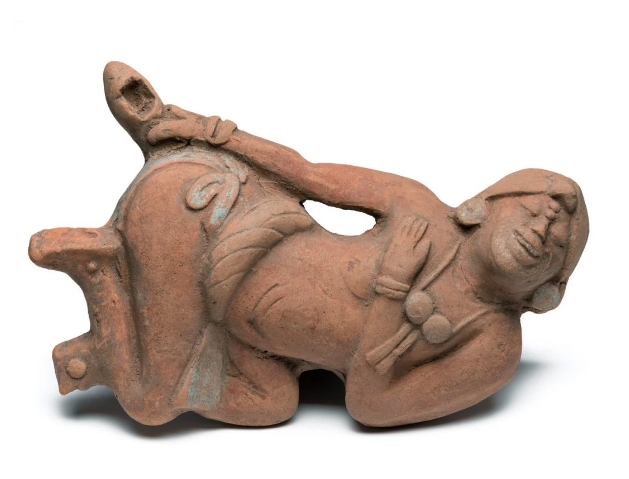
The liquid or gas was often used in enemas. An enema was a method of intensifying the effects of a drug by injecting the substance into the rectum with a syringe made of gourd or clay. One figure is vomiting and another is receiving an enema.
A painting on Late Classic Maya pottery depicts a jar overflowing with the foam of a fermented drink and an individual receiving an enema. Various colonial accounts (e.g., the Florentine Codex) also indicate that enemas were used to combat illness and discomfort in the digestive tract.
A hallucinogenic mushroom known as k’aizalaj okox in Maya was often consumed for ritual purposes. The mushrooms were eaten either in the form of fresh, unboiled mushrooms or as dried powdered mushrooms containing psilocybin and psilocin, another hallucinogenic compound that causes the user to experience hallucinations. An artifact called a “mushroom stone” also indicates the consumption of mushrooms by Mayan cult groups, and is believed to be associated with human decapitation, warfare, and Mesoamerican ball games.
Other plants, such as Nymphaea ampla, are known to have caused opiate-like effects in users and were used by the Maya as sedatives and mild trance inducers. The Ololiuqui plant, which contains seeds that contain different alkaloids of the LSD family, produces hallucinogenic visions when powdered and mixed with cocoa beverages.
One of the more unusual entheogens used by the Maya was derived from the skin and parotid glands of various species of toads; records from the 16th century indicate that the Maya added tobacco and toad skin to beverages such as barche to enhance their potency.
Source: Maya Drag Habitat ̇Mexico and the Americas ̇Central Maya and Indigenous Peoples
Maya canoe surrounded by animal and human bones found in ‘portal to the underworld’ in Mexico