
Is Water in Nanotubes the Key to Future Technology? What Scientists Are Discovering
Life, down to the cellular level, requires water for survival. Predicting how liquid H2O navigates molecular-scale channels is a challenging task that strains even the most powerful computers. To address this, researchers in the US used machine learning to study water’s electric properties when trapped inside nanometer-sized carbon cylinders.
Water, despite its simplicity, has a complex nature. Each molecule contains an oxygen atom that pulls electrons away from the hydrogen atoms, creating a charge imbalance known as a dipole. This dipole gives water its unique properties, such as surface tension and the ability to form various structures when frozen.
When water is confined in hydrophobic carbon nanotubes, the interaction with electric fields intensifies. Understanding how this confined water screens electric fields compared to bulk water is crucial. According to Marcos Calegari Andrade, a materials scientist at Lawrence Livermore National Laboratory (LLNL), this knowledge can advance separation technologies and other applications like energy storage and conversion.
The dielectric effect describes how materials like water respond to electric fields. While conductors transfer electric charges as currents, dielectric materials adjust their charged components to align with electric fields, influencing the field’s behavior.
Previous studies have shown that packing water molecules in nanotubes less than 10 nanometers in diameter can reveal new phases of water and facilitate rapid proton transfer along one-dimensional water chains. Enlarging the pore size can also result in the formation of ice structures not seen in bulk water.
Building a theoretical framework to explain these phenomena is challenging. Researchers used machine learning to determine dielectric constants along different directions in the confined water, incorporating quantum effects to calculate potential energy and describe molecular dynamics.
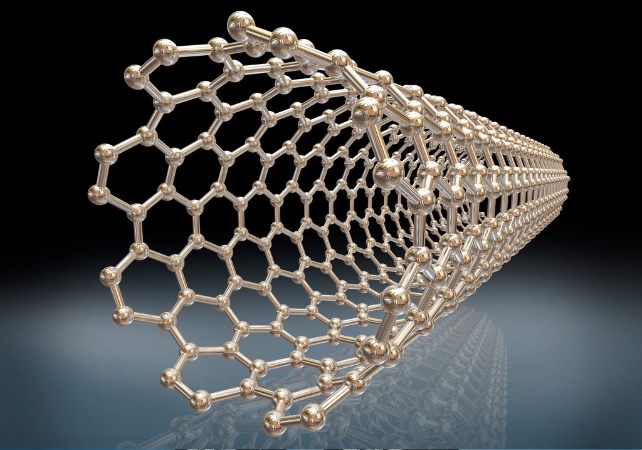
Their findings revealed an electronic structure parallel to the nanotube walls. The dielectric constant along the nanotube axis increased as the diameter decreased, peaking at 0.79 nanometers, where water molecules align in a single file.
Mapping this enhancement of water’s dielectric effect at small scales could provide valuable insights for molecular biologists studying water flow through tiny cellular channels. It may also aid in designing pharmaceuticals that work more effectively in confined spaces. Anh Pham, a computational materials scientist at LLNL, emphasizes that fundamental studies on water’s dielectric constant in confined spaces are crucial for improving current technologies.
Source: Is Water in Nanotubes the Key to Future Technology? What Scientists Are Discovering
Century-Old Chemistry Puzzle Solved: Researchers Unveils Game-Changing Compound
Century-Old Chemistry Puzzle Solved: Researchers Unveils Game-Changing Compound