Is Planet Formation Possible Around Wandering Gas Giants?
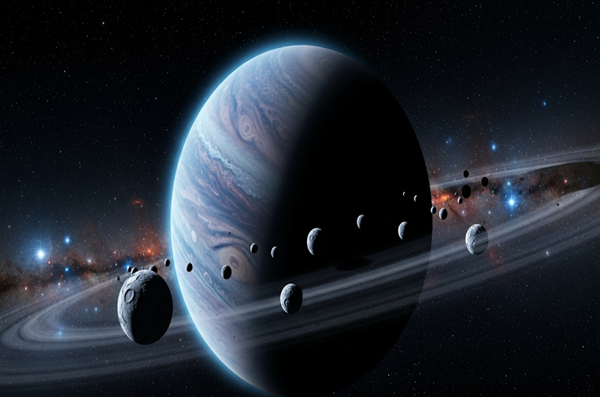
Could planets really form around objects that wander the galaxy alone? Recent findings from the University of St Andrews suggest they can. Using cutting-edge JWST observations, researchers have uncovered evidence that giant, free-floating planets—each five to ten times Jupiter’s mass—may host their own miniature planetary systems.
JWST Observations Reveal Infrared Disks Around Isolated Planetary-Mass Objects
Between August and October 2024, the James Webb Space Telescope turned its infrared spectrographs toward eight young, free-floating planetary-mass objects. Although dim and challenging to detect, these bodies radiate predominantly in the infrared, making JWST’s powerful instruments ideal for the task. Detailed spectroscopy revealed that six of the eight objects exhibit significant infrared excess—an unmistakable sign of circumplanetary disks. Moreover, these observations mark the first detection of silicate emission in objects of planetary mass.
Key SEO Phrases: James Webb Space Telescope discoveries, free-floating planet disks, infrared silicate emission.
Silicate Emissions and Dust Growth: The Seeds of Rocky Worlds
What processes drive planet formation around a lonely gas giant? Spectra from the JWST show clear silicate features—indicative of dust grain growth and crystallization. These are the very first steps toward building rocky cores. While silicate emissions have been observed around stars and brown dwarfs before, their presence here confirms that planet formation processes can operate even at the lowest mass scales.
Engaging Question: If dust can coalesce around a drifting giant, could miniature rocky worlds also take shape?
Formation Pathways: Star-Like Collapse or Planetary Ejection?
Researchers debate how these free-floating giants form in the first place. On one hand, they may resemble low-mass stars, born from the collapse of giant molecular clouds but never reaching fusion ignition. On the other hand, they could originate as planets in stellar systems and later be ejected by gravitational interactions. Either way, their ability to retain dust disks challenges our traditional definitions of planet and star formation.
Miniature Solar Systems: Scaling Down by 100×
Dr. Aleks Scholz, Principal Investigator, explains: “Taken together, these studies show that objects with masses comparable to those of giant planets have the potential to form their own miniature planetary systems. Those systems could be like the solar system, just scaled down by a factor of 100 or more in mass and size.” However, direct confirmation of moons or planetary embryos around these rogue giants remains elusive.
SEO Focus: miniature planetary systems, rogue planet moons, substellar disk evolution.
Implications for Exoplanetary Science and Astrobiology
The discovery that lonely, starless bodies can host planet-forming disks broadens the scope of exoplanetary science. If planets can form around isolated giants, then the diversity of potential habitable environments in the galaxy expands dramatically. Furthermore, these results raise the tantalizing question: could some of these rogue worlds harbor conditions suitable for life, even without a central star?
Thought-Provoking Question: Could life find a foothold on a moon circling a free-floating giant, bathed only in the faint glow of dusty disks?
Next Steps: Searching for Planetary Companions
Lead author Dr. Belinda Damian emphasizes that much work lies ahead. Future JWST surveys and deep imaging campaigns will target these rogue giants in search of substructures—gaps, rings, or companion bodies—that betray ongoing planet formation. As telescopes grow more sensitive, the era of starless planetary systems may well be upon us.
What surprises will our drifting neighbors reveal next? Only time—and more observations—will tell.
Source: Is Planet Formation Possible Around Wandering Gas Giants?