Hidden Structures Near Giza Pyramid: Archaeologists Puzzled by Ancient Anomaly
Slowly but surely, the ground is revealing its secrets. The history buried beneath the sands of time is being unearthed piece by piece through technology.
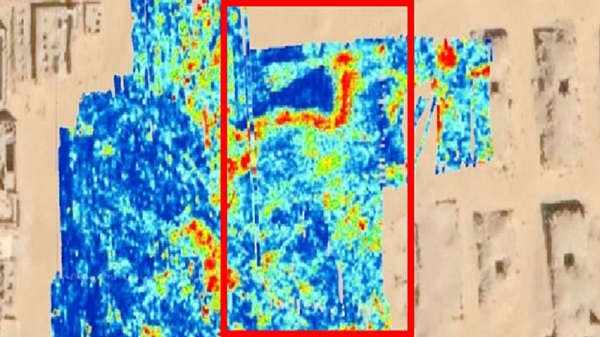
Near the Great Pyramid of Giza, Egypt, ground-penetrating radar and electrical resistivity tomography have unveiled a large, two-part structure concealed under a burial ground that has remained mostly undisturbed for over 4,000 years.
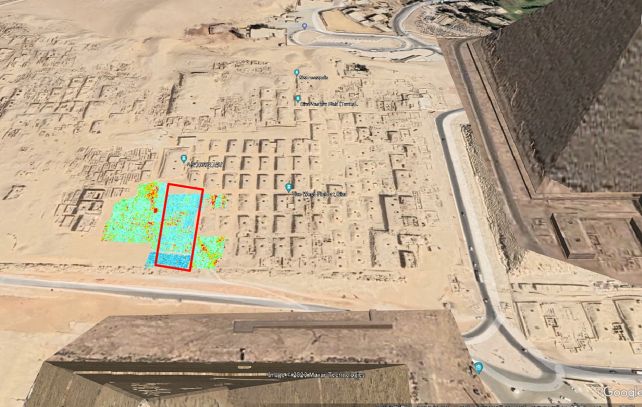
These scans, conducted under the Western Cemetery west of the Great Pyramid, revealed a shallow L-shaped structure spanning an area of 10 meters (33 feet) by 15 meters, located between 0.5 and 2 meters below the desert surface. Below this, there appears to be a much larger structure, between 3.5 and 10 meters deep, covering an area of 10 meters by 10 meters.
The purpose of these structures remains unclear, but their presence could yield new insights into the Giza pyramid complex and its builders.
Non-invasive technologies that reveal what lies below the surface without excavation have led to many recent discoveries, both on Earth and on other planets like Mars and the Moon. These technologies allow for the study of historical sites without damaging delicate evidence.
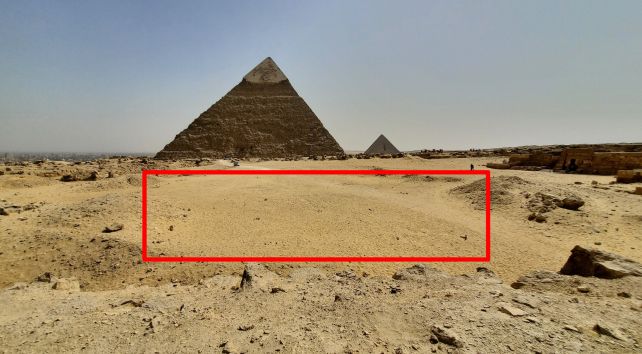
A section of the Western Cemetery has always puzzled archaeologists. While most of the area is filled with graves and tombs, one rectangular piece has remained bare and flat. A Japanese and Egyptian team, led by archaeologist Motoyuki Sato of Tohoku University in Japan, set out to study this relatively unexamined parcel of land.
Ground-penetrating radar works by directing radio waves into the ground and measuring them as they bounce back. Different densities and compositions below the ground reflect the radio waves in different ways, enabling the mapping of underground structures and geological formations. Electrical resistivity tomography detects changes in the electrical resistivity of subsurface materials in a similar manner.
Using these techniques, the researchers found regions of varying density beneath the flat section of the cemetery, forming shapes that are unlikely to be natural. This suggests they are human-made, although their purpose remains a mystery. The shallower structure was filled with homogeneous sand, indicating deliberate filling after construction.
The deeper structure, revealed by electrical resistivity tomography, was more challenging to interpret. It appeared to be filled with something highly resistive, possibly sand or a void, suggesting a hollow chamber. The researchers refer to it as an “anomaly” due to its ambiguous nature.
The alignment of both structures is significant, suggesting that the shallower one may have been an entrance to the larger one. Given the location, one plausible explanation is that these could be vertical walls of limestone or shafts leading to a tomb structure. However, a more detailed survey is needed to confirm this possibility.
“We conclude from these results that the structure causing the anomalies could be vertical walls of limestone or shafts leading to a tomb structure,” the researchers write in their paper. “However, a more detailed survey would be required in order to confirm this possibility.”
Source: Hidden Structures Near Giza Pyramid: Archaeologists Puzzled by Ancient Anomaly