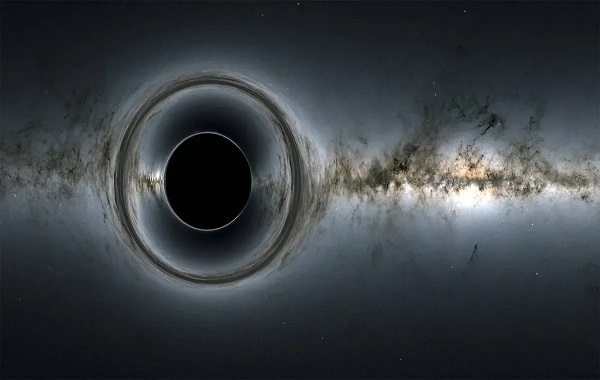
Hawking was right: All large objects will eventually evaporate
Theoretical physicist Stephen Hawking had a radiation theory named after him that dictated that all black holes will eventually evaporate. This theory extended to all large objects in the universe, like the remnants of stars, stating that they too will come to dissipate.
To come to this conclusion, the scientist used a clever combination of quantum physics and Einstein’s theory of gravity where he argued that the spontaneous creation and annihilation of pairs of particles must occur near the event horizon (the point beyond which there is no escape from the gravitational force of a black hole).
A particle and its corresponding anti-particle would be created very briefly from the quantum field, but would almost just as quickly annihilate. However, an exception to this disappearance would occur when a particle falls into the black hole allowing the other particle to escape. This phenomenon is what would eventually result in the evaporation of black holes.
New research, old theory
Now, new theoretical research by Michael Wondrak, Walter van Suijlekom and Heino Falcke of Radboud University is indicating that Hawking was partially right about black holes.
The research examined whether or not the presence of an event horizon is indeed crucial to the annihilation of black holes and potentially all large matter. Using techniques from physics, astronomy and mathematics the team researched what occurs when such pairs of particles are created in the surroundings of black holes.
Surprisingly enough, they found that new particles can also be created far beyond this horizon.This is according to a press release by Radboud University published on Friday.
“We demonstrate that, in addition to the well-known Hawking radiation, there is also a new form of radiation,” Wondrak said.
“We show that far beyond a black hole the curvature of spacetime plays a big role in creating radiation. The particles are already separated there by the tidal forces of the gravitational field,” added Suijlekom.
The results indicate that radiation is indeed possible without the event horizon and that it leads to the eventual disappearance of everything in the universe.
“That means that objects without an event horizon, such as the remnants of dead stars and other large objects in the universe, also have this sort of radiation. And, after a very long period, that would lead to everything in the universe eventually evaporating, just like black holes. This changes not only our understanding of Hawking radiation but also our view of the universe and its future,” concluded Falcke in the statement.
Source: Interesting Engineering
World’s First X-Ray Of A Single Atom Achieved
Hawking was right: All large objects will eventually evaporate