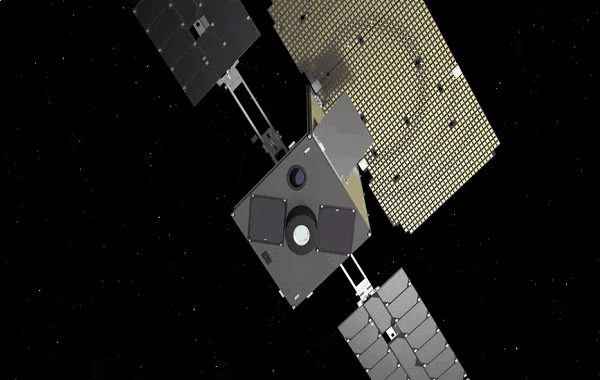
Getting CubeSats moving: M-Argo will be first to traverse interplanetary space under its own power
ESA’s M-Argo mission will be the first CubeSat to traverse interplanetary space under its own power. Due to launch in 2024-5, the suitcase-sized spacecraft will travel to a near-Earth asteroid, up to 150 million km away.
CubeSats are small, cheap satellites assembled from standardized parts in 10 cm boxes—M-Argo is a 12-unit CubeSat. Originally intended for educational purposes and technology testing, CubeSats have matured rapidly, and are becoming increasingly attractive to intuitional and commercial users for applications including Earth observation, telecommunications and even exploration.
Today hundreds of CubeSats are launched each year, while ESA employs them for early in-orbit demonstration of advanced technologies.
While CubeSats offer increasingly capable payload performance, their natural limits of size, mass and power typically preclude the inclusion of conventional spacecraft propulsion systems. At the same time, such propulsion capabilities are crucial to enable mobility and to enhance the potential of CubeSats, which have started to utilize miniaturized chemical and electric propulsion. This is the subject of a dedicated ESA workshop on Propulsion4CubeSats on 28-29 Apri. ESA’s annual CubeSat Industry Days will follow in June.
Source:http://www.esa.int/
Getting CubeSats moving: M-Argo will be first to traverse interplanetary space under its own power
A method to study extreme space weather events
Scientists at Skolkovo Institute of Science and Technology (Skoltech), together with international colleagues, have developed a method to study fast coronal mass ejections, powerful bursts of magnetized matter from the outer atmosphere of the sun.
The results could improve the understanding and prediction of the most extreme space weather events and their potential to cause strong geomagnetic storms that directly affect the operation of engineering systems in space and on Earth. The results of the study are published in the Astrophysical Journal.