
“Frontier Supercomputer Simulates the Universe at Unprecedented Scale”
When scientists push the limits of the world’s most powerful supercomputers, they often find those limits are just the beginning of what’s possible. In early November, the Department of Energy’s Argonne National Laboratory team did just that by employing the second-fastest supercomputer on the planet to execute the largest astrophysical simulation of the universe ever attempted.
The results? They reveal a universe that stretches even further and with greater complexity in our simulations than previously thought possible, offering new perspectives of the cosmos. Let’s explore how these groundbreaking simulations transform our view of the universe.
Frontier’s computational achievement
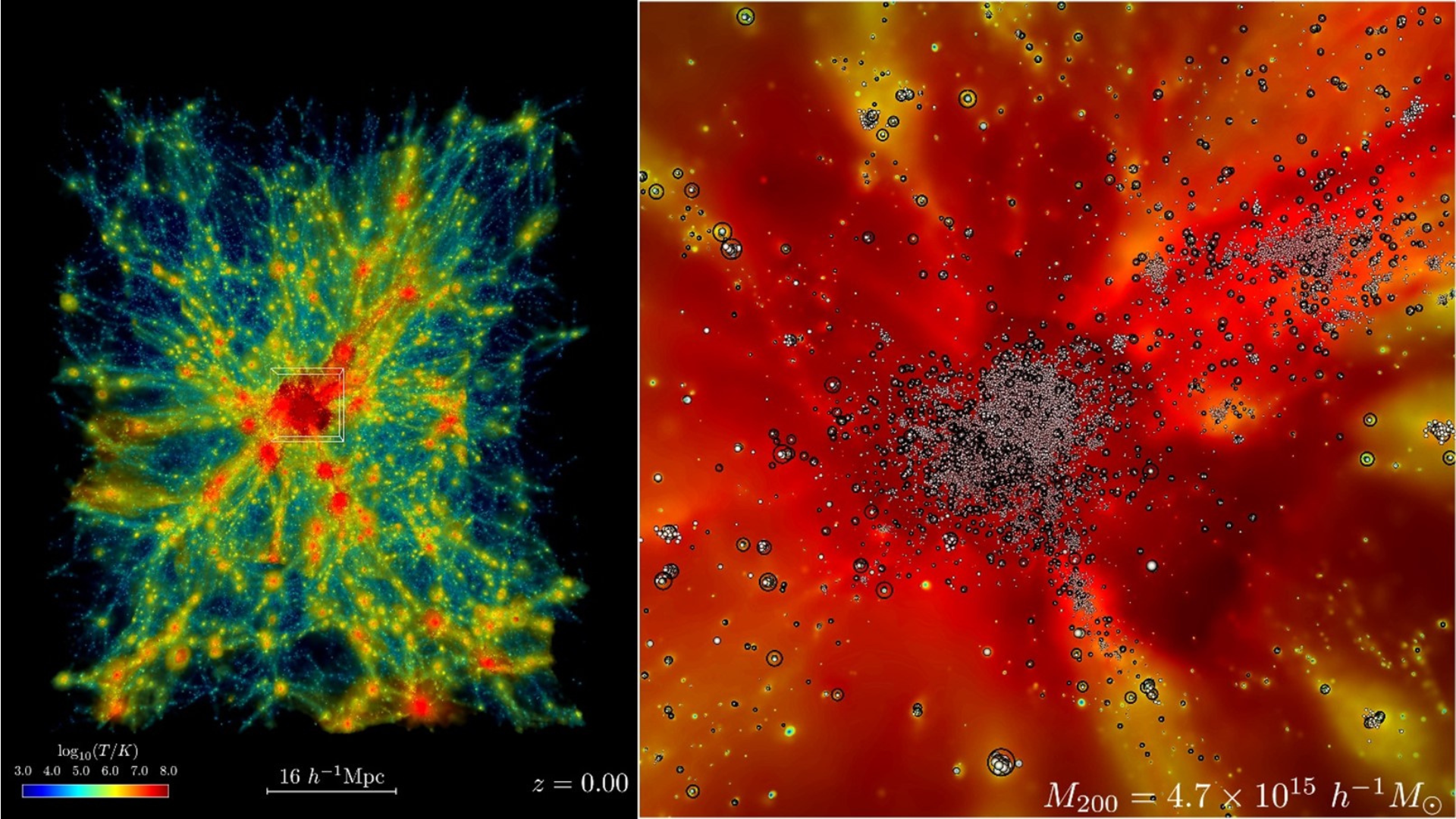
The notable achievement was made using the Frontier supercomputer at Oak Ridge National Laboratory (ORNL). The extensive calculations have set a new benchmark for cosmological hydrodynamics simulations, providing a groundbreaking foundation for simultaneously simulating the physics of atomic matter and dark matter. This level of simulation corresponds in scale to the surveys conducted by major telescope observatories, a feat previously unattainable at this magnitude.
Salman Habib, the project lead and division director for Computational Sciences at Argonne, explained the dual focus of the simulation, stating, “There are two components in the universe: dark matter — which, as far as we know, only interacts gravitationally — and conventional matter, or atomic matter.” He elaborated on the necessity of this comprehensive approach: “So if we want to understand what the universe is up to, we need to simulate both of these elements: gravity and all other physics including hot gas, the formation of stars, black holes, and galaxies. We’re essentially throwing everything but the kitchen sink into these simulations, which we refer to as cosmological hydrodynamics simulations.”
The complexities of cosmological hydrodynamics simulations
Cosmological hydrodynamics simulations represent a significant computational challenge, far surpassing the demands of simulations that solely address the gravitational effects within an expanding universe. These simulations require vast computational resources and the integration of complex physics that simulates dark and atomic matter over extensive periods.
Salman Habib, the project lead, illustrates the scale and complexity involved: “For example, if we were to simulate a large chunk of the universe surveyed by one of the big telescopes like the Rubin Observatory in Chile, you’re talking about observing billions of years of expansion. Until recently, we couldn’t imagine conducting such an expansive simulation beyond the gravity-only models.”
The role of HACC in exascale simulations
The code that powered these simulations is HACC, short for Hardware/Hybrid Accelerated Cosmology Code. Initially developed approximately 15 years ago for petascale machines, HACC was a finalist for the Association for ComputingMachinery’ss Gordon Bell Prize in computing in 2012 and 2013. It later underwent significant upgrades as part of ExaSky, a special project led by Habib within the Exascale Computing Project (ECP) — a Department of Energy (DOE) initiative that commanded a budget of $1.8 billion from 2016 to 2024. This project united thousands of experts to advance scientific applications and software tools in preparation for the new wave of exascale-class supercomputers.
Over the last seven years, the HACC research team has enhanced the code with new capabilities and optimized it for exascale machines equipped with GPU accelerators. One requirement of the ECP mandated that codes run approximately 50 times faster than they could on Titan, the fastest supercomputer during the ECP’s inception. Impressively, HACC’s performance on the Frontier supercomputer was nearly 300 times faster than the reference run.
Bronson Messer, the OLCF director of science, highlighted the significance of these advancements: “It’s not only the sheer size of the physical domain, which is essential for making direct comparisons to modern survey observations enabled by exascale computing. It also the added physical realism of incorporating baryons and all the other dynamic physics that elevates this simulation to a true tour de force for Frontier.”
The development and testing phases of HACC also included parameter scans on the Perlmutter supercomputer at the National Energy Research Scientific Computing Center (NERSC) at Lawrence Berkeley National Laboratory and large-scale runs on the exascale-class Aurora supercomputer at the Argonne Leadership Computing Facility (ALCF).
Frontier’s expanding universe of computation
Frontier, the fastest supercomputer, has a legacy beyond mere computational speed. Over the past year, Frontier has been instrumental in pioneering research across various scientific domains.
Despite recently being overtaken by Lawrence Livermore National Laboratories’ El Capitan supercomputer, which leads with a remarkable 1.74 exaFLOPS—nearly 30% faster—Frontier continues to set benchmarks in high-performance computing (HPC).
Projects such as the simulation of room-temperature water molecules at the atomic level, investigations into the metastability of diamonds under extreme pressures, and groundbreaking insights into the nuclear magnetic excitation of calcium-48 highlight the supercosupercomputer’s capabilities. These initiatives showcase the supercosupercomputer’s role in advancing scientific inquiry and deepening our understanding of complex phenomena.
Source: Interesting Engineering
“Evo AI: Transforming Genetic Research Through Precision Mutation Modeling”
“Frontier Supercomputer Simulates the Universe at Unprecedented Scale”/”Frontier Supercomputer Simulates the Universe at Unprecedented Scale”