
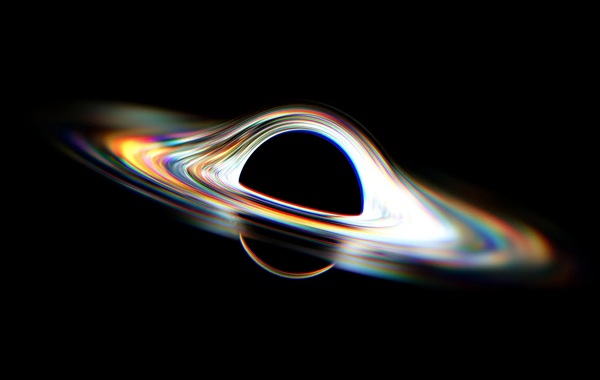
Einstein Was Right: Scientists Witness a Black Hole Literally Dragging the Fabric of Spacetime
For over a century, it remained one of Albert Einstein’s most mind-bending predictions: the idea that a massive, spinning object could actually “drag” the very fabric of the universe along with it. Today, that theoretical mystery has become an observed reality. In a groundbreaking cosmic find, astronomers have finally captured a black hole caught in the act of twisting spacetime itself.
A Whirlpool in the Cosmic Ocean
This phenomenon, known to physicists as Lense-Thirring precession or “frame-dragging,” describes how a rotating black hole acts like a giant blender in the dark. As it spins at near-light speeds, it doesn’t just pull matter toward it—it tugs and swirls the four-dimensional stage of space and time.
The breakthrough came during a violent event labeled AT2020afhd, a “tidal disruption event” where a doomed star wandered too close to a supermassive black hole and was shredded into cosmic spaghetti.
The 20-Day Cosmic “Wobble”
As the star was devoured, the resulting debris formed a glowing disk. By meticulously tracking X-ray and radio signals, an international team led by Cardiff University and the Chinese Academy of Sciences noticed something extraordinary: the disk and the powerful jets of energy it emitted were wobbling together on a 20-day cycle.
This rhythmic wobble is the definitive “smoking gun” for frame-dragging. It proves that the black hole’s immense spin is generating a gravitomagnetic field, forcing the entire local environment to spiral in a way that defies classical logic.
Why This Changes Everything
This isn’t just a win for Einstein’s legacy; it’s a vital tool for the future of astrophysics.
Measuring the Unmeasurable: We now have a new method to calculate exactly how fast black holes spin.
Jet Mechanics: It explains how these gravitational monsters launch jets of matter across entire galaxies.
The “Lighthouse” Effect: The discovery shows that black holes aren’t just static drains; they are dynamic, “precessing” engines that shape the structure of the cosmos.
As we look up at the night sky, we are no longer just seeing stars—we are watching a universe that is being physically twisted and reshaped by the invisible giants lurking in the dark.
Source: science daily
Einstein Was Right: Scientists Witness a Black Hole Literally Dragging the Fabric of Spacetime