EcoFABs: Berkeley lab fabricates ecosystem to bioengineer crops better
Improved knowledge of the mechanisms by which microorganisms and plants collaborate to store large amounts of atmospheric carbon in the soil will aid in developing more effective bioenergy crops to combat climate change.
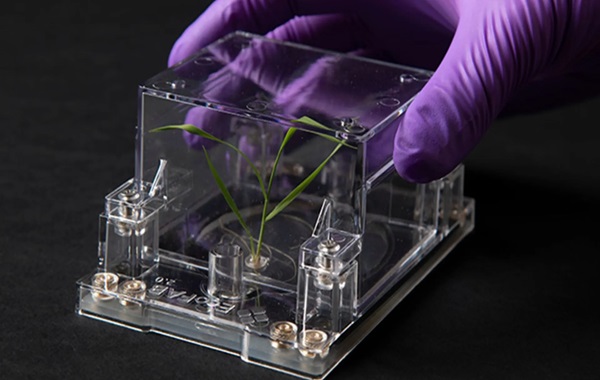
It is difficult for scientists to duplicate natural settings in the lab, which makes it difficult to understand the mechanics of this mutually beneficial connection. Researchers at Lawrence Berkeley National Laboratory (Berkeley Lab) developed artificial ecosystems, or EcoFABs, to solve this problem.
In their research, the team demonstrated how tiny plastic growing chambers the size of takeaway boxes may offer researchers worldwide a standardized and repeatable platform for studying model plants and the bacteria surrounding their roots.
Researchers claim that creating enhanced bioenergy crops that can thrive on soils deficient in nutrients and take up more carbon from the atmosphere than is now achievable may thus be accelerated as a result.
The details of the team’s study were published in the Journal of Science Advances.
Optimal nitrogen combination boosts growth
Using Brachypodium, a tiny grass species used as a model for bioenergy grasses, as a model, the team at Trent Northen’s lab tested using EcoFABs how different types of nitrogen affect the formation of organic compounds given out by the roots.
The scientists observed that while nitrogen is necessary for plant growth, its connection to root exudation—the kinds of molecules that a plant produces—had not been thoroughly studied in the literature on this particular grass species.
Researchers saw alterations in the composition of root exudate when they grew Brachypodium using various nitrogen sources, such as ammonium, nitrate, or a combination of both. They discovered that different nitrogen concentrations had an impact on the kinds of molecules that the roots made and that the plants thrived when they were given both nitrate and ammonium.
One intriguing discovery was that dopamine was only produced in the root exudates when nitrate and ammonium were present simultaneously. This implies that particular dietary circumstances affect the synthesis of particular metabolites, which may then have an impact on plant growth.
“The outcomes of this research can inform nutrient management practices, fundamentally saying that for Brachypodium or similar grasses, it is essential to supply both ammonium and nitrate simultaneously for optimal growth. It also gives us ideas of some pretty interesting organic compounds in the root microbiome to investigate in the future,” said Vlastimil Novak, lead author of the paper and a project scientist in Berkeley Lab’s Environmental Genomics and Systems Biology (EGSB) Division, in a statement.
According to the team, EcoFABs may be used in conjunction with robotics and AI learning advancements to accelerate plant microbiome research discoveries significantly. Another recent innovation at Berkeley Lab is an automated robotic system known as the EcoBOT, which is capable of conducting EcoFAB experiments on its own.
Furthering educational initiatives
EcoFABs extend beyond labs and engage California students in plant growth studies. High schoolers, part of Berkeley Lab’s Apprenticeship Program, have been exploring nitrogen impacts on plants using EcoFABs since 2020. Collaborations with local schools and Los Medanos College foster interest in biology and research among students, enriching educational experiences.
“EcoFABs allowed us to discuss microorganisms in the classroom in a way that connected other units. “This was incredibly important for students to get to see not just how roots grow, but to understand microbial communities,” said Christina McGhee-Esquivel, a biology teacher at Skyline High School in Oakland who is involved with the Berkeley Lab’s K-12 team in 2021.
Subsequent partnerships with groups like Biotech Partners intend to bring biotech instruction—including EcoFABs—to high schools in the Bay Area that serve minorities. Additionally, at Los Medanos College, researchers claim that students will once again have the chance to organize and carry out their own plant experiments in the summer of 2024. Talks are in on incorporating EcoFABs into more undergraduate instruction.
Source: Interesting Engineering
First-Ever Photos Of Humpback Whale Sex Involve Two Males
EcoFABs: Berkeley lab fabricates ecosystem to bioengineer crops better