Dyson Spheres: Potential Candidates and Evidence Against Their Existence
Astronomers report potential candidates for alien structures and evidence against their existence.
There are three primary methods to search for evidence of alien technological civilizations: looking for deliberate communication attempts such as radio broadcasts, evidence of them visiting the solar system, and signs of large-scale engineering projects in space.
A team of astronomers has taken the third approach, searching through recent astronomical survey data to identify seven candidates for alien megastructures, known as Dyson spheres, “deserving of further analysis.” Their research is published in the Monthly Notices of the Royal Astronomical Society.
This detailed study looks for “oddballs” among stars—objects that might be alien megastructures. However, the authors are careful not to make any overblown claims. The seven objects, all located within 1,000 light-years of Earth, are “M-dwarfs”—a class of stars that are smaller and less bright than the sun.
Dyson spheres were first proposed by physicist Freeman Dyson in 1960 as a way for an advanced civilization to harness a star’s power. Consisting of floating power collectors, factories, and habitats, they’d eventually surround almost the entire star like a sphere.
Dyson realized these megastructures would have an observable signature. Dyson’s signature (which the team searched for in the recent study) is a significant excess of infrared radiation. These megastructures would absorb visible light given off by the star, but they wouldn’t harness it all. Instead, they’d “dump” excess energy as infrared light with a much longer wavelength.
Unfortunately, such light can also be a signature of other things, such as a disk of gas and dust, or disks of comets and other debris. However, the seven promising candidates aren’t obviously due to a disk, as they weren’t good fits to disk models.
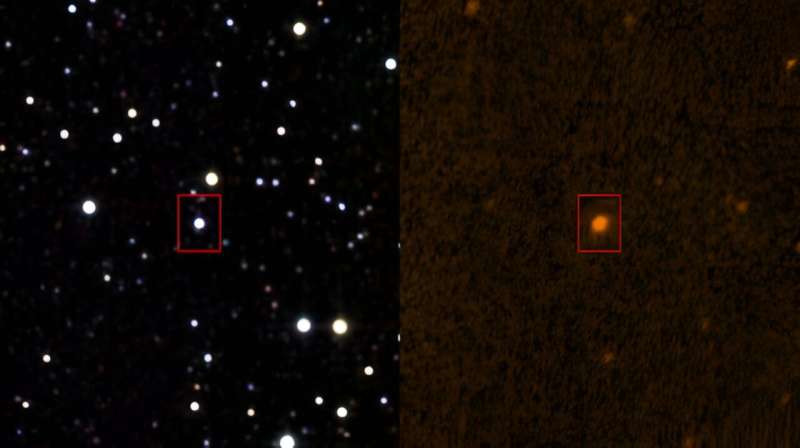
Another signature of a Dyson sphere is the visible light from the star dipping as the megastructure passes in front of it. This signature was found before, creating excitement around Tabby’s star, or KIC 8462852, which showed unusual dips in its light potentially due to an alien megastructure.
It almost certainly isn’t an alien megastructure. Various natural explanations have been proposed, such as clouds of comets passing through a dust cloud. However, it remains an odd observation. A logical follow-up on the seven candidates would be to look for this signature as well.
The Case Against Dyson Spheres
Dyson spheres may not exist. While not impossible, any civilization capable of building them might not need to, unless it was some mega art project.
Dyson’s reasoning for considering such megastructures assumed that advanced civilizations would have vast power requirements. Around the same time, astronomer Nikolai Kardashev proposed a scale to rate the advancement of civilizations, based on their power consumption.
In the 1960s, this made sense. Humanity’s power use had exponentially increased as technology advanced and population grew, leading to the assumption of ever-expanding future power needs.
However, global energy use has grown much more slowly over the past 50 years, especially in the last decade. Dyson and Kardashev never specified what these vast power levels would be used for, assuming they’d be needed for advanced alien activities.
Future technologies promise efficiency, miniaturization, and nanotechnologies, which suggest lower power use. Collecting 10% of the sun’s energy at Earth’s distance would require a surface area equal to 1 billion Earths. If advanced technology made the megastructure only 10 km thick, it would need about a million Earths worth of material.
A significant problem is that our solar system contains only about 100 Earths worth of solid material. Thus, an advanced alien civilization would need to dismantle all the planets in 10,000 planetary systems to build a Dyson sphere. Using the material available in a single system would make each part of the megastructure only one meter thick.
This assumes all elements in a planetary system are used. If a specific element, like carbon, is needed, dismantling millions of planetary systems might be necessary. While a super-advanced alien civilization could potentially do this, it is an enormous task.
By the time a civilization could build a Dyson sphere, they’d likely have a more efficient way of getting power than using a star, if they truly needed it.
Source: Dyson Spheres: Potential Candidates and Evidence Against Their Existence
Einstein was right about bizarre plunging region around black holes
Einstein was right about bizarre plunging region around black holes