Demystifying the Egyptian
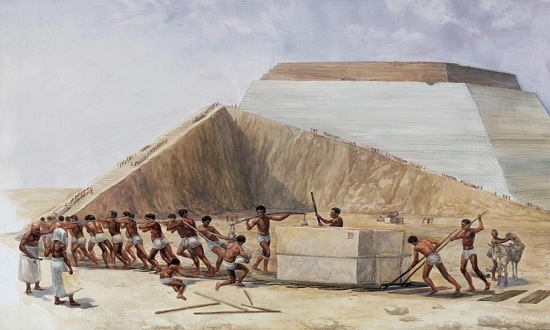
Talking of what happened to the blocks once they were at the building site, a team of physicists from the University of Amsterdam found in a study published in the journal Physical Review Letters in 2004, that “Egyptians pushed and pulled large wooden sledges and that sand in front of the sledge was likely dampened with water , reducing friction, making it easier to move.” And this act of pouring “water in-front of sledges” was so central to the building process that it is depicted many times in ancient Egyptian artwork.
But how on earth could a civilization of farmers “all of a sudden” build massive pyramids?
Practice Makes Perfect
Again, pseudo-historians never talk of the scores of “failed” pyramids which speckle the Egyptian deserts, which all add to archeologists understanding of the Egyptian’s building chronology. It is in the collapsed attempts at pyramid building that archeologists have learned of the techniques used to build the Giza pyramids, which were developed over centuries, with all of the challenges and setbacks that any modern-day designer, engineer or builder would face.
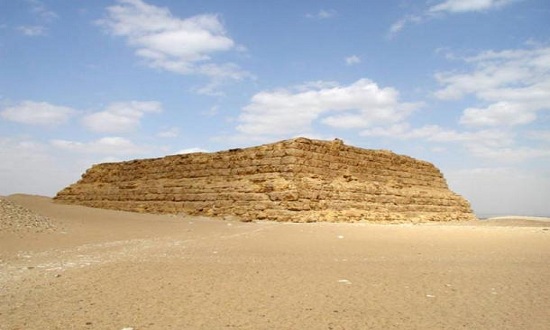
A Live Science article described how archaeologist Sir Flinders Petrie discovered that pyramids originated from “simple rectangular “mastaba” tombs that were being constructed in Egypt over 5,000 years ago.” He noted a major advance in building skills during “the reign of the pharaoh Djoser (reign started around 2630 B.C).” According to Petrie, Djoser’s pyramid was developed into “a six-layered step pyramid with underground tunnels and chambers.”
The evolution from “step pyramids” came during the reign of the pharaoh Snefru (reign started around 2575 BC), whose architects developed designs for smooth-faced, true pyramids, as we know them today. Practicing as they built, learning from mistakes, Snefru’s architects constructed what is known today as the “bent pyramid” because the angle of the pyramid changes course half-way up, by accident. Then, we see this design flaw being corrected at a second pyramid at Dahshur, the “red pyramid” which has a constant angle from base to tip, making it the first “true pyramid.” In conclusions, Snefru’s son Khufu, learned from all of his father’s construction mistakes and applied his learning in what we know as the “Great Pyramid” at Giza, the largest stone pyramid in the world.
In a report published recently in an AERA newsletter , Glen Dash, an engineer who studies the pyramids at Giza noted that Khufu’s pyramid is aligned “to true north within one-tenth of a degree.” Admittedly, how exactly the ancient Egyptians did this is not fully clear, but Dash wrote that the builders “used a circumpolar star like Polaris and lines of rope” to achieve this accuracy. And if you take a rope into your backyard and lay out 10 alignments to the celestial north pole, and average them, you get pretty close to this accuracy.
Source:http://www.ancient-origins.net/history/demystifying-egyptian-pyramids-hard-facts-009730/page/0/1