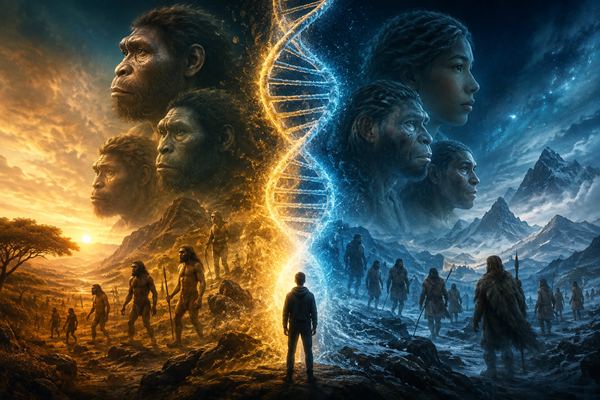
Could Your DNA Still Carry the Ghostly Traces of a Lost Human Lineage That Lived 1.8 Million Years Ago?
Ghost Ancestors and Super-Archaic DNA: How TRACE Reveals Hidden Human Lineages
Introduction: The Hidden Branches of Our Family Tree
Have you ever wondered what secrets your genome carries from relatives you never knew existed? Scientists at the University of California, Berkeley, have uncovered two long-forgotten human ancestors still lurking in our DNA. These findings reshape our understanding of human evolution. Instead of a simple branching tree, our past resembles a tangled web of migrations, encounters, and interbreeding. This article dives into the discovery, the methods behind it, and the profound questions it raises.
The Ghost Ancestor Shared by All Humans
One mysterious lineage, dubbed a ghost ancestor, interbred with Homo sapiens in Africa more than fifty thousand years ago. That event occurred before the last major wave of modern humans left Africa for Europe and Asia. Consequently, both African and non-African populations carry traces of this ghost. Each individual inherits roughly half a percent to one percent of their genome from this unknown hominin—about the same proportion as Neanderthal DNA in non-Africans.
How do scientists know this ghost existed without a single fossil? They reconstructed its genetic signature using a novel technique called TRACE (Tracking Archaic Contributions via ARG Estimation). The ghost lineage split from our ancestors around eight hundred thousand years ago. That timing closely matches the divergence of Neanderthals and Denisovans from each other. Yet the ghost interbred with modern humans earlier than those famous encounters outside Africa.
“Previous publications suggested there might be ghost ancestry in modern humans,” said Yulin Zhang, a Berkeley graduate student and first author of the study published in Science. “But they hadn’t concluded whether this unknown ancestry is present only in Africans, or when the introgression happened.”
Super-Archaic DNA: A Million-Year-Old Lineage
Even more astonishing is the discovery of a super-archaic ancestor. This hominin descended from a lineage dating back approximately one point eight million years. It appears to have interbred with Denisovans in Eurasia more than two hundred thousand years ago. Later, when Denisovans mixed with Homo sapiens, a small fraction of that super-archaic DNA entered modern human genomes.
Think about that: genetic material from a population that lived over a million years ago still persists inside us today. And we have no sequenced DNA from that population—only the echoes preserved through other archaic groups.
“The super-archaic finding is particularly exciting because it reveals genetic contributions from a human lineage that lived over a million years ago, despite the absence of any sequenced DNA from that population,” said Arjun Biddanda, a postdoctoral researcher at Johns Hopkins University and co-first author of the study.
Together, the ghost and super-archaic findings suggest that early Homo sapiens coexisted with multiple related human groups across Africa and Eurasia during the past million years. These populations were genetically similar enough to produce fertile offspring, leaving lasting biological traces.
TRACE: How Scientists Find Archaic DNA Without Fossils
Until now, researchers relied on ancient DNA extracted from Neanderthal and Denisovan fossils. That approach works well for those groups but fails for populations that left no bones behind. So how do you detect a ghost without a skeleton?
The Berkeley team developed TRACE, a computational method that scans hundreds of present-day human genomes. It reconstructs an ancestral recombination graph (ARG)—a detailed family tree for every segment of DNA across generations. By identifying regions whose ancestry extends unusually far back in time, TRACE can pinpoint genetic contributions from extinct populations.
“Genealogies preserve a record of our evolutionary past,” said Priya Moorjani, a Berkeley associate professor and senior author. “TRACE reconstructs those histories across the genome. By identifying regions whose ancestry extends unusually far back in time, we can uncover genetic contributions from extinct human populations, even in the absence of ancient DNA.”
The technique first validated itself by correctly identifying known Neanderthal and Denisovan segments. Then it found many other ancient regions that matched neither of those two groups. Those sections came from two separate archaic lineages: the ghost and the super-archaic.
Ancient Signals Hidden in Modern Genomes
What does this mean for our understanding of human history? First, it confirms that interbreeding among hominin groups was far more common than previously thought. Second, it shows that modern humans carry about two percent archaic DNA overall, with the ghost lineage contributing roughly half a percent to one percent per person.
But the signals are not uniform. African populations, for example, carry ghost ancestry that non-Africans also share—proof that the interbreeding occurred before the major out-of-Africa migration. Meanwhile, super-archaic DNA appears mostly in Asian and Oceanian populations, reflecting the later Denisovan admixture.
One might ask: could there be even more ghost lineages hiding in our genomes? Possibly yes. The TRACE method continues to improve, and researchers suspect that future scans will uncover additional unknown relatives.
The Big Picture: A Web, Not a Tree
“We often think of human evolution as a branching tree,” Moorjani noted. “But new genomic data and analytical methods reveal a much more interconnected history—more like a complex web of populations connected by repeated episodes of migration and mixing.”
Indeed, the identities of the ghost and super-archaic populations remain unknown. However, their estimated divergence times overlap with known Middle Pleistocene Homo groups living in Africa around eight hundred thousand years ago and Homo erectus populations in Eurasia around one point eight million years ago.
Could the ghost be a descendant of Homo heidelbergensis? Could the super-archaic be a late-surviving Homo erectus lineage? Without fossil DNA, we may never know for sure. But the genetic evidence is now undeniable.
Conclusion: What Other Secrets Does Our DNA Hold?
Every time scientists look deeper into the human genome, they find more complexity. The ghost and super-archaic ancestors represent only the latest discoveries. As techniques like TRACE become more powerful, researchers expect to find even older, stranger relatives hidden in our cells.
The next time you look at your own reflection, consider this: your DNA contains echoes of beings who walked the Earth more than a million years ago. Their stories are written in the language of genes—and we are only beginning to read them.
Source: Could Your DNA Still Carry the Ghostly Traces of a Lost Human Lineage That Lived 1.8 Million Years Ago?
Could Your DNA Still Carry the Ghostly Traces of a Lost Human Lineage That Lived 1.8 Million Years Ago?
Sources
- Zhang, Y., Biddanda, A., et al. (2025). “Ghost and super-archaic ancestry in modern human genomes revealed by ancestral recombination graph analysis.” Science.
- Moorjani, P., et al. (2025). “TRACE: Tracking Archaic Contributions via ARG Estimation.” University of California, Berkeley.
- Additional background on Neanderthal and Denisovan admixture from Green, R.E., et al. (2010). “A draft sequence of the Neanderthal genome.” Science.
- Background on Homo erectus and Middle Pleistocene hominins from Antón, S.C. (2003). “Natural history of Homo erectus.” American Journal of Physical Anthropology.
Could Your DNA Still Carry the Ghostly Traces of a Lost Human Lineage That Lived 1.8 Million Years Ago?