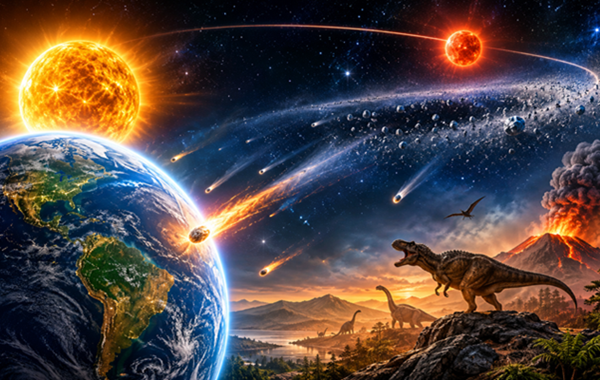
Could the Sun’s Mysterious Twin Star, Nemesis, Still Be Undiscovered? What Lies Behind Earth’s Greatest Catastrophes?
The Sun has illuminated Earth and sustained life for billions of years. But what if our Solar System is not as isolated as we think? What if another star is moving through the distant darkness, remaining hidden from astronomers?
A controversial hypothesis proposed by physicist Richard Muller suggests that the Sun may have an undiscovered stellar companion. This hypothetical object, known as Nemesis, could be a low-mass red dwarf star orbiting the Sun at an enormous distance.
Even more intriguing is the possibility that this unseen companion could periodically disturb billions of icy objects in the outer Solar System, sending some of them toward the inner planets.
Could this mysterious star be connected to the great extinction events that have shaped life on Earth? And could a hidden stellar companion still be waiting to be discovered?
What Is the Nemesis Star? Could the Sun Have a Hidden Companion?
The Nemesis hypothesis is based on the possibility that the Sun does not travel through space entirely alone.
In nineteen eighty-four, physicist Richard Muller and his colleagues proposed that the Sun might have a distant stellar companion orbiting a common center of mass with it.
They named this hypothetical object Nemesis, after the Greek goddess associated with retribution.
According to Muller’s proposal, Nemesis could be a low-mass red dwarf star following an extremely wide and slightly elliptical orbit around the Sun.
However, there is an important distinction: Nemesis is not the same as the hypothetical Planet Nine or Planet X. It is not supposed to be a large planet hiding beyond Neptune. Instead, it would be a distant stellar companion capable of influencing the outer Solar System through its gravitational pull.
If such a star exists, its enormous orbital distance could help explain why astronomers have not directly identified it.
But how could a star remain hidden for so long, especially if its gravity is strong enough to influence billions of comets?
What Is the Oort Cloud? A Billion-Trillion Reservoir of Icy Comets
At the heart of the Nemesis hypothesis lies one of the least explored regions of our Solar System: the Oort Cloud.
Astronomers believe this enormous, roughly spherical region surrounds the Solar System and contains vast numbers of icy objects left over from its formation approximately four and a half billion years ago.
Some estimates suggest that the Oort Cloud may extend as far as approximately one and a half light-years from the Sun.
It could contain trillions of cometary bodies, many of them extremely small and separated by enormous distances.
Unlike the planets and major moons, these objects are difficult to observe directly. They are incredibly faint, receive very little sunlight, and reflect almost none of it back toward Earth.
Nevertheless, astronomers have strong indirect evidence for their existence. Long-period comets entering the inner Solar System are believed to originate from this distant reservoir.
But what causes these icy objects to abandon their distant orbits and travel toward the Sun?
This is where the Nemesis hypothesis becomes particularly interesting.
How Could Nemesis Trigger a Massive Comet Shower?
Richard Muller suggests that Nemesis could periodically disturb the gravitational balance of the Oort Cloud.
As the hypothetical star travels along its enormous elliptical orbit, its gravitational influence could alter the paths of distant icy bodies.
Some of these objects might then be redirected toward the inner Solar System, potentially increasing the number of comets passing near Earth.
In Muller’s proposed scenario, this would not necessarily be a brief event.
Instead, a large number of cometary objects could be disturbed over an extended period. Muller has suggested that an intense comet shower might last approximately one million years.
Even if only a small fraction of these objects eventually crossed Earth’s path, the consequences could be significant.
Large comet impacts can release enormous amounts of energy, trigger widespread environmental disruption, and potentially contribute to mass extinctions.
However, this mechanism remains hypothetical. There is currently no observational evidence confirming that Nemesis exists or that it has triggered periodic comet showers.
Why Are Earth’s Mass Extinctions Linked to a Twenty-Six-Million-Year Cycle?
One of the most fascinating aspects of the Nemesis hypothesis is its proposed connection to Earth’s ancient extinction events.
In the early nineteen eighties, paleontologists David Raup and Jack Sepkoski examined extensive fossil records of marine life.
Their research suggested that major extinction events might follow a recurring pattern, with an interval of approximately twenty-six million years.
This finding raised an extraordinary question:
Could something beyond Earth be responsible for periodically disrupting life on our planet?
Richard Muller and his colleagues explored a possible astronomical explanation.
They suggested that a distant stellar companion might periodically disturb the Oort Cloud, increasing the number of comets entering the inner Solar System.
If enough large objects were redirected toward Earth, the resulting impacts could contribute to widespread biological extinctions.
The idea offered a possible connection between events separated by millions of years: the movements of a distant star and the disappearance of entire groups of living organisms.
However, the proposed extinction cycle remains controversial.
Some studies have identified patterns in the fossil record, while others have questioned whether these patterns are statistically significant. Incomplete fossil records and the methods used to identify extinction events can also influence the results.
Therefore, the existence of a regular twenty-six-million-year extinction cycle has not been established as a scientific consensus.
Did a Comet Kill the Dinosaurs? The Mystery of the Chicxulub Impact
Perhaps the most dramatic part of the Nemesis discussion concerns the extinction event that occurred approximately sixty-six million years ago.
At the end of the Cretaceous Period, a massive celestial object struck the region of what is now Mexico’s Yucatán Peninsula.
The impact created the Chicxulub crater and triggered environmental changes that contributed to the extinction of non-avian dinosaurs and many other life forms.
The prevailing scientific explanation identifies the impactor as an asteroid.
However, Richard Muller has argued that the possibility of a comet should not be dismissed entirely.
Asteroids and comets differ in their composition, density, and orbital characteristics. Identifying the original object can therefore provide important information about the history of the Solar System.
Muller has pointed out that the distinction between an asteroid and a comet was not necessarily established with absolute certainty in the earliest discussions of the impact.
Nevertheless, there is currently no convincing evidence that Nemesis sent the Chicxulub impactor toward Earth.
The asteroid explanation remains the accepted scientific interpretation.
But the larger question remains fascinating: Could some of Earth’s greatest extinction events have been influenced by objects arriving from the darkest regions of the Solar System?
Why Has the Nemesis Star Never Been Discovered?
The biggest challenge facing the Nemesis hypothesis is straightforward: nobody has directly observed the star.
If Nemesis is an ordinary red dwarf, why have astronomers failed to identify it?
Muller has suggested that its motion alongside the Sun could make it difficult to distinguish from the surrounding stars.
Because the hypothetical companion would share much of the Sun’s movement through the galaxy, its apparent motion across our sky might be relatively small.
However, this explanation does not eliminate the observational difficulties.
In fact, modern astronomical surveys have placed significant limits on the possibility of an undiscovered stellar companion.
NASA’s Wide-field Infrared Survey Explorer, known as WISE, conducted an extensive survey of the sky using infrared observations.
In two thousand fourteen, researchers reported that they had found no evidence for a Saturn-sized object or anything larger within the surveyed outer regions of the Solar System, significantly weakening some versions of the Planet X hypothesis.
The observations also placed important constraints on large, previously undetected objects.
Although these findings did not test every conceivable version of the Nemesis hypothesis, they made the existence of a nearby hidden companion increasingly difficult to support.
Today, Nemesis remains an unconfirmed idea rather than an established astronomical discovery.
Could the Vera C. Rubin Observatory Finally Solve the Mystery?
A new generation of astronomical instruments may help researchers understand the distant Solar System in unprecedented detail.
One of the most promising facilities is the Vera C. Rubin Observatory in Chile.
Designed to repeatedly survey large portions of the night sky, Rubin can identify faint objects and track changes in their positions over time.
Its observations are expected to significantly expand the known population of distant Solar System objects, including long-period comets.
This could help astronomers investigate the structure of the Oort Cloud and understand the gravitational processes that send comets toward the Sun.
Researchers may also gain a better understanding of how passing stars, planetary gravitational interactions, and other forces influence distant icy bodies.
However, discovering more comets would not automatically prove that Nemesis exists.
To establish the hypothesis, astronomers would need direct evidence of the proposed star or convincing gravitational evidence that cannot be explained by other known mechanisms.
Could future observations finally reveal an undiscovered companion to our Sun? Or will they show that the mysterious comet patterns have a completely different explanation?
When Could the Next Dangerous Comet Shower Reach Earth?
According to Richard Muller’s interpretation of the Nemesis hypothesis, the next major comet shower capable of increasing Earth’s impact risk would not be expected for another twelve to fifteen million years.
This is a theoretical prediction based on the proposed orbital cycle, not an established forecast of a future extinction event.
Furthermore, potential impact threats do not depend on Nemesis alone.
Passing stars, gravitational interactions between planets, and other processes can influence the orbits of distant comets.
For this reason, astronomers continue to monitor near-Earth objects and investigate the long-term dynamics of our planetary system.
Understanding these processes is essential for assessing the real risks posed by asteroids and comets.
Is the Sun Really Alone? The Unanswered Mystery of Nemesis
The Nemesis hypothesis raises one of astronomy’s most intriguing questions: Could the Sun have an undiscovered stellar companion hidden in the vast darkness beyond the known planets?
At present, there is no confirmed evidence that such a star exists.
The proposed twenty-six-million-year extinction cycle also remains disputed, and the connection between Nemesis and Earth’s ancient catastrophes has not been demonstrated.
Nevertheless, the Oort Cloud, long-period comets, and the gravitational history of our Solar System remain fascinating subjects of scientific investigation.
Perhaps future observations will reveal something unexpected about the distant environment surrounding our Sun.
Or perhaps Nemesis will ultimately remain an unconfirmed hypothesis, an attempt to explain complex patterns in Earth’s history through an invisible cosmic companion.
But what if the Sun is not as alone as we think? Could an unseen star still be moving through the darkness, influencing the fate of comets and perhaps holding clues to some of the greatest mysteries in Earth’s history?
Source: Could the Sun’s Mysterious Twin Star, Nemesis, Still Be Undiscovered? What Lies Behind Earth’s Greatest Catastrophes?
Theory predicting an older universe without dark matter or dark energy passes key cosmological tests
Theory predicting an older universe without dark matter or dark energy passes key cosmological tests
Could the Sun’s Mysterious Twin Star, Nemesis, Still Be Undiscovered? What Lies Behind Earth’s Greatest Catastrophes?
Scientific Sources and Further Reading
Nature – Extinction of Species by Periodic Comet Showers (nineteen eighty-four).
NASA – WISE Survey Finds Thousands of New Stars, But No Planet X.
Monthly Notices of the Royal Astronomical Society – Research on the Nemesis hypothesis and long-period comets.
Scientific research by David Raup and Jack Sepkoski on periodic patterns in marine extinctions.
Vera C. Rubin Observatory – Official information about the Legacy Survey of Space and Time.
Could the Sun’s Mysterious Twin Star, Nemesis, Still Be Undiscovered? What Lies Behind Earth’s Greatest Catastrophes?