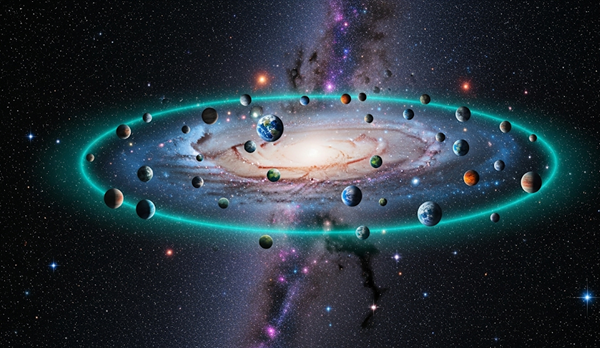
Could the Outer Milky Way Hold More Earth-Like Planets Than We Thought?
Galactic Habitable Zone and the Search for Life Beyond Earth
The Galactic Habitable Zone (GHZ)—the region of a galaxy where complex life could evolve—offers scientists a roadmap for identifying stars most likely to host habitable planets. But what can the GHZ truly teach researchers about where to look for Earth-like worlds? A new study, recently accepted for publication in Astronomy & Astrophysics, explores this very question.
An international team investigated how stellar migration, the process where stars drift from their birthplaces, influences the probability of finding habitable planets across the Milky Way. Their findings could redefine how we search for life, providing deeper insight into the astrophysical parameters that shape habitable worlds beyond Earth.
How Stellar Migration Shapes the Galactic Habitable Zone
To answer these questions, the researchers employed advanced computer simulations. Their models compared galactic evolution with and without stellar migration, calculating the likelihood of rocky planets forming around stars. They also incorporated a chemical evolution model to account for the galaxy’s thickness and composition.
The results were striking: stellar migration increases the probability of habitable planets in the outer galaxy by a factor of five. The redistribution of stars appears to be a crucial factor in creating environments where terrestrial planets can form. Interestingly, the presence of gas giant planets was found to influence rocky planet formation in the galaxy’s inner regions, potentially limiting habitability there.
Could this mean that the outer edges of our galaxy might be richer in habitable planets than we ever imagined?
Expanding the Definition of the Galactic Habitable Zone
The concept of the GHZ builds on the classic stellar habitable zone (HZ)—the orbital range where liquid water can exist on a planet’s surface. First introduced in the 1950s, the HZ revolutionized our understanding of habitability. The GHZ, introduced in the 1980s, extends this idea on a galactic scale, taking into account heavy elements like iron, silicon, and oxygen that are essential for terrestrial planets.
Yet, its boundaries are still debated. Most researchers agree, however, that the galactic center is hostile to life. The abundance of supernovae and violent cosmic events in that region would likely sterilize planets before life could gain a foothold. If so, perhaps life is more likely to flourish in the galaxy’s calmer outskirts—an idea this new study strongly supports.
Upcoming Space Missions and the Hunt for Habitable Worlds
This research arrives at a pivotal moment, as several European Space Agency (ESA) missions prepare to revolutionize our search for exoplanets and life:
PLATO (2026) will survey one million stars for transiting exoplanets, using one of the most proven detection methods.
Ariel (2029) will analyze the chemistry and heat profiles of at least 1,000 confirmed exoplanets, offering new insights into planetary atmospheres.
LIFE (started in 2017) focuses on directly studying exoplanet atmospheres in search of biomarkers—potential signs of alien life.
These missions will provide unprecedented data, further refining our understanding of the GHZ and the role of stellar migration in shaping habitable environments.
The Future of the Galactic Habitable Zone: What Lies Ahead?
The study concludes that our understanding of the Galactic Habitable Zone must expand beyond static definitions. The dynamic movements of stars, combined with galactic chemical evolution, may be the key to uncovering where life can thrive.
What surprises might await us as telescopes peer deeper into the galaxy? Could entire civilizations exist in the quiet outskirts, where conditions for life may actually be better than in our bustling stellar neighborhood?
One thing is certain: the combination of cutting-edge models and next-generation space missions is bringing us closer to answering one of humanity’s greatest questions—Are we alone in the universe?
Source: Could the Outer Milky Way Hold More Earth-Like Planets Than We Thought?
Did TESS Really Spot Interstellar Visitor 3I/ATLAS Months Before We Did?
Did TESS Really Spot Interstellar Visitor 3I/ATLAS Months Before We Did?