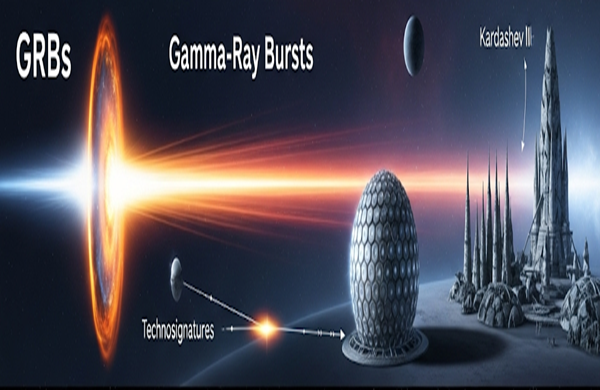
Could Gamma‑Ray Beacons Be Our First Contact with Alien Civilizations?
Harnessing High-Energy Astronomy for Cutting-Edge SETI Technosignatures
In the quest to answer one of humanity’s most profound questions—“Are we alone?”—researchers are now turning their telescopes to some of the universe’s most energetic phenomena. A recent white paper to NASA’s 2025 Decadal Astrobiology Research and Exploration Strategy (DARES) RFI proposes high-energy astronomy as a promising new frontier for detecting technosignatures, the indirect signs of extraterrestrial technology.
Why High-Energy Astronomy Transforms Technosignature Searches
Traditional SETI searches have focused almost exclusively on narrowband radio or optical signals. Yet gamma rays, X‑rays, cosmic rays, and neutrinos offer untapped channels that civilizations might exploit for interstellar communication, advanced industry, or even buoyant habitats powered by nuclear processes. Could a secretive alien society simply be “speaking” in cataclysmic bursts of high-energy radiation?
Gamma-Ray Bursts (GRBs) and pulsar wind nebulae may carry modulated pulses beyond natural astrophysical patterns.
Neutron stars and black-hole accretion disks produce X‑rays and cosmic rays at intensities far exceeding typical stellar processes.
Neutrino detectors on Earth continuously collect data across vast swaths of sky—ripe for commensal SETI analyses.
Technosignature Communication: Sending Data with Gamma Rays and X‑Rays
Active civilizations require high bandwidth for metaconscious exchanges. To transmit vast archives—cultural libraries, quantum-encrypted messages, or interstellar video feeds—radio may not suffice. Instead, gamma-ray channels offer:
Extremely low background noise, boosting signal-to-noise ratios.
Penetration through interstellar dust, allowing messages to traverse galactic arms.
Time‑tagged pulses that resist natural astrophysical mimicry.
Question: What unique modulation patterns might distinguish an engineered gamma‑ray beacon from a cosmic explosion?
Industrial Technosignatures: From Nuclear Reactors to Star Engines
High-energy phenomena could betray the footprints of civilization-scale engineering:
Rocket launches and particle accelerators emit telltale bursts of X‑rays and cosmic rays.
Advanced nuclear reactors on moons or asteroids would produce neutrino fluxes detectable by large underground detectors.
Mega-structures like Dyson spheres or Shkadov thrusters (star engines) could alter a star’s gamma-ray or X‑ray output in subtle but measurable ways.
Imagine a civilization harnessing its sun’s energy: would the X‑ray spectrum reveal artificial “holes” where energy collectors intercept stellar flux?
Habitats Amidst Neutron Star Radiation: Life in Extreme Environments
Could life flourish on surfaces bathed in intense radiation? Some models speculate that neutron-star colonies might exploit natural nuclear processes:
Surface microorganisms protected by regolith or artificial shields could thrive on nuclear fission energy.
Radiation-driven ecosystems would emit unique technosignatures, including modulated gamma-ray or neutrino emissions.
Question: How would we distinguish a bioengineered glow on a neutron star’s surface from volcanic or magnetic field–driven particle jets?
Integrating Machine Learning with Commensal Observations
The white paper emphasizes a commensal approach—piggybacking on existing high-energy observatories rather than building dedicated telescopes:
Machine-learning algorithms can sift petabytes of archival X‑ray imagery for anomalous light curves.
Real-time neutrino burst monitoring could flag repeatable patterns unlike any known astrophysical sources.
Synergistic gamma-ray network analyses across Fermi, Swift, and future missions enhance sky coverage.
By automating anomaly detection, researchers can rapidly prioritize candidate technosignatures for follow‑up with ground‑based and spaceborne arrays.
Lessons from Early SETI Pioneers and the Wow! Signal
SETI’s roots stretch back to the formation of the SETI Institute in 1984. Yet the most tantalizing hint arrived in 1977, when Ohio State University’s Big Ear detected the famous “Wow! Signal”—an unexplained, minute-long radio burst. Despite decades of follow‑up, no repeat has ever been recorded. This history teaches us:
Importance of interdisciplinary collaboration: Combining radio, optical, and now high-energy data.
Value of commensal observing: Like optical SETI piggybacking on telescope schedules.
Need for patience: Breakthrough Listen and other programs took years to refine data‑processing pipelines.
Charting the Future: Building Robust High-Energy SETI Frameworks
High-energy SETI stands at a crossroads. To mature this subfield, astronomers must:
Develop standardized anomaly catalogs for gamma‑ray, X‑ray, and neutrino events.
Secure cross‑facility data-sharing agreements that maintain rigorous time‑synchronicity.
Design next-generation detectors optimized for narrowband technosignature searches in high-energy regimes.
Will the next cosmic flash be proof that we share the galaxy with other civilizations? Only by expanding our search into the highest-energy domains can we hope to find out—and that exploration promises to revolutionize both astronomy and our place in the cosmos.
Source: Could Gamma‑Ray Beacons Be Our First Contact with Alien Civilizations?
10 billion light-years away, a galaxy cluster glows with ancient radio energy
10 billion light-years away, a galaxy cluster glows with ancient radio energy
Could Gamma‑Ray Beacons Be Our First Contact with Alien Civilizations?