CERN’s LHC to explore new frontiers with US-made superconducting magnets
The world’s largest and most powerful particle collider, the Large Hadron Collider (LHC), is getting ready for a major upgrade that will boost its performance and enable new discoveries in physics. The upgrade, known as the high-luminosity LHC (HL-LHC), will require new types of magnets to focus the beams of protons more tightly at the collision points of the ATLAS and CMS experiments.
New magnets by US Accelerator Upgrade Project
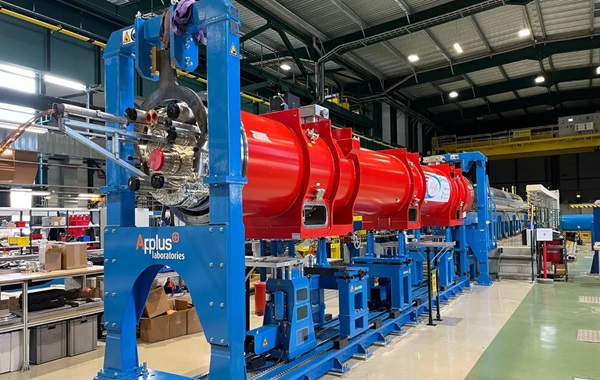
These new magnets are called final-focusing quadrupoles and are installed in the LHC’s interaction regions around the experiments.
Their special shape allows them to squeeze the beams of protons to a very small size, increasing the chances of collisions and producing more data for the physicists to analyze. The current LHC magnets can create a beam spot size of about 16 micrometers (one micrometer is a thousandth of a millimeter) at the collision points. In comparison, the new magnets will reduce it to about 10 micrometers.

Made from niobium-tin (Nb3Sn)
The first batch of these new magnets, developed by the US Accelerator Upgrade Project (AUP), arrived at CERN in early December. The shipment contained a cryo-assembly of two magnets, each 4.2 meters long, made from a superconducting material called niobium–tin (Nb3Sn). This material can generate higher magnetic fields than the niobium–titanium (Nb–Ti) used in the current LHC magnets, but it is also more brittle and difficult to handle.
Despite the challenges, recent tests at Fermilab have confirmed that the new quadrupole magnets developed by the HL-LHC Accelerator Upgrade Project (AUP) in the US are operational at target current at both 1.9 kelvin (-271.25°C) and 4.5 kelvin (-268.65°C), meeting the project requirements.
A total of 30 magnets
The US AUP is producing a total of 20 magnets (16, plus four spares) for the HL-LHC, while the CERN Technology department is developing another ten magnets (eight, plus two spares), each 7.2 meters long, based on the same design and technology. The longer magnets will be installed in the LHC tunnel. In contrast, the shorter ones will be used in a test facility at CERN, called the inner-triplet (IT) string, where all the components of the interaction regions will be assembled and tested.
The arrival of the first US-made magnets was celebrated at CERN on Monday, December 18, with a ceremony attended by representatives from both sides of the Atlantic. “This is a remarkable achievement for the US AUP, which has successfully overcome the challenges of manufacturing and testing Nb3Sn magnets,” says Mike Lamont, CERN Director for Accelerators and Technology. “The HL-LHC is a global endeavor that relies on the collaboration and expertise of many partners. We are grateful to the US AUP for their invaluable contribution to the future of particle physics at CERN.”
Giorgio Apollinari, Project Director of the HL-LHC AUP, looks forward to this next project phase. “We have been building these magnets in the US for the last five years and have now completed 75% of their production,” he said. “We’ve sent the first two magnets in a final cryo-assembly after extensive tests in the US and are already putting together the next cryo-assembly, scheduled to arrive at CERN by early 2024.”
The HL-LHC project leader, Oliver Brüning, adds: “This is the beginning of a new phase of the CERN-US cooperation: the delivery of ready-to-install cryo-assemblies for the LHC. The first one will be integrated into the IT string and undergo extensive testing in 2025. The IT string will be a crucial testbed for the HL-LHC, which will start operation in 2029.”
The HL-LHC will increase the luminosity, or the number of collisions, of the LHC by a factor of five to ten, allowing physicists to explore new phenomena beyond the Standard Model of particle physics. The HL-LHC will also extend the lifespan of the LHC, which is expected to run until the late 2030s.
Source: Interesting Engineering
Physicist Discovers ‘Paradox-Free’ Time Travel Is Theoretically Possible
CERN’s LHC to explore new frontiers with US-made superconducting magnets