Bizarre Creatures Are World’s First Self-Replicating ‘Living Robots’, Scientists Say
Scientists have engineered what they say are the first self-replicating ‘robots’ ever made from living cells.
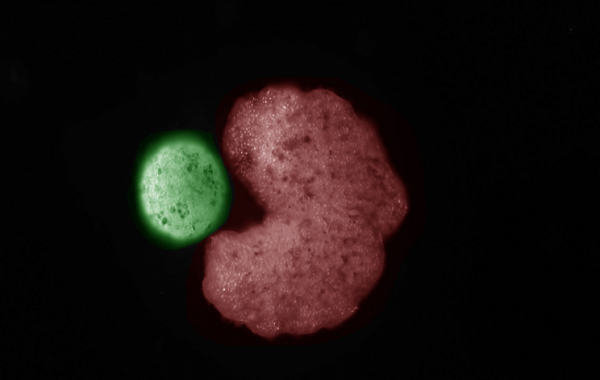
At first, these freaky-looking ‘xenobots’ might seem notable for their superficial resemblance to Pac-Man, but their likeness to the video game character is probably the least strange thing about them.
“These are novel living machines,” computer scientist and roboticist Joshua Bongard from the University of Vermont explained at the time.
“They’re neither a traditional robot nor a known species of animal. It’s a new class of artifact: a living, programmable organism.”
Now, Bongard and his collaborators have taken the next step, giving the xenobots the ability to self-replicate and spawn new versions of themselves.
Instead, the researchers found that if they put enough of the xenobots in close proximity with one another in a petri dish, their collective movement began to pile up other loose frog cells floating alongside in the solution.
Once enough of those cells were stacked together, the aggregated heap of about 50 cells became a kind of offspring to the xenobot organism, capable of swimming by itself, and in so doing, piling up its own offspring.
“We find that synthetic multicellular assemblies can also replicate kinematically by moving and compressing dissociated cells in their environment into functional self-copies,” the researchers explain in a new paper describing the reconfigurable organisms.
“This form of perpetuation, previously unseen in any organism, arises spontaneously over days rather than evolving over millennia.”
To make the self-replicating robots, the researchers extracted pluripotent stem cells from African clawed frog (Xenopus laevis) embryo skins and incubated them in a saline solution, during which time a number of the cells would adhere into a spheroid organism, growing cilia on its outer layer which enabled it to move around.
When a dozen of the first-generation organisms were dropped into a second dish along with dissociated stem cells, the movement of the organisms clumped the stem cells into piles that formed a new generation of organisms, which then proceeded to repeat the same behavior of stacking up cells into heaps.
That this kinematic self-replication, a behavior never before seen in plants or animals, could arise without genetic modification, demonstrates how radically biological entities can adapt and change in response to their environment, the researchers explained in their paper.
The team also found they could amplify the phenomenon by using artificial intelligence to simulate conditions that might enhance the self-replicating behaviors.
“Simulations indicated that some body shapes amplified pile size and replication rounds, while others damped or halted self-replication,” the researchers explain. “Some but not all geometries were better than the spheroids.”
Ultimately the semitorus shape (Pac-Man in 3D, basically) was the best candidate for piling loose frog cells into new organisms, and modifications to the environment – introducing walls that constrain the movement of the xenobots – also helped.
While we’re still very much at the beginning of tampering with these living robot creatures, the researchers say the unusual organisms could one day perform useful work, if we can keep figuring out how they function, and also decide the right jobs to give them.
“This suggests that future technologies may, with little outside guidance, become more useful as they spread,” the team explains, “and that life harbors surprising behaviors just below the surface, waiting to be uncovered.”
Source: Science Alert
Bizarre Creatures Are World’s First Self-Replicating ‘Living Robots’, Scientists Say/Bizarre Creatures Are World’s First Self-Replicating ‘Living Robots’, Scientists Say